About
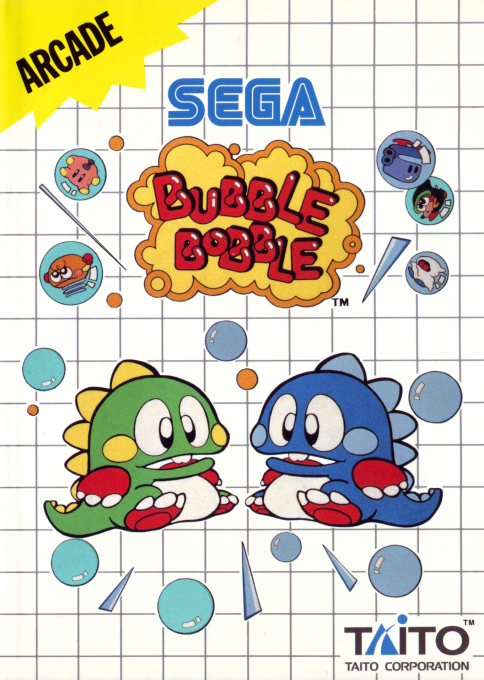
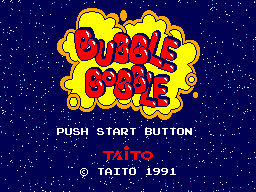
Bubble Bobble for Sega Master System brings Taito's single-screen action-platform game to Sega's 8-bit console in a notably expanded form. Developed by Taito and published by Sega, this version arrived in Japan in 1988 as Final Bubble Bobble and reached Europe in 1991 under the simpler Bubble Bobble title. It stars the familiar dragon brothers Bub and Bob, who enter the Cave of Monsters to rescue their kidnapped girlfriends. The premise carries over from the arcade game, but the Master System edition is more than a straightforward conversion: its longer adventure, added material, and altered route through the caves give it a separate identity.
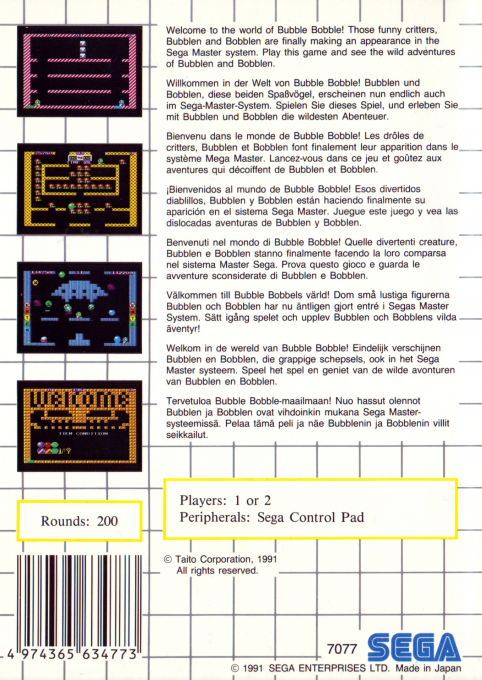
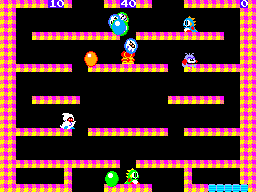
Each round is a compact platform arena filled with enemies. Bub and Bob can walk, jump, and fire bubbles; trapping an enemy inside one is only the first step, because the bubble must then be burst to defeat its captive. A popped foe leaves behind food that adds to the score, while collecting several enemies at once produces larger rewards. Bubbles also become temporary platforms, letting players climb toward higher ledges or approach opponents from unexpected directions. Clearing every enemy advances the pair to the next room, so quick reactions and careful positioning matter as much as the simple controls suggest.
The cave is built around escalating screen-clearing challenges rather than scrolling exploration. Enemies can escape if a bubble is left alone too long, and time pressure prevents a cautious player from lingering indefinitely. Useful items change the rhythm of play, improving the dragons' movement or bubble attacks, while special bubbles can unleash effects such as fire, water, or lightning. In two-player play, the brothers can cooperate by setting up bubble platforms, sharing space, and clearing several enemies at once; the same crowded screens can also make an ill-timed bubble or jump a problem for both players.
What distinguishes the Sega Master System version is its scale and structure. Instead of the arcade game's 100 stages followed by its separate Super mode, this conversion presents 200 rounds in one campaign. It adds new items, hidden rooms, and extra boss encounters, and its later progression requires players to find key objects rather than merely surviving a linear sequence. These additions make secrets part of the game’s central design: reaching the best outcome depends on discovering particular rooms and collecting what they contain. The Japanese title Final Bubble Bobble reflects how substantially this version extends the original formula.
The Master System game also preserves the series' bright fantasy personality. Bub and Bob's rounded dragon designs, the food bonuses, and the strange residents of the Cave of Monsters give each small arena a playful visual character even as the danger rises. The game can be played alone, but its two-player option is especially suited to the deliberate cooperation at the heart of Bubble Bobble. Finishing together also has narrative importance in the original concept, where the dragons' adventure eventually reveals their human identities.
Bubble Bobble remains closely associated with Taito's 1986 arcade hit, designed by Fukio Mitsuji, but this Master System installment is worth seeking out as its own branch of the series. It translates the arcade idea of bubbles as weapons, traps, and stepping stones to home hardware while expanding the number of rounds and embedding more secrets in the journey. For players exploring Sega Master System games, it offers a long, level-based platform challenge whose apparent simplicity gives way to score chasing, route knowledge, and cooperative problem-solving.
Gallery
Details
- Developer
- Taito
- Publisher
- SEGA
- Genre
- Platformer
- Players
- 1-2
- Release Date
- December 1, 1991
- System
- Master System