About
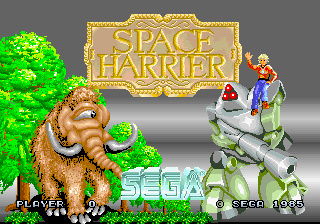
Space Harrier is Sega’s landmark 1985 arcade rail shooter, developed by Sega AM2 and published by Sega. This Rev A, 8751 315-5163A arcade set is a revision of the original coin-operated game, rather than a home conversion or one of its sequels. Players guide Harrier, a jet-propelled warrior, through the brightly colored and deliberately strange world introduced as the Fantasy Zone. The game combines rapid forward movement, large scaling enemies, and an instantly recognizable checkerboard horizon into an arcade challenge built around reflexes, positioning, and constant visual pressure.
The basic objective is direct but demanding: survive each assault while destroying enemies and avoiding anything that can collide with Harrier. An analog flight stick moves the character around the screen, while fire controls operate the underarm cannon. Harrier advances automatically, so there is no time to stop and line up a cautious shot. Movement is as important as shooting; incoming projectiles, charging opponents, scenery, and obstacles all force the player to read the approaching scene and choose a safe route. Harrier can move high above the ground or skim lower through the landscape, though neither position is universally safe.
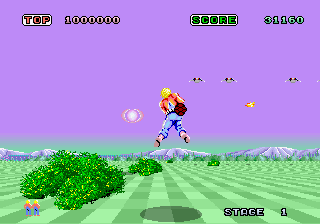
Space Harrier presents its action from behind the protagonist, creating the sensation of flying into each scene. Its arcade hardware uses fast sprite scaling to make foes and objects swell dramatically as they approach, giving the game a vivid simulated-depth effect without rendering the world as polygonal 3D. The result is a continuous stream of visual decisions: a distant object may be a target, a hazard, or part of the scenery, and its danger becomes clearer as it races toward the foreground. Success depends on keeping the player character clear of threats while firing often enough to remove enemies before they fill the route ahead.
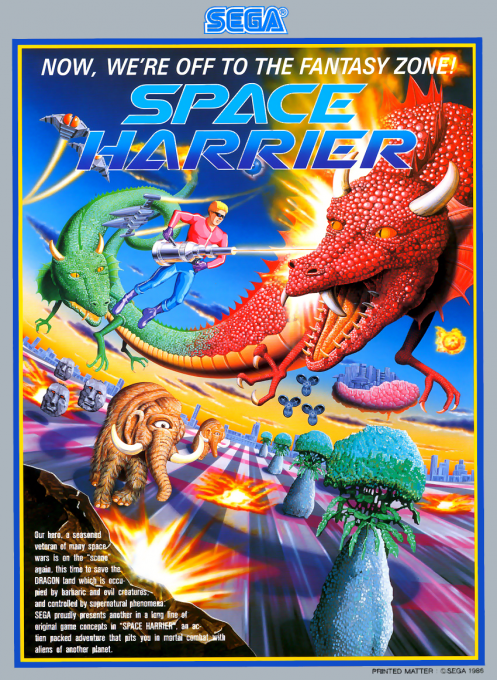
The setting is one of the game’s defining features. Instead of a conventional military flight scenario, Space Harrier sends its hero through surreal landscapes populated by creatures and machines that can include fantastical beasts, strange geometric forms, mobile suits, giant mushrooms, and dragons. Most stages build toward a powerful boss encounter, turning a long evasive run into a focused battle. Two of the eighteen stages change the pace with bonus sequences: Harrier rides the friendly dragon Uriah and crashes through scenery for points without facing the normal enemy attacks. The final stage revisits earlier boss threats in a concentrated closing challenge.
Sega produced multiple cabinet styles for the arcade release, including upright and sit-down versions, but the deluxe moving cockpit is the version most closely associated with Space Harrier. Its seat and cabinet respond to the player’s movement, pitching and rolling to reinforce the onscreen flight. The motion is driven mechanically rather than hydraulically, while the analog stick maps directly to Harrier’s screen position. That physical design made the game part of Sega’s early taikan, or “body sensation,” arcade line: the cabinet itself contributed to the play experience instead of merely housing the monitor and controls.
The original arcade Space Harrier became the foundation for a long-running Sega property, leading to numerous computer and console ports, the home-system follow-ups Space Harrier 3-D and Space Harrier II, and later revivals. Those releases vary in their controls, visuals, stage content, and hardware, but this arcade version is the source of the high-speed flight, fantastical enemy designs, and 18-stage progression that define the series. For arcade players, Space Harrier remains a one-player score-focused shooter in which the spectacle and the challenge arrive together: every new landscape is both a destination and an obstacle course.
Gallery

Details
- Developer
- SEGA AM2
- Publisher
- SEGA
- Genre
- Third-Person Shooter
- Players
- 1
- Release Date
- January 1, 1985
- System
- Arcade