About
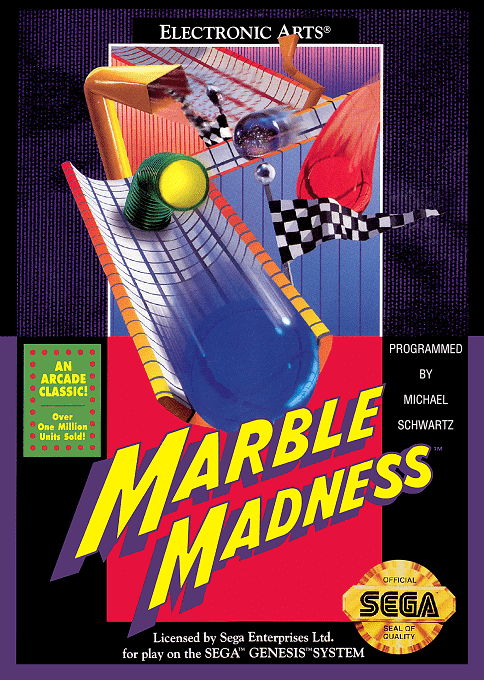
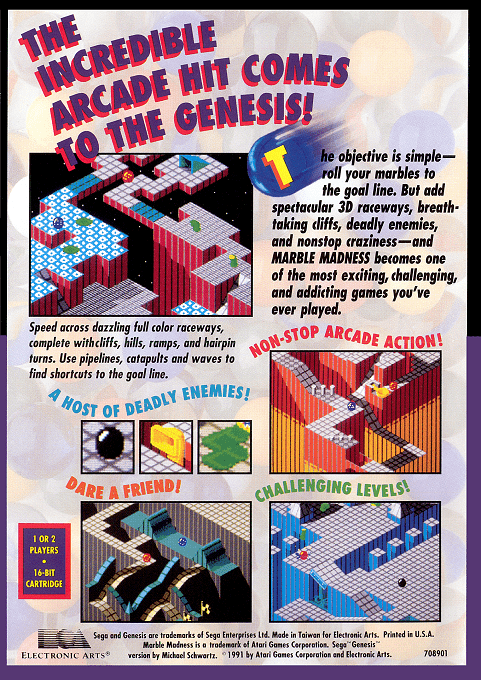
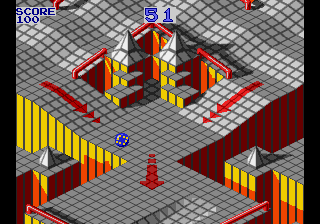
Marble Madness for Sega Genesis is Electronic Arts’ 1991 home-console version of Atari Games’ landmark 1984 arcade action game. Developed and published by Electronic Arts for the North American Genesis and European Mega Drive, it translates the original’s unusual isometric marble race to Sega’s 16-bit hardware. Rather than steering a character across platforms, the player guides a colored marble through a succession of elevated, hazardous courses before the timer expires. The angled view makes every turn, ramp, and drop feel less straightforward than it first appears, turning a simple premise into a demanding test of direction and momentum.
Each attempt begins with the relatively approachable Practice course and moves through six themed races of escalating complexity. A countdown governs progress, so reaching the goal quickly matters as much as avoiding a fall. Time left at the end of a stage carries into the following one alongside the next course’s time allowance, giving a strong run room to continue while making early mistakes costly. The later courses layer in narrower routes, faster descents, awkward corners, and obstacles that can knock the marble away from the safe path. Falling off the course or being overwhelmed by a hazard sends the player back at the price of valuable seconds.
The arcade original was built around a trackball, but Marble Madness on Genesis is played with the standard directional controller. Input moves the marble in the direction implied by the isometric screen, so players must learn to read the layout instead of relying on a conventional side-scrolling sense of left and right. Slopes accelerate the ball, and surfaces, walls, and enemies alter the route or interrupt a clean line through a course. The game’s challenge comes from controlling that movement precisely enough to preserve time: rushing recklessly can mean an immediate tumble, while hesitation can be just as damaging when the clock is nearly empty.
Marble Madness also includes a simultaneous two-player race. Each competitor controls a separate marble and works toward the exit while navigating the same dangerous landscape. The race format adds another consideration to the clock-based design, since getting through a stage ahead of the other player can earn an advantage for the next course. It remains recognizably the same focused experience in either mode: compact stages, quick restarts, and a steady increase in pressure rather than a long adventure with inventories or character upgrades. The courses’ abstract, geometric scenery helps keep the marble and its immediate route easy to identify amid the hazards.
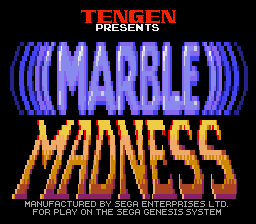
The Genesis cartridge is one of several home adaptations of Marble Madness, a game originally designed by Mark Cerny and released to arcades by Atari Games in 1984. Its original design was notable for pairing an isometric view with physical-feeling marble movement and for making the control method central to the game. Electronic Arts had previously handled several home versions and brought the game to Genesis in 1991. This release should not be confused with the separate Japanese Mega Drive edition published by Tengen: that version is a different conversion with its own presentation and hardware-support options, while the Electronic Arts release is the Genesis version represented here.
For Genesis players, Marble Madness offers a concise arcade-style challenge built around repeated improvement. Learning the safest routes, anticipating the behavior of course hazards, and deciding when to push for speed give the six-race structure its replay value. Its mix of time attack, obstacle navigation, and head-to-head competition also places it among the early games that made a rolling-ball mechanic the entire focus of play. The Sega Genesis edition preserves the essential goal that made the arcade game distinctive: keep the marble under control long enough to reach the finish line before the last seconds disappear.
Gallery
Details
- Developer
- Electronic Arts
- Publisher
- Electronic Arts
- Genre
- Maze
- Players
- 1-2
- Release Date
- November 1, 1991
- System
- Genesis/Megadrive