About
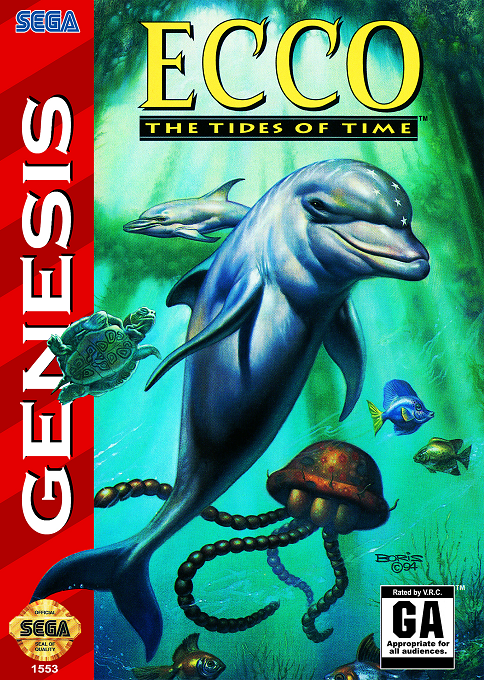
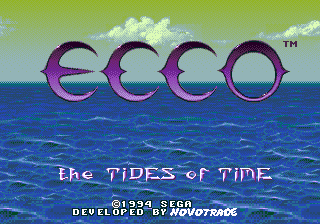
Ecco: The Tides of Time for Sega Genesis is a 1994 action-adventure sequel developed by Novotrade International and published by Sega. It resumes the unusual science-fiction journey begun in Ecco the Dolphin: after Ecco defeated the alien Vortex and saved his pod, a surviving Vortex Queen reaches Earth and destroys the Asterite, the ancient being that had aided him. The crisis leaves the seas threatened again, sending the young dolphin through familiar waters, lost civilizations, and far stranger places in an effort to restore the Asterite and stop the Vortex.
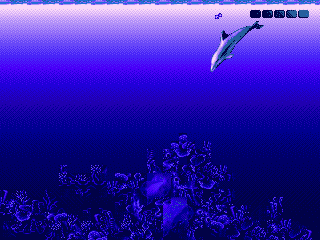
The Sega Genesis game is built around navigating broad underwater stages as Ecco. He can swim in every direction, build speed for a ramming charge, and use sonar. Sonar functions both as a way to communicate with other dolphins and as a tool for activating certain Glyphs and learning about an area; echolocation can also reveal a map. Ecco must surface regularly to replenish his air, so exploration has a steady rhythm of diving, searching, and returning to the waterline. Enemies can be struck with a charge, while combining movement and sonar gives Ecco a ranged defensive option.
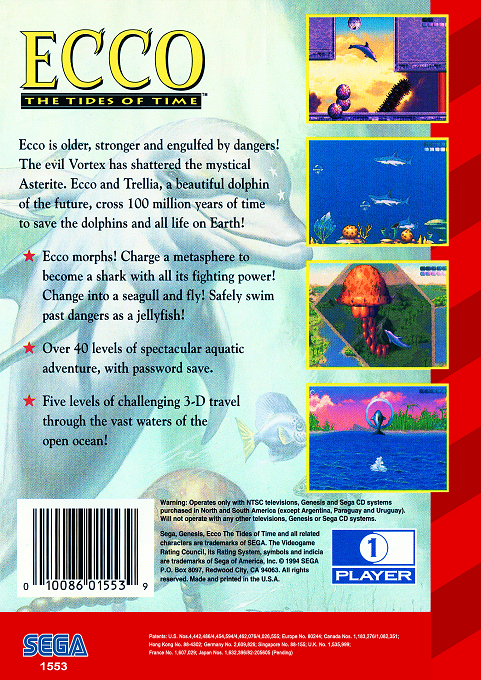
Progress depends on observation and puzzle solving as much as reflexes. Ecco meets sea creatures that supply clues, investigates hidden routes, and works through tasks such as following dolphins through submerged passages and gathering the scattered globes needed to revive the Asterite. The adventure moves from natural ocean environments into an increasingly surreal future. Time travel is central to its story: one possible future is tied to evolved dolphins and a connected ocean, while the Vortex-controlled future is a hostile mechanical world. That contrast gives the sequel a larger scope while maintaining the first game’s solitary underwater exploration.
New abilities expand the Genesis gameplay beyond the original. The temporary Pulsar power-up creates a multidirectional sonar attack, and the Metasphere changes Ecco into other creatures for specific stages, including a seagull, jellyfish, shark, school of fish, and a Vortex drone. These transformations change how an individual sequence is approached instead of simply adding another attack. Several levels also shift to a pseudo-3D presentation, asking Ecco to travel through moving rings while evading hazards or attacking foes. Missing too many rings, or suffering too much damage, can send the player back to try the challenge again.
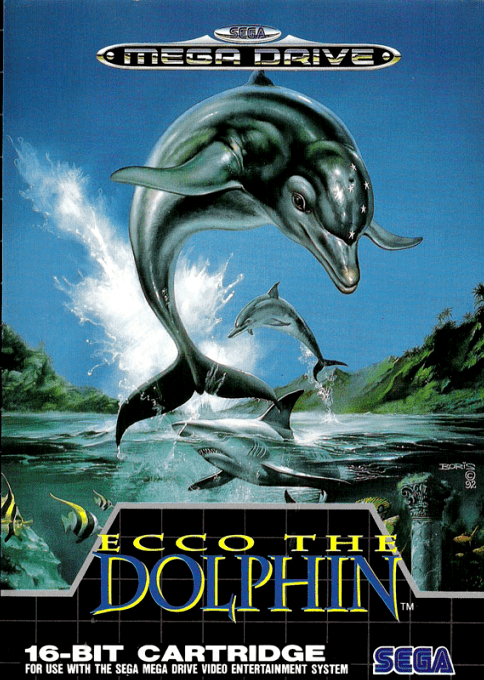
Ecco: The Tides of Time on Genesis is the direct follow-up to the 1992 Ecco the Dolphin and keeps the series’ distinctive mixture of aquatic movement, cryptic exploration, and alien fantasy. Its music was written for the Mega Drive/Genesis hardware by Attila Dobos, Andras Magyari, David Javelosa, and Andy Armer. Sega also issued versions for other systems in 1994, but they should not be treated as interchangeable: the Game Gear and Master System release was heavily redesigned with different level content, while the Sega CD version uses an alternate Spencer Nilsen soundtrack and adds its own presentation features. This Genesis cartridge version is the original 16-bit form of the sequel’s full time-travel adventure.
Gallery
Details
- Developer
- Novotrade
- Publisher
- SEGA
- Genre
- Other Adventure
- Players
- 1
- Release Date
- November 1, 1994
- System
- Genesis/Megadrive