About
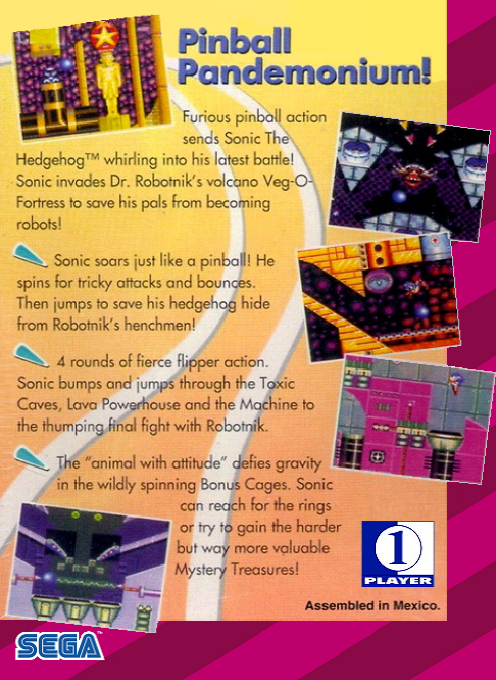
Sonic Spinball for Sega Game Gear is a 1994 single-player action pinball game from Sega. Also known as Sonic the Hedgehog Spinball, it recasts Sega’s blue mascot as the ball inside a huge mechanical defense system rather than sending him through a conventional side-scrolling adventure. The Game Gear release adapts the earlier 16-bit Sonic Spinball concept for Sega’s handheld, combining pinball tables, platform-style movement, enemy hazards, and the familiar conflict between Sonic and Dr. Robotnik.
The story takes Sonic to Robotnik’s Veg-O-Fortress, a volcano-powered stronghold built to imprison the animals of Mobius and turn them into robotic servants. Sonic and Tails attack the fortress, but Sonic is forced into its dangerous interior. From there, the player guides him through the fortress’s pinball defenses, working to disrupt Robotnik’s plan and free the captive animals. The setting gives each table a clear purpose: pipes, bumpers, ramps, traps, and machinery are part of an enemy base rather than a separate arcade cabinet.
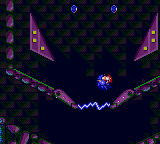
Play centers on four large pinball stages. Sonic bounces from flippers, bumpers, loops, targets, and other table features, while the directional controls let the player influence his movement and position him during the action. He can also travel through portions of the environment on foot, making the game a hybrid of direct-control Sonic action and pinball. Points come from striking targets, navigating the table, collecting rings, and defeating robotic foes, while falling through a drain costs one of Sonic’s lives.
Each stage is built around a progression goal rather than a high-score chase alone. Sonic must locate and collect the Chaos Emeralds hidden around the table, often first activating switches or opening routes that make them reachable. Once the required emeralds have been gathered, the way to that area’s boss becomes available. A status display provides progress information and hints, helping communicate what remains to be done in an environment that can scroll beyond the immediate screen.
After a boss is defeated, Sonic Spinball changes pace with a bonus sequence based on a more traditional pinball table. These rounds focus on scoring with a limited supply of balls and offer a table-shake feature that can alter the ball’s path. Using that shake too often triggers a tilt penalty and disables the flippers, so it is most useful as a measured recovery tool rather than a constant advantage. Clearing the game means overcoming all four fortress sections and their bosses, then bringing Robotnik’s operation to an end.
The Game Gear version was developed by Sega Interactive Development Division and published by Sega, arriving in Europe in August 1994 and North America the following month. It remains closely connected to the better-known Genesis/Mega Drive game, but it is an 8-bit handheld production with its own development credits and presentation. For Game Gear players, Sonic Spinball stands out in the Sonic library as an early genre experiment: a compact, goal-driven pinball adventure that uses Sonic’s speed, rings, enemies, and world to frame every ricochet.
Gallery

Details
- Developer
- SEGA
- Publisher
- SEGA
- Genre
- Pinball
- Players
- 1
- Release Date
- September 1, 1994
- System
- Game Gear