About
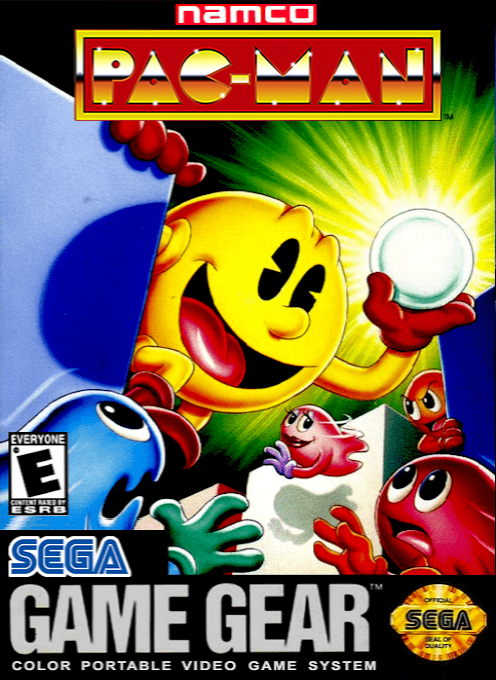
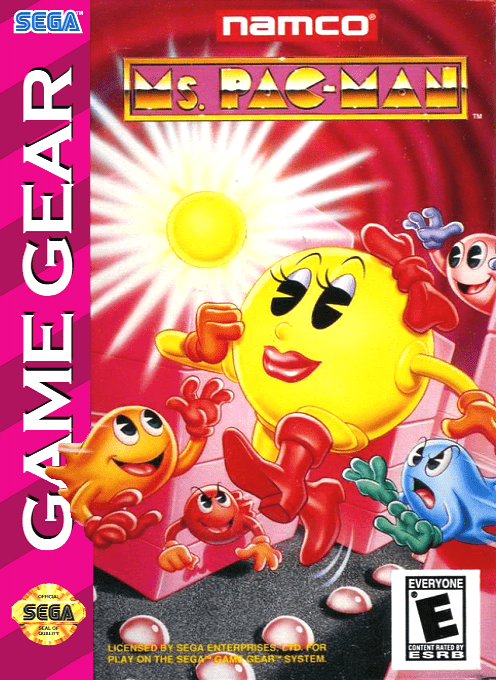
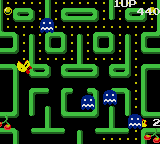
Ms. Pac-Man Game Gear brings Namco's celebrated maze-chase game to Sega's color handheld in 1993. This version places the familiar yellow heroine in compact, single-screen labyrinths where quick reactions and route planning matter more than brute force. It is a portable edition of the arcade game that followed Pac-Man, preserving the central challenge of clearing a maze while a quartet of ghosts turns every junction into a decision point. The goal is simple to understand but demanding to sustain: guide Ms. Pac-Man through every path, collect the pellets, and stay alive long enough to advance to the next round.
Each maze is filled with ordinary pellets that must be eaten to complete the stage. Four larger energizers offer a short-lived change in fortunes. Taking one turns the pursuing ghosts blue, allowing Ms. Pac-Man to chase and eat them for increasing bonus values before they recover and return to the maze. That reversal creates the game’s essential rhythm: avoid danger while collecting dots, then seize a narrow chance to turn defense into offense. The Game Gear directional controls keep the action focused on choosing turns at the right instant, using corners, tunnels, and open routes to avoid being boxed in.
Blinky, Pinky, Inky, and Sue each patrol the maze in ways that make a fixed route unreliable. Their different behavior encourages players to watch the whole board rather than simply sprint toward the nearest remaining pellet. Warp tunnels provide an escape route from one side of a maze to the other, while bonus fruit enters the playfield as a moving target worth extra points. Picking up fruit is optional for finishing a round, but its appearance asks the player to weigh a rewarding detour against the risk of meeting a ghost in a narrow corridor.
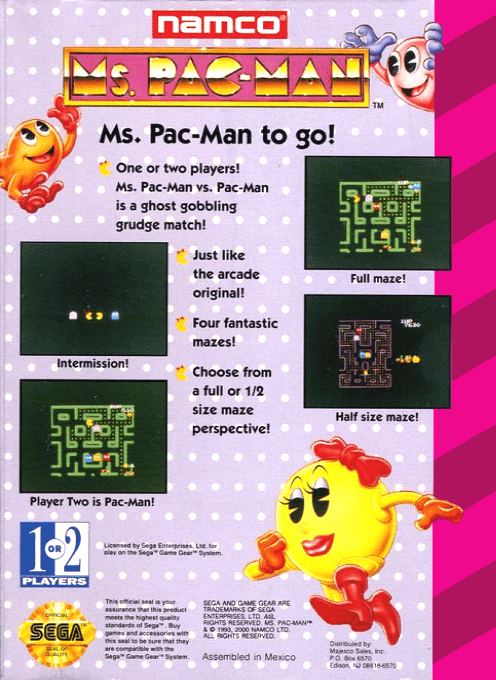
Ms. Pac-Man is distinguished from the first Pac-Man by its selection of maze layouts, changing colors, moving bonus items, and less predictable ghost behavior. The arcade game cycles through four maze designs rather than relying on one board, helping later rounds feel less like a repeated exercise. Its short intermissions also add a playful thread to the Pac-Man family story, showing meetings between Pac-Man and Ms. Pac-Man and eventually introducing their child. Those touches give the chase a small amount of personality without interrupting the fast, score-driven structure at the heart of the game.
For Game Gear owners, Ms. Pac-Man offers an enduring arcade-style challenge built around short attempts and steadily tougher rounds. The speed rises as play continues, and the time that ghosts remain vulnerable after an energizer becomes less generous, so tactics that work early cannot be relied on forever. Whether pursuing a higher score, learning safer routes through the mazes, or trying to clear another screen with a limited stock of lives, the Game Gear release remains a direct connection to one of the Pac-Man series’ most recognizable maze games.
Gallery
Details
- Developer
- Namco
- Publisher
- Namco
- Genre
- Maze
- Players
- 1-2
- Release Date
- January 1, 1993
- System
- Game Gear