About
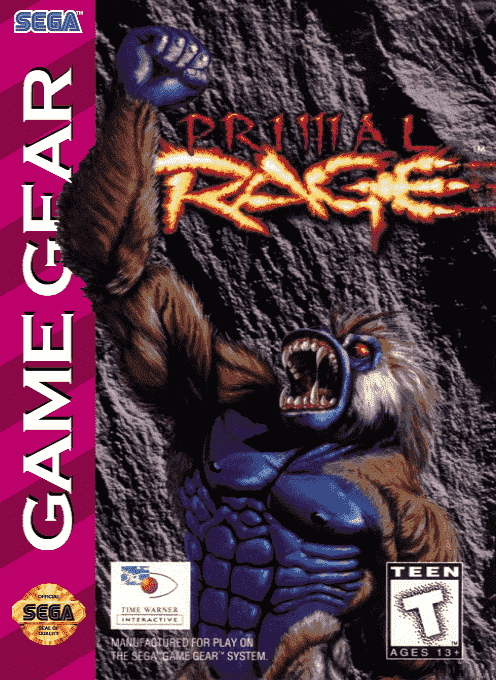
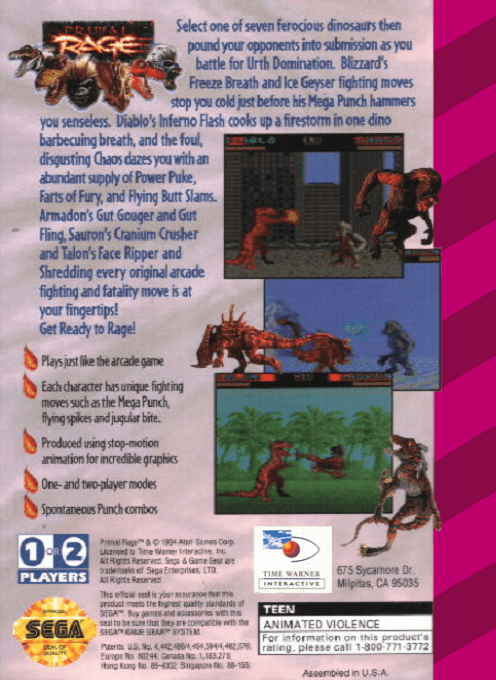
Primal Rage for Sega Game Gear brings Atari Games’ prehistoric one-on-one fighter to Sega’s color handheld. Developed by Probe Entertainment and published by Time Warner Interactive, this 1995 release adapts the arcade game’s battle of giant creatures to an 8-bit portable format. Its premise begins after a meteor catastrophe remakes Earth into the savage world of Urth, where surviving humans gather into tribes and enormous beings awaken to be revered as gods. The player chooses one of these supernatural beasts and fights for control of the post-apocalyptic planet.
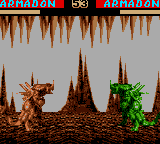
The fundamental contest is a series of side-view, best-of-round duels. Each combatant has a health gauge, and the immediate aim is to drain the rival’s energy before time runs out. A solo player progresses through computer-controlled opponents, while the Game Gear version also supports head-to-head play for two people with the appropriate system-link setup. Punches, kicks, leaps, throws, blocking, and character-specific attacks create the basic fighting vocabulary. As in the original arcade release, the action is built around a small set of face buttons and directional inputs rather than an extensive control panel.
Primal Rage’s fighters are creatures with distinct powers and allegiances. The selection includes Blizzard, an ape-like guardian; Armadon, a horned armored beast; Talon, a swift raptor; Sauron, a tyrannosaur-like predator; Chaos, a destructive ape; and Diablo, a tyrannosaur-shaped lord of evil. The handheld version reduces the arcade roster by omitting Vertigo, the cobra-like goddess, and trims the individual move sets to suit its hardware. Every remaining fighter still has a separate style, so choosing a character affects the kinds of special attacks, reach, and tactics available during a match.
Human worshippers are more than scenery in Primal Rage. Small tribespeople appear near the battlefield and reinforce the game’s idea that these competitors are living deities. A fighter can interact with them during a match, including consuming worshippers to recover health, though harming one’s own followers carries a penalty. Stages reflect the domains associated with the combatants, ranging from icy cliffs and ruined territory to volcanic ground. Victories can also lead into the series’ theatrical finishing-move tradition, giving successful players a brief chance to end a bout with a character-specific attack.
The Game Gear edition is part of a broad wave of Primal Rage home conversions that followed the 1994 arcade debut. Unlike the arcade machine’s photographed stop-motion models and large display, this version reworks the monsters, arenas, animation, and audio for a portable screen, but preserves the color presentation that distinguished it from the related Game Boy adaptation. It retains much of the game’s violent finishers despite its reduced scale. For Game Gear players, Primal Rage offers a compact mid-1990s fighting game built around monster combat, unusual special-move inputs, and the distinctive Urth mythology shared by the larger arcade and console releases.
Gallery

Details
- Developer
- Probe Entertainment
- Publisher
- Time Warner Interactive
- Genre
- Fighting
- Players
- 1-2
- Release Date
- August 25, 1995
- System
- Game Gear