About
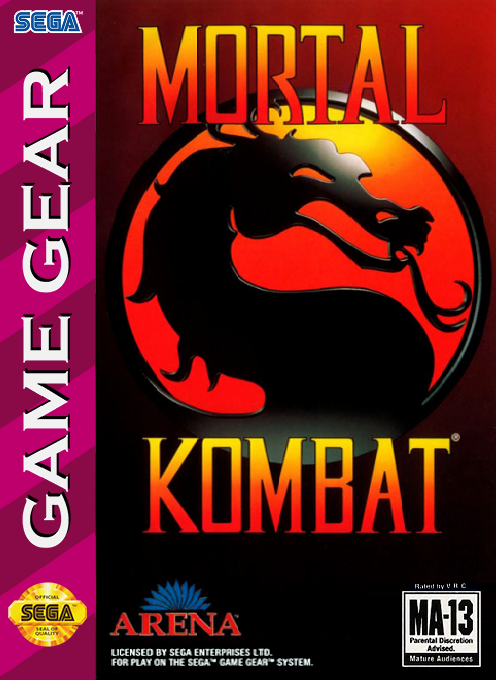
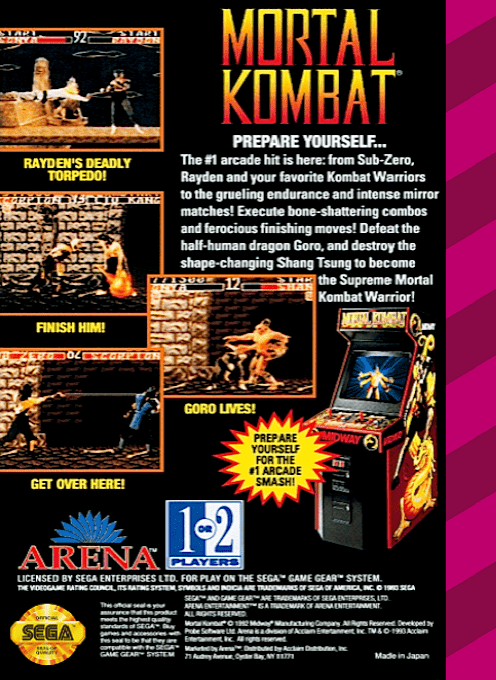
Mortal Kombat for Game Gear brings Midway's landmark 1992 arcade fighting game to Sega's color handheld. Released on September 13, 1993 as part of the heavily promoted Mortal Monday home launch, this version was developed by Probe Software and published by Arena Entertainment. It turns the series' martial-arts tournament into portable one-on-one bouts, with Earthrealm's fate hanging on a challenge to the sorcerer Shang Tsung and his seemingly unbeatable champion, Goro. The Game Gear edition is a compact adaptation rather than a new sequel, preserving the original game's competitive fighting focus, recognizable digitized look, and ominous tournament atmosphere for a smaller screen.
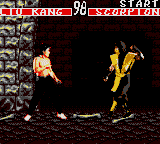
Each match is a best-of-three contest in which the goal is to empty the other fighter's health bar before time expires. Fighters can attack at different heights, block incoming blows, sweep low, throw an opponent, and perform character-specific special techniques by combining directional inputs with the handheld's buttons. Spacing and timing matter: blocking helps stop pressure without simply backing away, while a well-placed uppercut or special move can create an opening for further attacks. The two-button Game Gear layout necessarily condenses the arcade machine's more elaborate control panel, but the game still asks players to learn its move commands rather than rely on a single attack.
The portable roster centers on six selectable combatants: Liu Kang, Johnny Cage, Raiden, Sonya Blade, Scorpion, and Sub-Zero. Their motivations bring them to Shang Tsung's island from very different directions, whether they are seeking victory, revenge, fame, rescue, or a chance to protect Earthrealm. Liu Kang represents the Shaolin order, Sonya pursues the criminal Kano, Johnny Cage wants to prove he is more than a movie star, and the masked rivals Scorpion and Sub-Zero carry their own deadly conflict into the tournament. Shang Tsung and the four-armed Goro remain major computer-controlled obstacles in the single-player climb.
Mortal Kombat Game Gear follows a run of computer opponents in its solo mode, including mirror matches and endurance-style confrontations before the boss fights. A second player can join for head-to-head combat, making the cartridge a direct portable counterpart to the arcade game's versus play. Between battles, the Test Your Might bonus challenge breaks the pace by asking players to fill a power meter rapidly enough to smash a material block. That mix of tournament advancement, character move discovery, and competitive rematches gives the Game Gear release more to do than simply stage isolated fights.
This conversion differs from the larger console releases in important ways. It has a reduced character selection, omitting Kano as a playable fighter and leaving out the arcade game's hidden Reptile encounter. Even so, compared with the contemporaneous Game Boy adaptation, the Game Gear release benefits from color graphics, quicker action, and a more responsive feel. It also retains the series' famous finishing-move tradition, though its violence is censored by default; players who know the proper startup code can enable the bloodier presentation. These choices show the compromises involved in fitting a high-profile arcade fighter onto Sega's handheld hardware while keeping its identity recognizable.
The original Mortal Kombat became a defining fighting-game phenomenon because of its digitized actors, distinct fighters, dramatic special moves, and controversial finishers. Its home versions helped bring that arcade rivalry into living rooms and onto portable systems at the same time. Mortal Kombat on Game Gear is therefore a snapshot of the first game's 1993 breakout: a handheld conversion of the chapter that established Liu Kang, Raiden, Sonya, Scorpion, Sub-Zero, Shang Tsung, and Goro as central figures in a series that would continue for decades.
Gallery
Details
- Developer
- Probe Software
- Publisher
- Arena Entertainment
- Genre
- Fighting
- Players
- 1-2
- Release Date
- September 13, 1993
- System
- Game Gear
/Shining_Force_Gaiden_Final_Conflict.png)