About
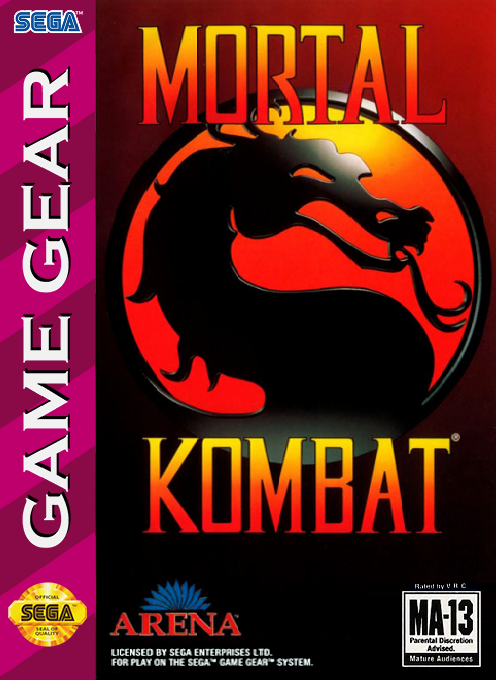
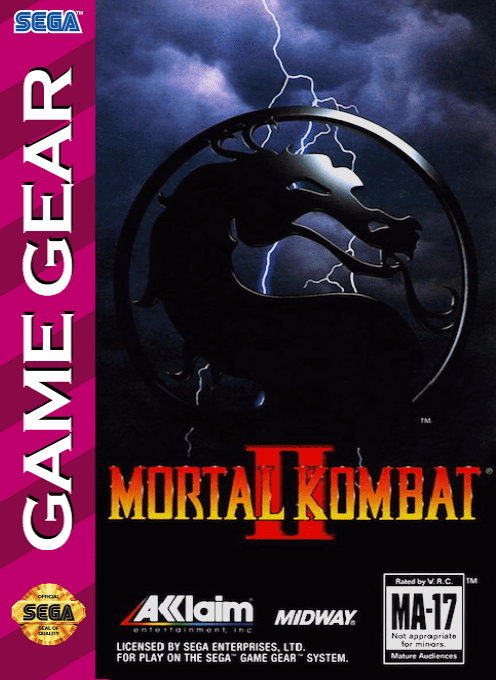
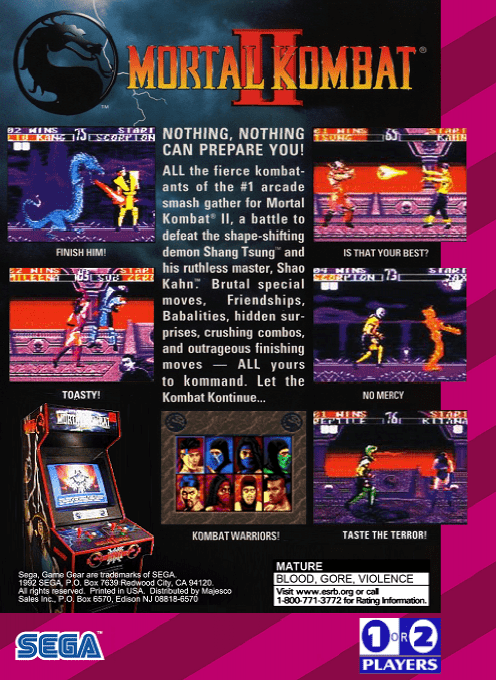
Mortal Kombat II brings Midway's one-on-one tournament fighter to Sega Game Gear in a 1994 conversion developed by Probe Software and published by Acclaim Entertainment. The contest follows Shang Tsung's failed bid to defeat Liu Kang: Shao Kahn renews the sorcerer's strength and lures Earthrealm's fighters into an Outworld tournament, where Kahn has the advantage of fighting on his own ground.
A match is a best-of-three-round duel. Each fighter has a life bar, and taking two rounds wins the bout; a defeated opponent is left dazed long enough for the winner to attempt a finishing move. The single-player ladder has the player work through the other competitors before facing Shang Tsung, Kintaro, and finally Shao Kahn, while a second player can challenge locally or select the same fighter for a mirror match.
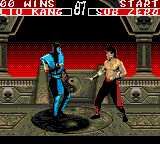
The Game Gear selection contains Jax, Kitana, Mileena, Liu Kang, Shang Tsung, Reptile, Scorpion, and Sub-Zero. Every combatant has punches, kicks, throws, uppercuts, sweeps, jumping attacks, blocks, and character-specific commands. Shang Tsung can change into the other available fighters, while examples of individual special techniques include Liu Kang's fireballs and bicycle kick, Scorpion's spear and teleport, Sub-Zero's ice attacks, Reptile's acid spit, and Kitana's fans.
With only two face buttons, the handheld version maps attacks through button combinations and directions rather than providing the arcade cabinet's full set of attack buttons. Its move inputs also make use of held buttons: the Game Gear move list includes charged techniques such as Jax's earthquake and Mileena's sai throw. This compact control scheme preserves the need to judge range, block, jump, and chain ordinary attacks with specials despite the portable hardware.
The game retains the series' end-of-match spectacle, including a Fatality and Babality for each playable fighter, a Friendship option, and the Kombat Tomb's stage finish. Blood is present on Game Gear, but markedly less abundant than in the larger home versions. The port also has hidden encounters with Jade and Smoke, in arenas specific to the version.
Probe's 8-bit conversion is necessarily a reduced interpretation of the arcade game. Baraka, Johnny Cage, Kung Lao, and Raiden are absent from the playable roster, leaving eight of the arcade's twelve selectable fighters. Only the Kombat Tomb, the Pit II, and Goro's Lair are carried over as standard arenas, and several Fatalities are simplified or altered into generic piles of limbs and bones. Unlike the related Game Boy release, however, the Game Gear version keeps Kintaro in the end-of-ladder sequence and presents the action in color.
Gallery
Details
- Developer
- Probe Software
- Publisher
- Acclaim Entertainment
- Genre
- Fighting
- Players
- 1-2
- Release Date
- January 1, 1994
- System
- Game Gear