About
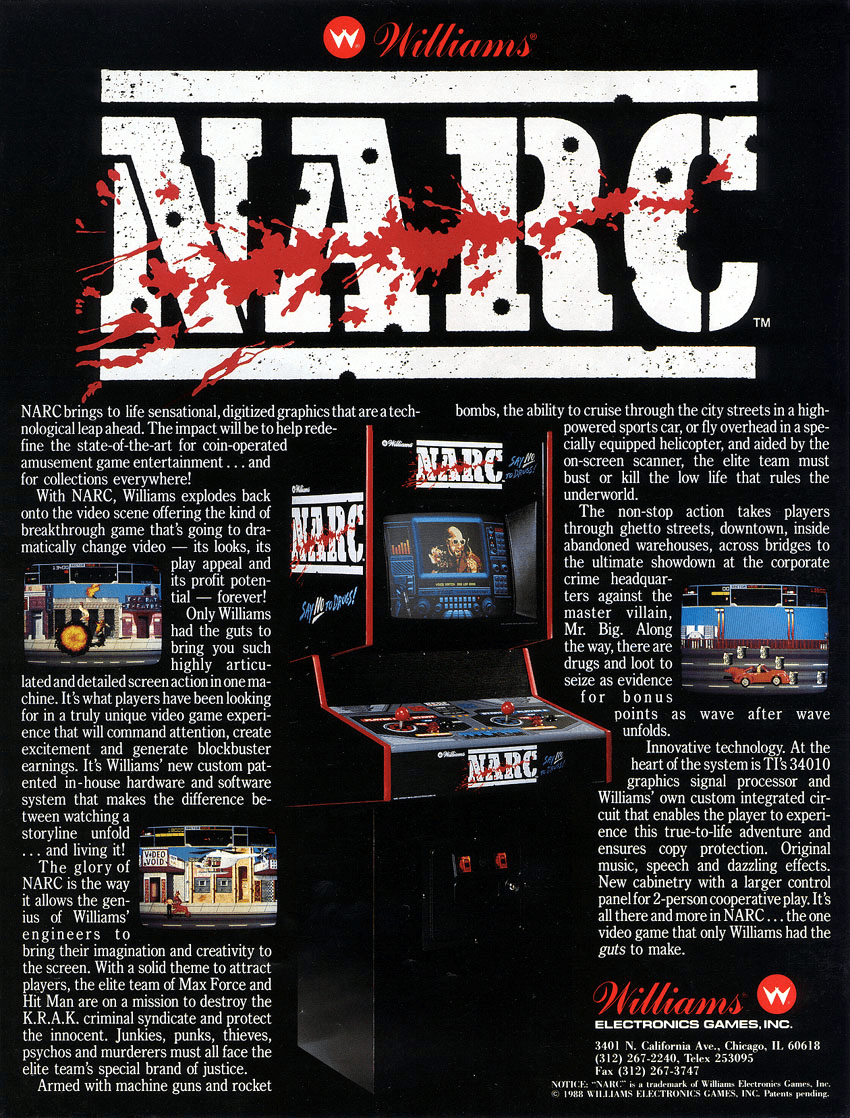
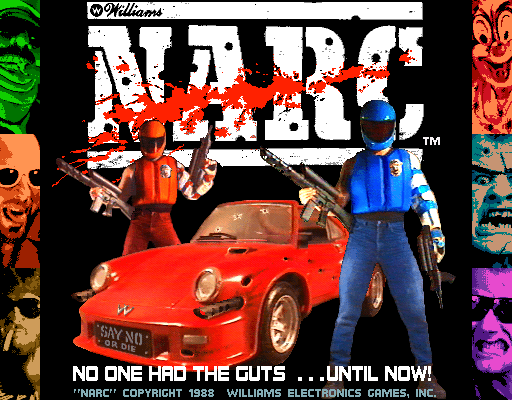
NARC (rev 7.00) is the arcade version of Williams Electronics’ 1988 side-scrolling run-and-gun game. Designed by Eugene Jarvis, it puts one or two players in the roles of narcotics agents Max Force and Hit Man on a deliberately exaggerated campaign against the criminal organization K.R.A.K. This is the original coin-operated NARC, rather than the later console and computer conversions or the separate 2005 revival. Its near-future crime setting, digitized performers, and confrontational drug-war theme made it a conspicuous Williams arcade release of its era.
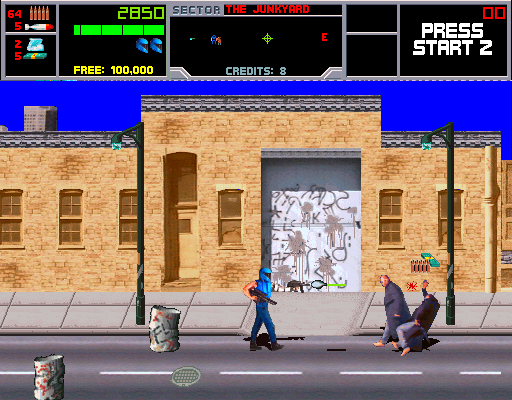
Each player moves with an eight-way joystick and attacks with an automatic weapon and a limited supply of rockets. Enemies approach from both directions across scrolling streets, industrial areas, and other hostile city locations, so choosing when to advance, fire, or use a powerful missile matters as much as simply clearing the screen. The game supports solo play or a two-player partnership, with Max Force and Hit Man working through the same mission. Its arcade structure keeps the pressure high: hazards and opponents rapidly consume lives and credits, while the campaign continually asks the player to survive another densely populated section.
NARC’s stated objective is not only to defeat criminals but to break their organization and reach its leader, Mr. Big. Many opponents can be shot, but some surrender and can be arrested instead. That distinction is built into the game’s scoring: arrests are counted alongside the drugs and cash seized from defeated enemies, and the totals are presented after a stage. The system gives a small strategic and thematic dimension to an otherwise direct action game, since a player can pursue points through captures and confiscation rather than treating every encounter exactly alike.
Progression also uses colour-coded keycards. On applicable sections, players must find the required card before moving on, which adds a search objective amid the constant attacks. The weapons reinforce the contrast in its play: the automatic gun is the regular response to advancing enemies, while rockets produce a much larger and more destructive result but must be conserved. The arcade cabinet’s buy-in feature allowed a player to continue a run more than once, although not in the final stage, fitting a game designed for repeated coin-op attempts.
Williams built NARC around hardware that helped its imagery stand apart from earlier arcade shooters. It used the Texas Instruments TMS34010 graphics processor and custom Williams support hardware, with a 512-by-400 display mode. Actors in costume were photographed for the large digitized character graphics, giving enemies and agents a photographic look instead of the smaller hand-drawn sprites common in many 1980s arcade games. The same appetite for digitized visual impact would become strongly associated with later Williams and Midway arcade productions, even though NARC remains a 2D scrolling action game at heart.
The original NARC also differs sharply from its home adaptations. Acclaim’s 1990 NES release, developed by Rare, altered content and presentation, while several contemporary computer versions made their own technical compromises. Those adaptations should not be confused with this Williams arcade release or with the later game that reused the title. For players exploring late-1980s arcade action, NARC (rev 7.00) is a snapshot of Williams combining two-player run-and-gun design, mission scoring, digitized graphics, and an unmistakably over-the-top law-enforcement premise.
Gallery

Details
- Developer
- Williams
- Publisher
- Williams
- Genre
- Run and Gun
- Players
- 1-2
- Release Date
- January 1, 1988
- System
- Arcade