About
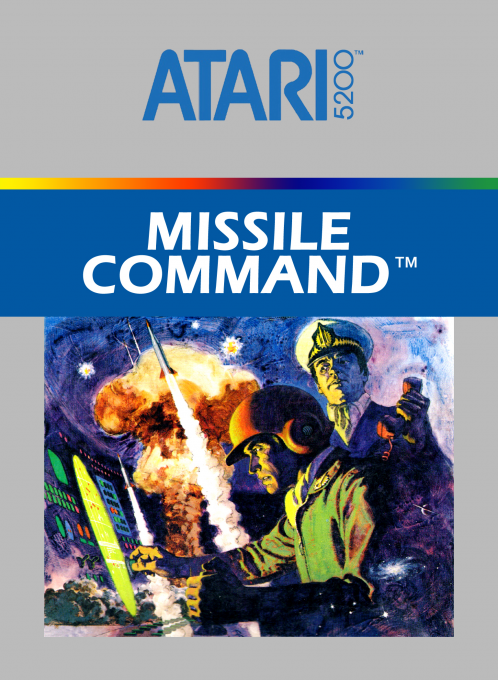
Missile Command Atari 5200 is Atari's 1982 home conversion of the landmark fixed-screen defense game. Programmed for the 5200 by Robert Zdybel, it recasts the original arcade premise as a battle for the resource planet Zardon, whose six cities and missile installation face an assault from the hostile world of Krytolia. Atari's cartridge turns the familiar Cold War-era survival concept into a science-fiction emergency: every wave demands that the commander protect a populated world for as long as possible.
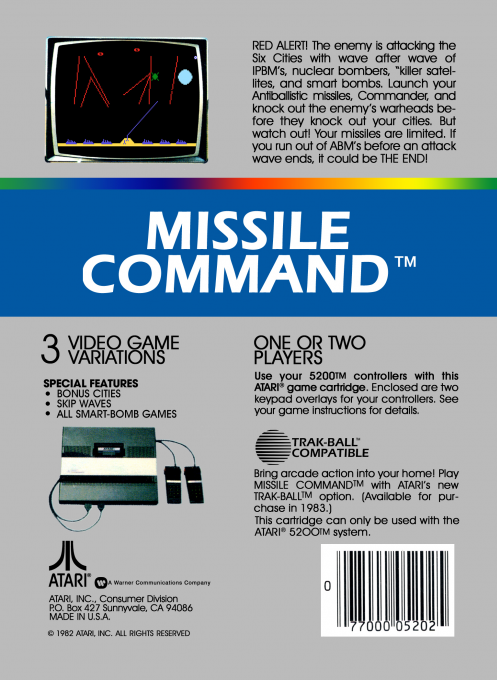
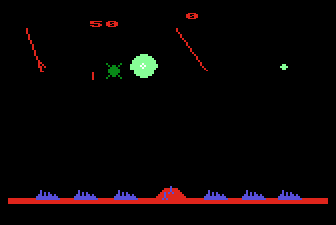
The screen presents the cities along the lower edge while enemy weapons descend from above. The player moves an aiming cursor with the 5200 controller's analog stick and presses either lower red fire button to launch an antiballistic missile, or ABM, toward that point. An ABM creates a temporary blast zone when it reaches its destination, so successful defense depends on leading targets and allowing them to fly into an expanding explosion. The cursor can be moved immediately after firing, making rapid target selection as important as accuracy.
A standard wave gives the defender 30 ABMs, supplied to the launch pad in groups, and ammunition management is central to the game. The attacking force includes interplanetary ballistic missiles, splitting MIRVs, bombers, killer satellites, and, from the sixth wave onward, smart missiles that can evade poorly placed explosions and home in on valuable targets. A strike on the missile base wipes out the missiles waiting there, while the destruction of all six cities ends the campaign. The game has no final victory condition; increasingly demanding waves test how long a player can preserve Zardon and build a score.
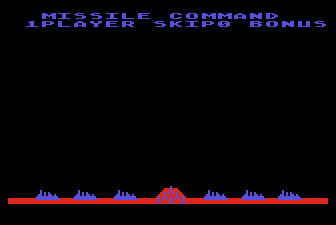
Missile Command on Atari 5200 supports one or two players. In the two-player setting, competitors take turns and the console tracks their scores, while the first controller selects the game and starts play. The keypad offers useful options unusual for a simple pick-up-and-play defense game: players can skip up to nine opening waves to begin at a tougher, higher-scoring point, practice against smart missiles alone, or disable the bonus-city feature. Under the normal rules, every 10,000 points earns a replacement city, which can be held in reserve until a vacant site is available.
The 5200 edition was designed for the system's analog controllers and also includes support for Atari's separately sold Trak-Ball, a natural fit for sweeping the crosshair across the battlefield. Surviving a wave yields points for remaining cities and ABMs, and the scoring multiplier rises every two waves before reaching its maximum. Its colorful changing displays, compact controls, escalating enemy mix, and emphasis on placing explosions rather than shooting directly preserve the strategic rhythm that made Missile Command one of Atari's defining early action games.
Gallery
Details
- Developer
- Atari
- Publisher
- Atari
- Genre
- Shoot 'em Up
- Players
- 1-2
- Release Date
- January 1, 1982
- System
- Atari 5200