About
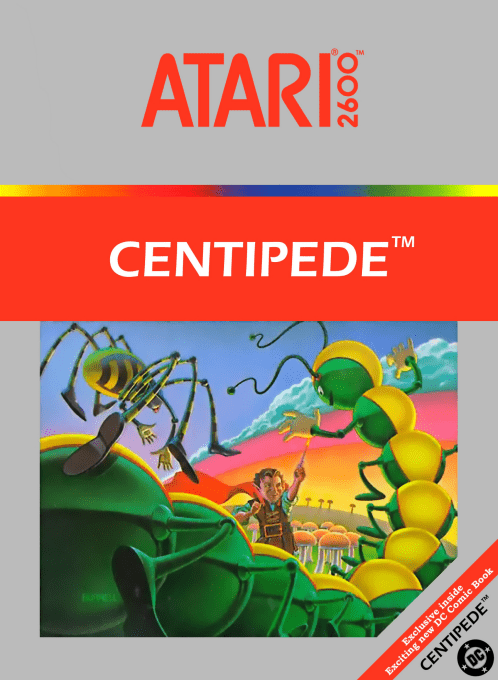
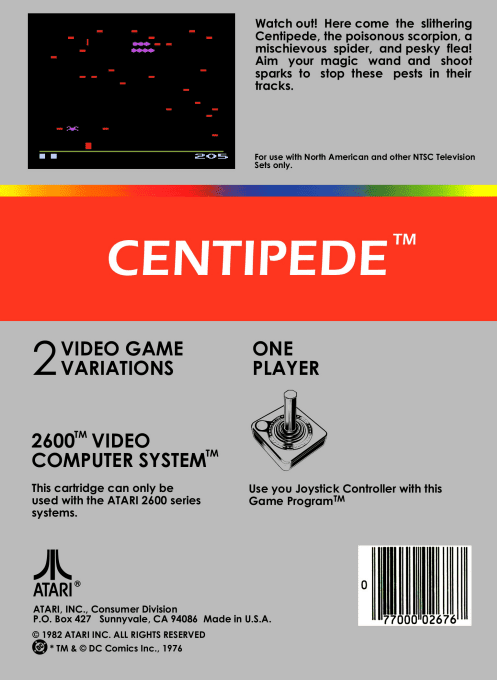
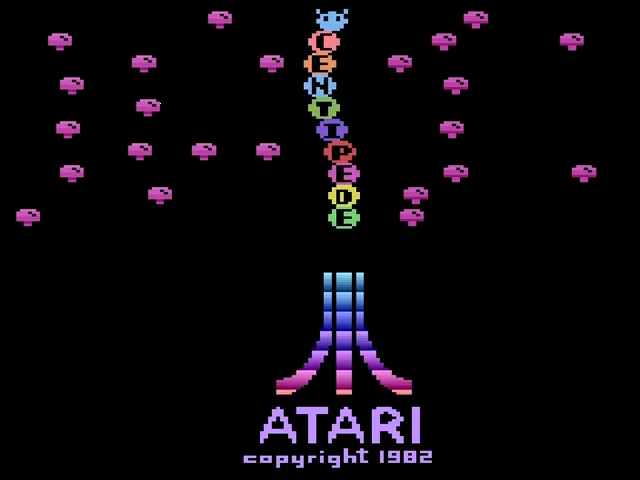
Centipede for the Atari 2600 is Atari's home conversion of the 1981 arcade fixed shooter, released in the early 1980s as a cartridge for the Video Computer System. Published by Atari, it takes the arcade game's insect assault into a compact one-player format built around a joystick and a single fire button. The manual frames the action as a defense of an enchanted mushroom garden: the player guides the elf Oliver's magic wand through the lower part of the screen, firing sparks at a giant centipede and the other creatures that crowd the forest.
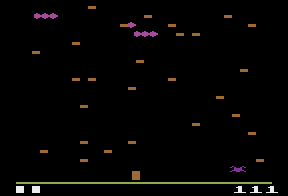
The main danger begins at the top of the playfield. A nine-part centipede travels across the mushroom rows, dropping down and reversing direction whenever it meets a mushroom or a screen edge. Hit a segment and it becomes a new mushroom, while the section behind it gains a head and carries on independently. This turns accurate shooting into a tactical choice: breaking up the creature can make the board more crowded with smaller threats, but heads are worth far more points than ordinary body segments. Clearing a formation starts another attack wave, and later waves increasingly replace its body with detached, fast-moving heads.
Mushrooms shape nearly every decision in Atari 2600 Centipede. They block and redirect the centipede, so removing them can open a vertical route for an enemy to fall quickly toward the player's area. A mushroom needs three consecutive shots to disappear, and it can also be worth leaving cover in place. The player has an unlimited supply of shots and can keep the fire button held down, while the wand moves left, right, and about a quarter of the way up the screen. Each game begins with three wands; losing the last ends the run, while every 10,000 points awards an extra wand up to a maximum of seven held at once.
The centipede is joined by three insects with roles of their own. A spider leaps around the lower battlefield, eating mushrooms and putting pressure directly on the wand; it scores more when it is struck at close range. Fleas appear when too few mushrooms remain near the player, dropping downward and planting fresh mushrooms as they go. A scorpion eventually crosses the field and poisons the mushrooms it touches. When the centipede encounters one of those poisoned mushrooms, it abandons its usual side-to-side path and plunges straight down through the field, creating a sudden hazard that can also present a scoring opportunity.
Atari tailored this version's rules and presentation to the 2600 rather than simply duplicating every arcade feature. It is a solo game controlled with the standard joystick in the left controller port, with no use for the console's difficulty switches. Game Select offers Easy Play and Standard Play instead. Easy Play is identified by a teddy-bear symbol and softens the challenge by preventing the flea and spider from taking a wand; it also starts the centipede in one connected formation rather than including detached heads. Standard Play raises the scoring ceiling and leaves the player to manage the full set of dangers.
Centipede's arcade original was created at Atari by Ed Logg and Dona Bailey, and the game became a defining hit of the early arcade era before spreading across Atari hardware and other systems. The 2600 edition preserves the essential tension of its source in a different form: a shifting maze of mushrooms, an enemy that divides under fire, and a limited safe zone that becomes less secure as a wave descends. Its immediate controls and evolving patterns make it a notable Atari 2600 action game for players drawn to score chasing, quick reactions, and classic fixed-screen shooters.
Gallery
Details
- Developer
- Atari
- Publisher
- Atari
- Genre
- Shoot 'em Up
- Players
- 1
- Release Date
- January 1, 1983
- System
- Atari 2600