About
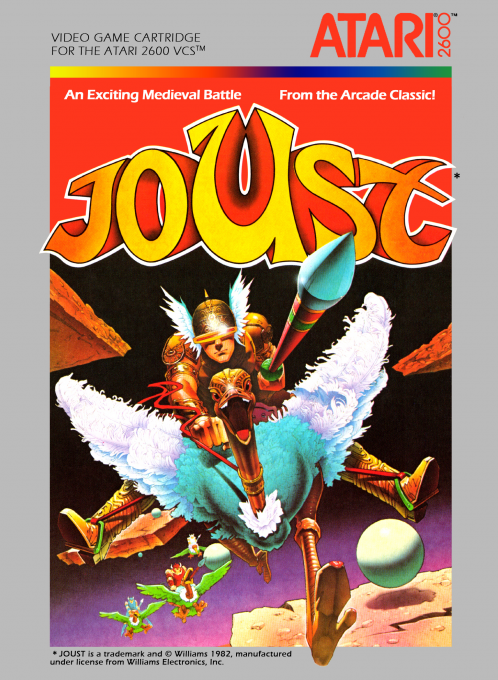
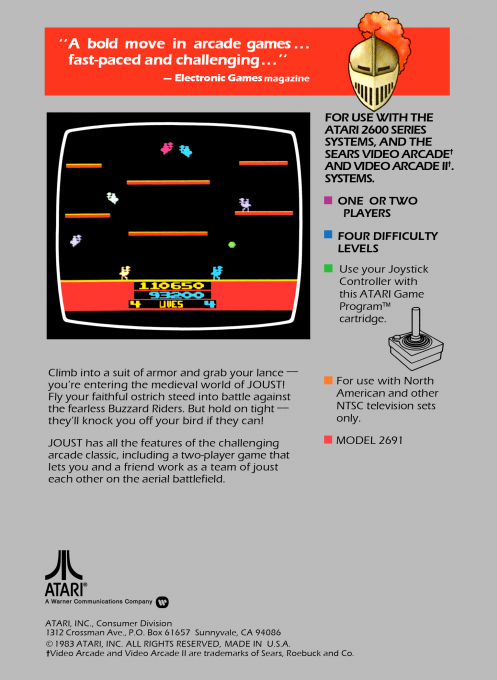
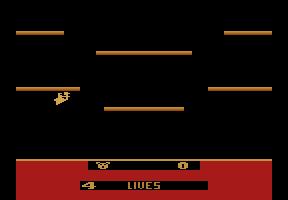
Joust for the Atari 2600 is Atari's 1983 home conversion of Williams Electronics' medieval arcade action game. It brings the unusual contest of lance-bearing knights riding giant birds to the Atari Video Computer System in a compact single-screen format. One player rides a yellow ostrich and, in two-player play, the second rider uses a blue stork. The aim remains immediate and tactical: outfly rival riders, meet them at the right height, and unseat them before they do the same to you.
The joystick moves a mount left and right, while the controller button makes it flap. That simple arrangement puts the crucial vertical control in the player's hands. A rider whose mount is higher when lances meet wins the clash; equal-height encounters send both combatants apart. The challenge comes from judging momentum, turning back toward an opponent, and choosing when to rise or descend around the platforms. Moving beyond either side of the screen carries a rider to the opposite edge, making the arena's boundaries part of every pursuit and escape.
Joust pits the player against three increasingly dangerous classes of Buzzard Rider: red Bounders, gray Hunters, and blue Shadow Lords. Defeating one leaves an egg in play. Collecting it adds to the score, but delaying lets it hatch into another mounted enemy, so a successful joust is often only the beginning of the job. Clearing the active opponents advances the game to a new wave, where the pressure builds as enemy riders return and the player has to preserve a limited supply of lives.
The Atari 2600 version also includes the hazards and bonus-round ideas that shape its own rhythm. After the early waves, the bottom fire pits are uncovered and become deadly terrain. A pterodactyl occasionally enters the contest; hitting its beak defeats it for bonus points, while a collision costs a life. Special waves alter the objective: a solo Survival Wave rewards staying alive, a two-player Team Wave rewards partners who avoid unseating one another, Gladiator Waves turn the two riders into direct rivals, and Egg Waves begin with the opposition as eggs.
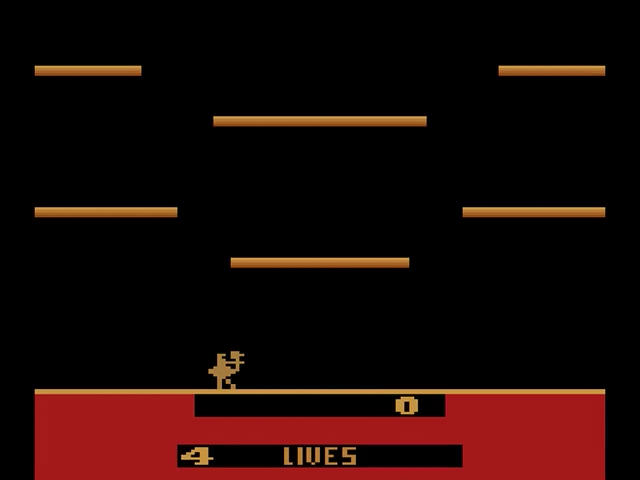
Two players can therefore treat the same screen as either a cooperative defense or a contest for position and points. That flexibility is central to Joust's appeal: the same flapping and lance-height rules support saving a partner, racing for an egg, or attempting a perfectly timed attack. The Atari 2600 hardware necessarily presents a pared-back interpretation of the arcade game, with a symmetrical arrangement of platforms and simplified visual detail, but the conversion preserves the defining airborne duels, wraparound arena, waves, and local simultaneous play.
As an Atari-published licensed adaptation, Joust for Atari 2600 belongs to the early-1980s wave of arcade games brought home on cartridge. Its fantasy premise stands apart from the period's many space combat games, while its controls make each encounter a brief test of timing rather than a shooting match. For players exploring the Atari 2600 library, it is a score-driven action game built around a distinctive idea: victory is decided not by the sharpest lance, but by who owns the sky at the moment of impact.
Gallery
Details
- Developer
- Williams
- Publisher
- Atari
- Genre
- Platformer
- Players
- 1-2
- Release Date
- January 1, 1983
- System
- Atari 2600