About
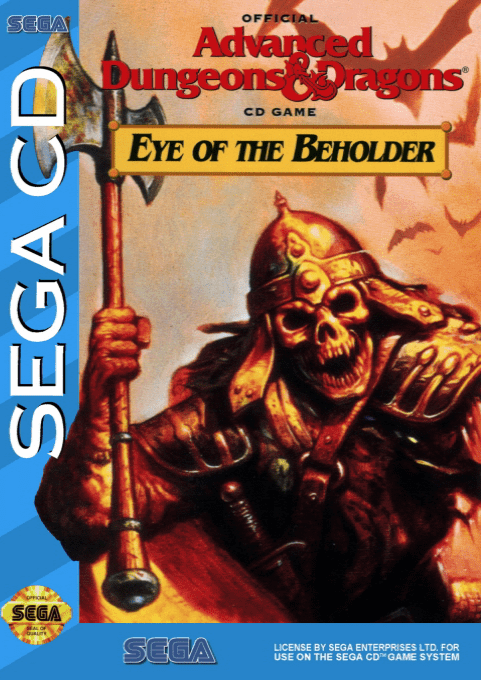
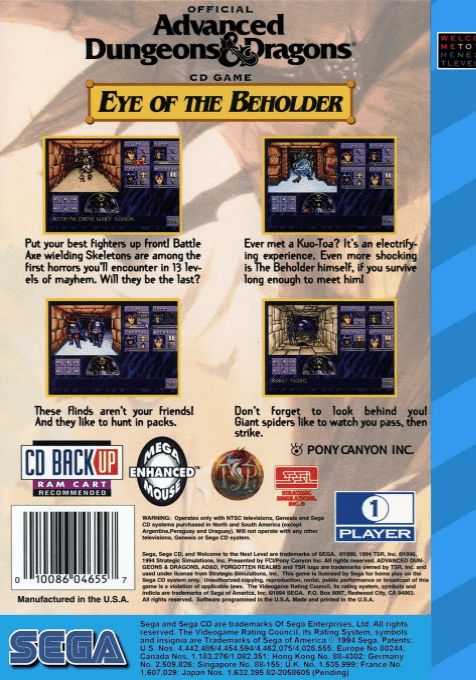
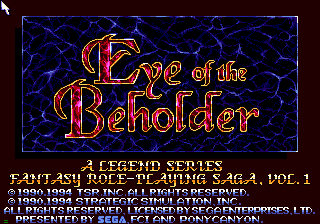
Advanced Dungeons & Dragons: Eye of the Beholder for Sega CD is a first-person dungeon-crawling role-playing game released in 1994. Developed for this version by Opera House and published by Sega, it adapts the earlier Eye of the Beholder adventure to Sega’s CD-ROM add-on while retaining its Forgotten Realms setting and Advanced Dungeons & Dragons 2nd Edition rules. The story begins in Waterdeep, where the Lords of the city send a newly assembled band of adventurers beneath the streets to investigate a growing threat. A collapse seals the party in the sewers, making the descent through the city’s underground passages the only route forward.
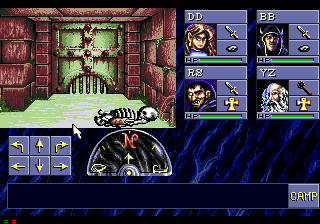
Play unfolds through a first-person 3D view of corridors, chambers, doors, and encounters. The player moves the group one step at a time, turns at intersections, and examines the dungeon for items, wall switches, levers, keys, and hazards. Progress depends on both fighting and reading the environment: a closed gate may open with a nearby control, a key, or a thief’s skills, while treasures, food, weapons, and useful objects must be collected and arranged among the party. The maze-like spaces also make navigation and careful observation central to the adventure.
Before setting out, players can form a four-character party or begin with a default group. Character creation lets them select race, gender, class, alignment, portrait, and ability scores within the game’s AD&D framework. Humans, elves, half-elves, dwarves, gnomes, and halflings are available, with different class options and attribute modifiers. Fighters, rangers, paladins, mages, clerics, and thieves contribute different strengths: armed characters hold the line, spellcasters provide magic, and thieves can help when locked obstacles block the way. Up to two non-player characters can join the regular four-member party during the quest.
Combat occurs in real time rather than in turns. Characters at the front can strike with equipped melee weapons, while those in the rear can support the formation with spells and ranged attacks. Clerics and paladins cast through holy-symbol icons, and mages use spell-book icons, placing equipment and spell management directly alongside exploration. The group’s portraits indicate its marching arrangement, and players must monitor weapons, inventory, character condition, and the practical limits of the party as enemies approach through the dungeon view.
The game’s Waterdeep scenario carries the party from the sewer investigation into deeper catacombs and dangerous subterranean territory tied to the mysterious Xanathar. Its campaign mixes monsters, traps, locked routes, and puzzles with character advancement and resource handling. That focus on a controlled party moving through a hostile enclosed world gives Eye of the Beholder Sega CD its particular rhythm: investigate a passage, solve the means of opening it, prepare for a close encounter, then press farther into the underground mystery.
Opera House’s Sega CD conversion was designed around the console’s control options. A directional pad moves an on-screen cursor over the adventure interface, with separate actions for handling items and attacking; the manual also supports Sega’s Mega Mouse. The version uses the Sega CD’s backup memory for saved games and includes a soundtrack credited to Yuzo Koshiro and Motohiro Kawashima. As the first entry in the Eye of the Beholder series, it presents the original Waterdeep expedition in a console CD format, bringing a computer-style AD&D dungeon adventure to the Sega CD library.
Gallery
Details
- Developer
- Opera House
- Publisher
- SEGA
- Genre
- Action RPG
- Players
- 1
- Release Date
- June 29, 1994
- System
- Sega CD