About
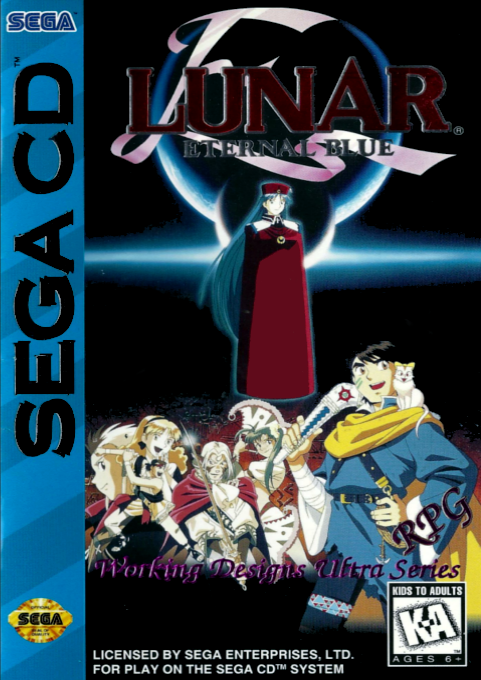
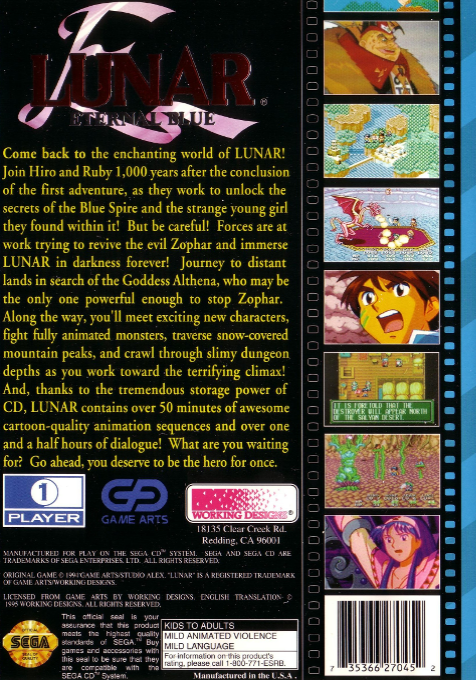
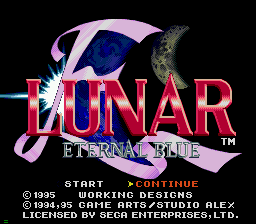
Lunar: Eternal Blue for Sega CD is a Japanese role-playing game developed by Game Arts with Studio Alex, originally released in Japan in December 1994. It is the direct sequel to Lunar: The Silver Star, set one thousand years later in the same fantasy world. Game Arts published the Japanese Mega-CD edition, while Working Designs brought the game to North America in September 1995. The Sega CD original should not be confused with the later Sega Saturn and PlayStation remake, Lunar 2: Eternal Blue Complete.
The story begins with young explorer Hiro and his small, pink, winged companion Ruby investigating ancient ruins. Their discovery at the Blue Spire introduces them to Lucia, a mysterious visitor from the Blue Star. Lucia is pursuing a threat connected to Zophar, a destructive force whose return could endanger Lunar. Hiro accompanies her on a long journey that reaches villages, forests, mountains, sacred sites, and the holy city of Pentagulia. Returning series figures and new traveling companions gradually broaden both the party and the stakes.
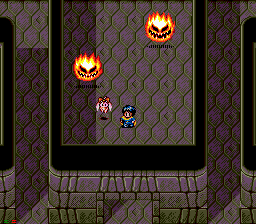
Exploration uses a top-down view, with towns, overworld locations, ruins, and dungeons linking the story’s major destinations. Players speak with non-player characters, investigate their surroundings, and advance through scripted objectives. Hostile areas use random encounters, moving the party to a separate battle screen. The game’s fantasy setting is presented through colorful two-dimensional character art and backgrounds, while CD technology is used for animated story sequences, recorded dialogue, and music.
Battles are turn-based and party members bring their own attacks, spells, and special techniques. Position matters: characters must get close enough to strike foes unless they use an appropriate ranged option, so arranging a party’s actions is part of planning each round. Victories grant experience that improves the group for tougher enemies ahead, and magical growth unlocks additional abilities. The North American Working Designs version also made changes to its balance and save system, including a cost paid from battle-earned magic experience when recording progress.
Hiro’s companions give the adventure a varied party dynamic. Ruby presents herself as a baby dragon, while the group also includes healer and former priest Ronfar, dancer Jean, magician Lemina, and the White Knight Leo. Lucia’s unfamiliarity with Lunar’s people and customs is a recurring part of the journey, alongside the group’s search for the truth behind the world’s religious authority and the danger surrounding the dragons. Animated scenes and voice work help deliver key plot moments beyond the game’s standard text conversations.
Eternal Blue expanded on the Sega CD formula established by The Silver Star with a larger adventure and a stronger emphasis on CD-based presentation. Its Japanese release is also known as Lunar II, and the original game later received the substantially revised Lunar 2: Eternal Blue Complete for Sega Saturn and PlayStation. For the Sega CD library, Lunar: Eternal Blue remains the original 1994–1995 version: a single-player, story-led RPG built around exploration, party-based combat, animated cutscenes, and the continuing world of Lunar.
Gallery
Details
- Developer
- Game Arts
- Publisher
- Working Designs
- Genre
- JRPG
- Players
- 1
- Release Date
- January 1, 1995
- System
- Sega CD