About
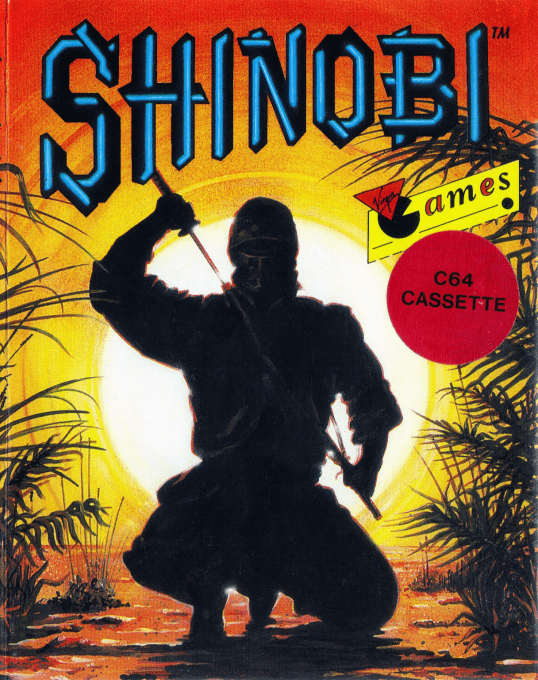
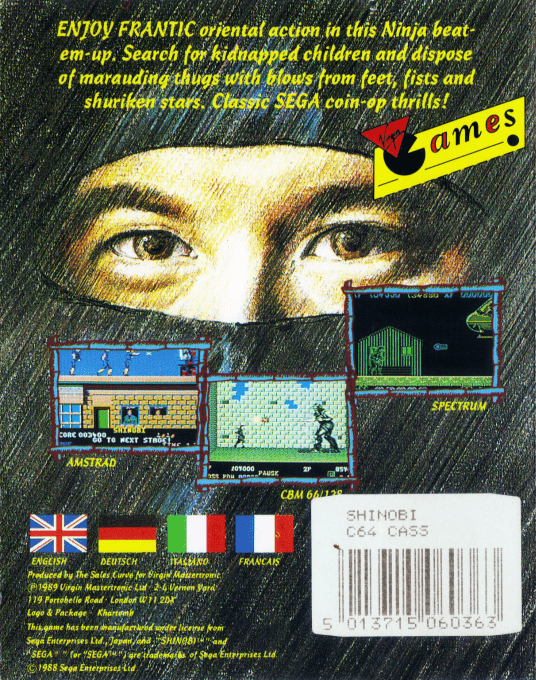
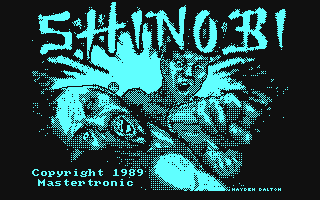
Shinobi for Commodore 64 is a 1989 side-scrolling action game, produced by The Sales Curve and issued by Virgin Mastertronic in Europe under licence from Sega. It adapts Sega’s 1987 arcade hit for Commodore’s 8-bit home computer, putting the player in the tabi of ninja hero Joe Musashi. A North American C64 release was published by Sega, while the European version later returned as a Mastertronic Plus budget title. The conversion keeps the arcade game’s blend of shooting, close combat, platform movement and hostage rescue, but presents it for joystick and keyboard play on the C64.
The Commodore 64 manual gives this version a colourful set-up. Joe is attending a ceremony at his former ninja school when the renegade Bwah Foo and his followers abduct the junior pupils. Foo demands the school’s gold and sets a deadline, leaving Joe to find the villain’s hideout and bring the children back. The basic objective is therefore both direct and urgent: move through dangerous territory, free the captives and stop the mastermind behind the kidnapping. This C64-specific presentation preserves the heroic rescue theme associated with Shinobi while giving the conversion its own written story details.
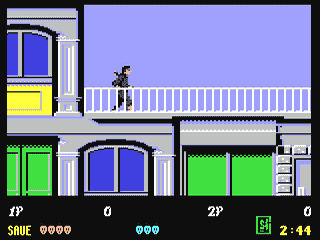
Play unfolds across five missions, each split into three or four stages. Stages mix streets and multi-level environments with mobile enemies, hostages and a major adversary waiting at the end of a mission. A time limit applies to each section, and remaining time becomes score once a mission is cleared. To reach a boss, Joe must rescue the children placed through the mission; passing a captive triggers the Ninja Magic that sends them to safety. Every successful rescue also contributes points, so advancing is tied closely to searching each stage rather than merely racing to the exit.
Joe’s standard tools are shuriken for attacks at a distance and punches or kicks when danger closes in. Saving enough children can award a stronger weapon, adding an incentive to complete the rescue work carefully. Ninja Magic is the emergency resource: it can be called on only once per level, making its timing an important decision during a crowded encounter or a boss fight. The combination of ranged attacks, hand-to-hand moves, jumping and limited magic gives Shinobi a rhythm that changes from one screen to the next instead of relying on a single attack style.
The C64 controls are built around a joystick, with left and right turning and walking, up for a jump and down for a crouch. Pressing fire attacks with the current weapon or performs a kick or punch at close range. Fire combined with up or down moves Joe between ground level and higher platforms, a useful mechanic in the game’s vertically arranged areas. Space activates Ninja Magic, P pauses play, and this edition even includes a C64-only option to change the player’s colour while paused. The release is listed for one or two players, offering an arcade-style action challenge for solo play or shared sessions.
Shinobi arrived on Commodore 64 during a wider 1989 wave of home-computer conversions, alongside versions for machines including the Amiga, Atari ST, Amstrad CPC and ZX Spectrum. The C64 edition was programmed by Simon Pick, with graphics by Ned Langman and music credited to Tony Williams. Its release linked the computer to one of Sega’s best-known arcade ninja games and to a series that would continue with titles such as Shadow Dancer and The Revenge of Shinobi. For C64 players, it remains a distinctive home-computer interpretation of Joe Musashi’s early mission.
Gallery
Details
- Developer
- Sales Curve
- Publisher
- Virgin Mastertronic
- Genre
- Platformer
- Players
- 1-2
- Release Date
- January 1, 1989
- System
- Commodore 64