About
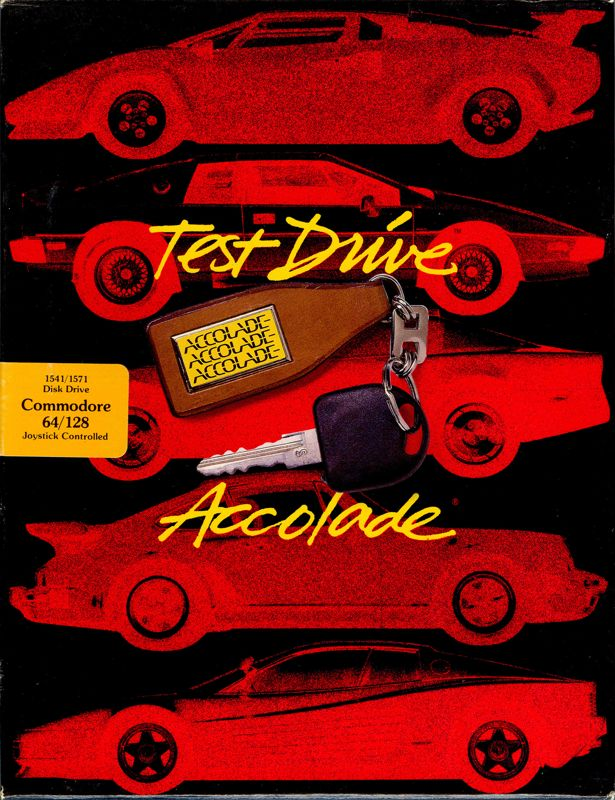
Test Drive for the Commodore 64 is a 1987 first-person driving game from Distinctive Software, published by Accolade. It puts the player in the driver’s seat of an exotic sports car for a demanding run up a mountain road rather than a conventional race against a field of computer opponents. The C64 release is part of the original multi-platform launch of the game that began the long-running Test Drive series, and its central challenge is simple to describe but difficult to master: reach the top of the road as quickly as possible without turning a fast test run into a wreck, an arrest, or a mechanical disaster.
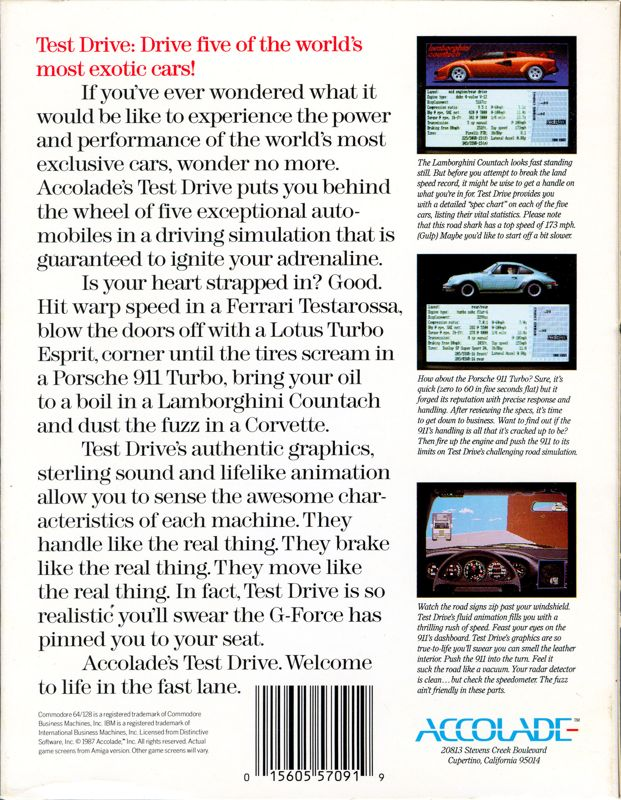
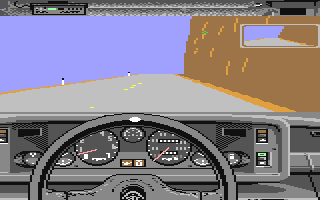
The game frames the outing as a fantasy visit to a dealership after the player character has struck it rich. Five high-performance cars are available at the selection screen, each presented with its own performance specifications. After choosing a vehicle, the drive begins on “The Rock,” a lengthy mountainous stretch intended to test both speed and control. The road is viewed from inside the car, with the dashboard and windshield forming the player’s frame on the journey. That cockpit presentation makes the changing road, surrounding traffic, and instruments part of the experience rather than mere scenery.
Driving in Test Drive on Commodore 64 is built around steering, acceleration, braking, and manual gear changes. The joystick accelerates or reverses with an upward movement and brakes with a downward one, while left and right steer the car; combining the fire button with up or down changes gears. The driver must select the appropriate gear and manage engine speed instead of simply holding down an accelerator. A display option can switch the C64 version to a digital readout, while keyboard commands handle functions such as pausing, restarting, and toggling music or sound effects.
The climb is complicated by hazards that demand attention at high speed. Potholes, wet patches, and slower road users can cost momentum or cause crashes, so finding a clear line through traffic matters as much as raw pace. A failed run does not end immediately: players have five chances to reach the “Top of the Rock,” continuing after a mishap by pressing the fire button. This structure turns the route into a test of repeatable car control, memory of dangerous stretches, and the willingness to balance a quick run against the limited number of attempts.
Police surveillance provides one of Test Drive’s most distinctive pressures. A radar detector mounted near the windshield warns of approaching traps with beeps and flashing red LEDs. When all of the lights are active, the Highway Patrol has measured the car’s speed. Slowing down and complying is the safe response, but a player who tries to escape may shake the pursuing officer or be forced to stop. Attempting to pass a patrol car is especially risky, as colliding with it sends the driver to jail and ends the game. The feature gives the road a different tension from a pure time trial: the fastest choice is not always the one that preserves the run.
Distinctive Software’s team included designers and programmers Don Mattrick, Mike Benna, Kevin Pickell, Bruce Dawson, Amory Wong, and Brad Gour; Patrick Payne is credited for sound and music. Accolade released Test Drive for the Commodore 64 alongside versions for other contemporary home computers, with the manual specifying a joystick in port two for the C64/128 edition. Although later Test Drive games expanded the brand in many directions, this first entry established its identity around licensed-feeling exotic-car aspiration, a driver’s-eye viewpoint, and the hazard-filled challenge of keeping a powerful machine under control on an open road.
Gallery
Details
- Developer
- Distinctive Software
- Publisher
- Accolade
- Genre
- Racing & Driving
- Players
- 1
- Release Date
- January 1, 1987
- System
- Commodore 64