About
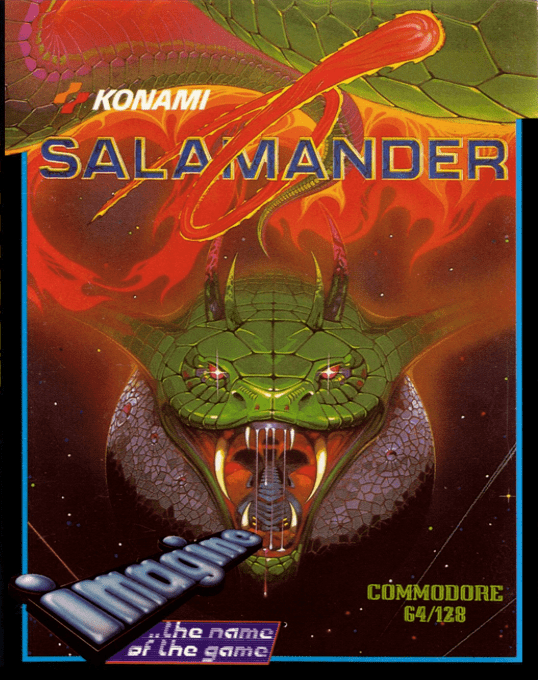
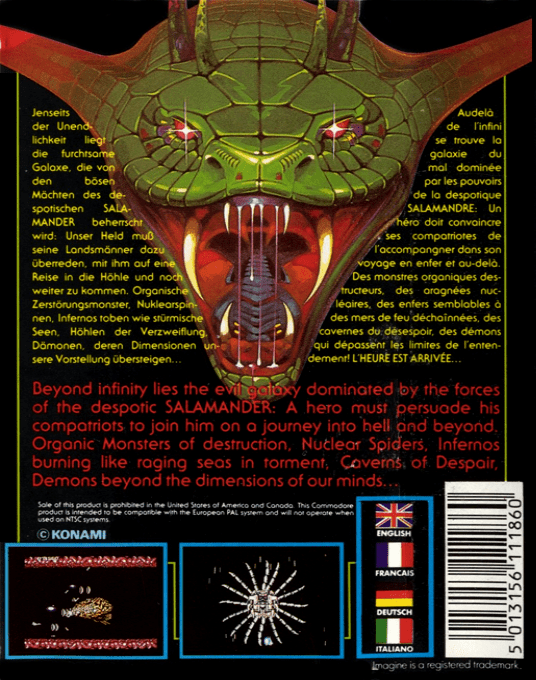
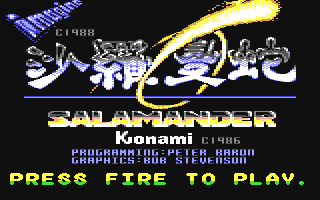
Salamander for Commodore 64 is a 1988 licensed conversion of Konami's 1986 arcade scrolling shooter, released in Europe by Imagine Software. The original arcade game belongs to the wider Gradius family, but this home-computer edition is its own compact adaptation for Commodore's 8-bit machine. Credited to Peter Baron in contemporary C64 catalogues, it sends a lone starfighter into the territory of the hostile Salamander force, whose final command centre must be destroyed. The result is a science-fiction shoot 'em up built around precise movement, memorising enemy formations, and improving a fragile ship before the next hazard arrives.
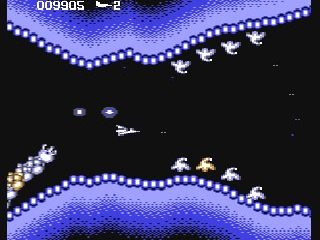
The Commodore 64 game is organised into four long levels rather than the arcade original's six. Its route shifts between horizontal and vertical scrolling and moves through sharply different danger zones, from open space and enemy attack waves to constricted passages, organic-looking defences, flames, and mechanical obstacles. Each stage is divided into changing stretches of terrain instead of being a single uninterrupted backdrop. A major enemy blocks the way forward at the end of each level, so survival depends on reading both the scrolling environment and the pattern of incoming fire.
Control is deliberately direct. A joystick in port 2 steers the ship in all directions and its fire button launches the current weapon; the keyboard can pause play or toggle the music. The player begins with a limited supply of ships, and a lost ship means trying again with less protection. The display stays uncluttered, concentrating on the score and the remaining-ship indication when a replacement craft enters. That simple presentation keeps attention on positioning, which is especially important when the screen is crowded by opponents and landscape hazards.
Weapon collection gives Salamander its tactical rhythm. Early enemy formations can leave bonuses when an entire wave is cleared, encouraging players to take calculated risks rather than merely slip through. Pickups can strengthen the ship with faster movement, missiles, ripple-style lasers, defensive shields, and trailing multiples that add extra firepower. The manual stresses that these upgrades are valuable but not automatically safe: taking too many speed increases can make controlled flying harder, while a shield only absorbs a limited number of collisions. Learning when to collect an item, when to preserve a favourable position, and when to retreat from a dangerous formation is central to the game.
The C64 conversion preserves the arcade game's alternating-scroll identity while reshaping its scale for the home computer. Its four stages combine material from the larger game into a shorter campaign, and the play is notably more forgiving than the coin-operated version. Even so, its fixed enemy placements reward repeated attempts. A player who knows where a wave will appear can clear it for a useful bonus; one who drifts into a narrow section without the right weapon or speed may quickly lose a ship. That balance of rehearsal and immediate reaction makes each level feel like a route to master rather than a purely random battle.
Salamander also reflects an era when arcade publishers licensed prominent coin-op games to home-computer labels. Imagine released corresponding Spectrum and Amstrad versions in 1988, while the Commodore 64 edition earned particular attention among contemporary C64 coverage for capturing a fast arcade shooter on the platform. For players exploring the system's action catalogue, Salamander remains a focused Konami-inspired space assault: four demanding stages, identifiable bosses, collectible weapons, and a final push toward the enemy brain controlling the invasion.
Gallery
Details
- Developer
- Konami
- Publisher
- Imagine
- Genre
- Shoot 'em Up
- Players
- 1
- Release Date
- January 1, 1988
- System
- Commodore 64
/Rocket_Smash_EX.png)