About
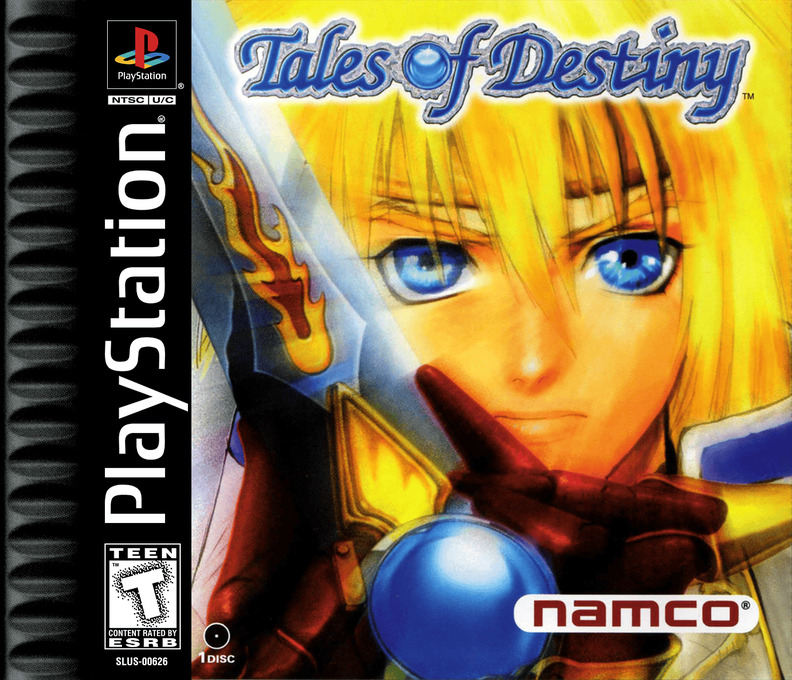
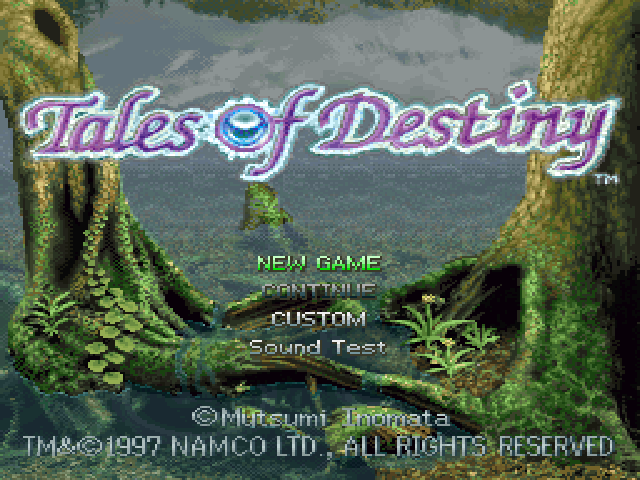
Tales of Destiny for PlayStation is a fantasy action role-playing game released by Namco in Japan in 1997 and in North America in 1998. Developed by Wolf Team, the group whose staff had also worked on Tales of Phantasia, it is the second main entry in the Tales series. The original PlayStation version combines illustrated 2D adventure scenes, character designs by Mutsumi Inomata, and animated sequences from Production I.G. Its defining idea is that the heroes’ weapons are not merely equipment: the central blades are conscious Swordians with their own voices, histories, and chosen wielders.
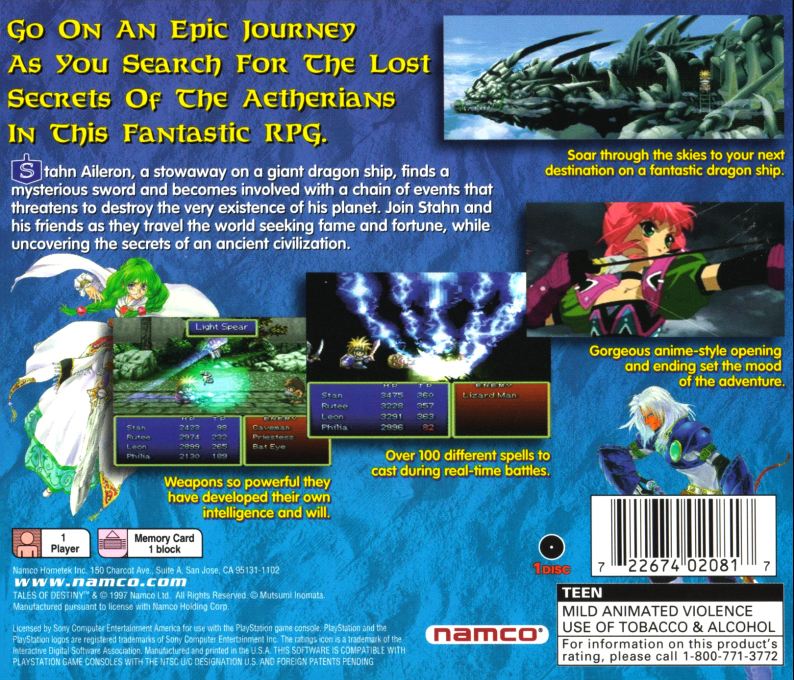
The story begins with Stahn Aileron, an eager young adventurer who stows away aboard the flying ship Draconis. When the vessel comes under attack, Stahn finds a discarded sword while trying to escape. The weapon identifies itself as Dymlos, a Swordian that has awakened after a long sleep. Their meeting draws Stahn into a conflict far larger than the fame and adventure he initially seeks. Along the way he joins forces with other travelers, including the Lens hunter Rutee Katrea, the gifted swordsman Leon Magnus, priestess Philia Felice, and Prince Garr Kelvin.
The game’s world is shaped by the distant Aeth’er Wars. A devastating comet brought the energy source called Lens, and an earlier civilization used it to create cities in the sky while much of humanity remained below. The resulting struggle between the sky-dwelling Aetherians and the Erthers ended only after the creation of Swordians, sentient elemental swords made to fight the former rulers’ power. In Stahn’s era, the ancient war is no longer common knowledge, but the reawakening of the Swordians and the powerful Eye of Atamoni make its consequences immediate again. This gives the adventure both a personal starting point and a long-buried history to uncover.
Tales of Destiny uses the Enhanced Linear Motion Battle System, an evolution of the real-time system introduced in Tales of Phantasia. Encounters play out on a two-dimensional battle plane rather than through conventional turn-based menus. The player directly controls one party member for movement, attacks, guarding, and assigned special techniques, while the remaining allies are run by AI. Before and during combat, players can set formations and battle behavior, choose which spells allies may use, issue orders, and switch the character under direct control. The structure makes party planning important even when the immediate action focuses on one fighter.
Regular strikes, ranged attacks, and special artes operate in real time, while spells require a casting period. Technical Points are spent on stronger techniques, and successful strings of hits can reward careful offensive timing. The command menu also remains available for items, magic, and party-wide instructions, allowing tactical adjustments without abandoning the fight. This blend of side-view action and role-playing systems—levels, hit points, spell resources, equipment, and a traveling party—sets the PlayStation game apart from slower menu-driven RPG battles of its era.
The original release is a single-player PlayStation adventure. It arrived first in Japan under the Japanese title Tales of Destiny, followed by a North American localization that retained Japanese character voices but used different opening music. That version should not be confused with the 2006 PlayStation 2 remake, which rebuilt the game with substantially changed presentation and combat, or with the 2008 Japanese-only Director’s Cut. The 1997 PlayStation game also led to the later PlayStation 2 sequel Tales of Destiny 2; in North America, the unrelated Tales of Eternia was released under the title Tales of Destiny II, making the distinction especially important for series history.
As an early Tales entry, Tales of Destiny established several series touchstones: an ensemble journey, dramatic animation, an emphasis on character interaction, and fast battles built around player input and AI teammates. Its Swordian premise also gives the adventure a distinct identity within the wider fantasy role-playing series. For players exploring the original PlayStation catalog, it represents a late-1990s Namco RPG that carries forward the experimental real-time approach of Tales of Phantasia while telling a self-contained story of Stahn, Dymlos, and the legacy of the Aeth’er Wars.
Gallery
Details
- Developer
- Namco
- Publisher
- Namco
- Genre
- JRPG
- Players
- 1
- Release Date
- September 15, 1998
- System
- PS1