About
Sid Meier’s Civilization on Super Nintendo brings the original empire-building strategy game to a cartridge. Beginning in 4000 BC, you choose a people and guide it from a tiny settlement toward a modern power, with the map, neighbours and course of history changing from game to game. It is a single-player contest measured in centuries: exploration opens new territory, settlement turns it into an economy, and every decision can shape the next era.
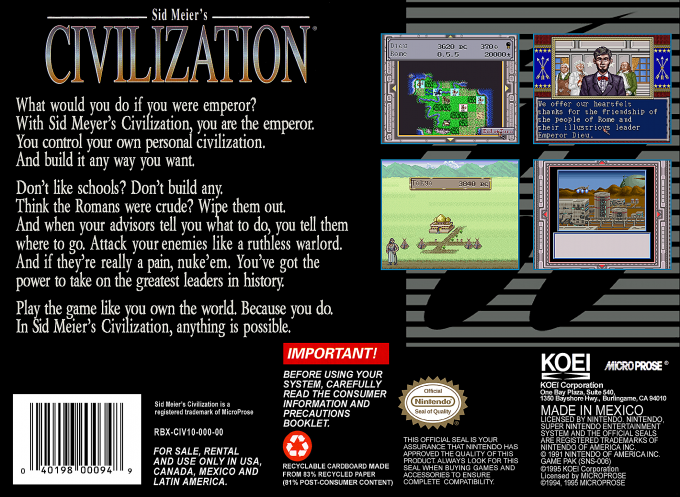
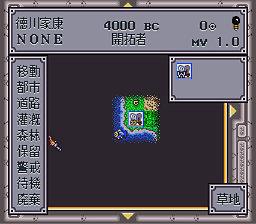
Play advances in turns. Scouts and settlers reveal the unknown map, while each unit is given orders before the calendar moves on. Founding a city establishes a base for growth and production, and the city screens let you direct what it is working toward. Buildings, military units and Wonders of the World compete for the same production, so expanding quickly can leave a frontier exposed while a strong garrison may delay a valuable improvement.
Science supplies the game’s long-term momentum. Choosing a new technology begins research along a broad chain of discoveries, unlocking new units, buildings, forms of government and possibilities for development. Progress from ancient tools to later industry and spaceflight is not merely cosmetic: it changes what an empire can build, how it travels, and how it defends itself. Managing growth, income and production across several cities gives the research choice real weight.
Other civilizations share the world, led by recognizable historical figures. Meetings can lead to negotiation, tribute, treaties, exchanges or war, and the diplomatic mood is never something to take for granted. Barbarians add another early hazard. Combat is turn-based and positional, with units moving across the map to defend territory, clear a route or attack a rival city; the outcome depends on the units involved and the terrain around them.
There are two decisive ambitions at the end of a long campaign. A player can remove every rival civilization from the map through conquest, or develop the technology and industry needed to build a spacecraft for Alpha Centauri. If neither conclusion arrives before the game’s end date, the civilization’s overall performance is assessed instead. That framework makes peaceful expansion, technological focus and military pressure viable approaches rather than separate modes.
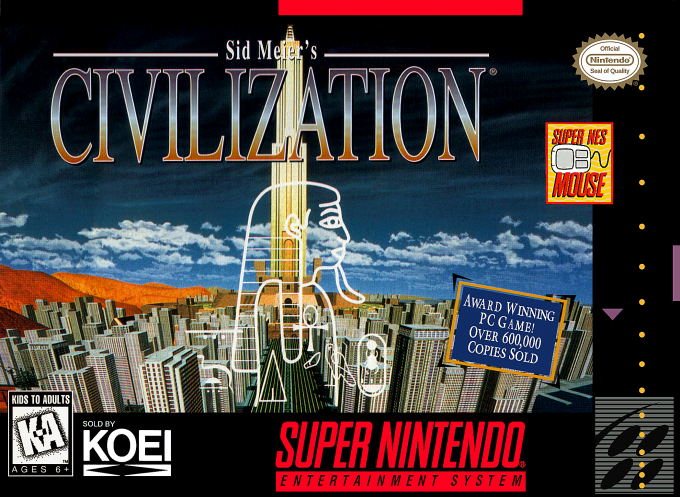
This is the foundational Civilization, designed by Sid Meier and Bruce Shelley at MicroProse before the series gained the systems and victory types introduced by later entries. The SNES edition keeps its enormous historical sweep but translates the computer game’s information-heavy play to a gamepad-driven interface of map views, cursors and separate management screens. It also supports the SNES Mouse, and battery-backed saving suits the campaign-length games.
The console release was handled as a port by Asmic Software: it appeared in Japan through Asmik in 1994 and in North America through Koei in 1995. The result is an unusually ambitious strategy game for the system, asking for patience and planning rather than fast reflexes. Its essential appeal is the accumulation of consequences: a city placed near a river, a technology selected many turns ago, or one choice at a diplomatic meeting can still matter far into the future.
Gallery
Details
- Developer
- MicroProse
- Publisher
- Koei
- Genre
- Turn-Based Strategy
- Players
- 1
- Release Date
- November 1, 1995
- System
- SNES