About
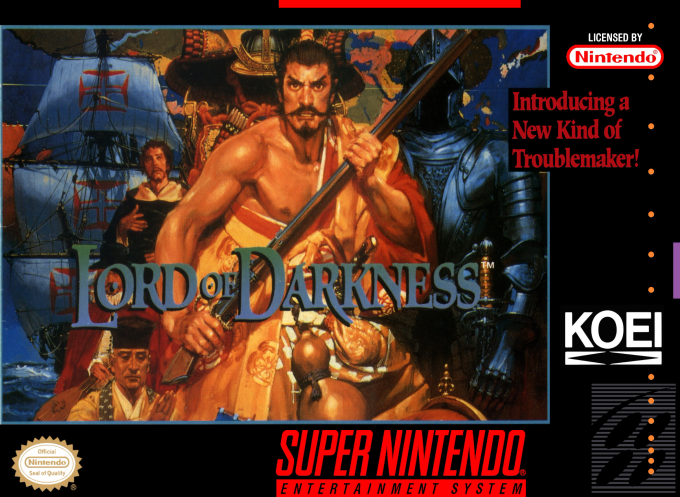
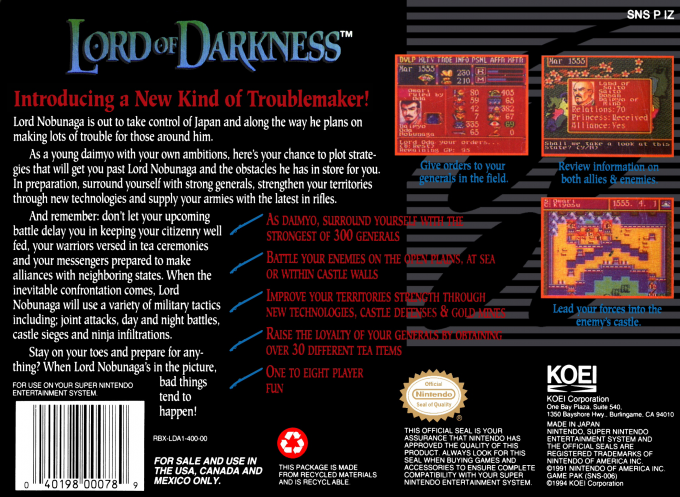
Lord of Darkness SNES is Koei's historical grand-strategy game, released in North America in 1994 as Nobunaga's Ambition: Lord of Darkness. It is the localized Super Nintendo version of Nobunaga no Yabo: Bushou Fuunroku, the fourth main entry in the long-running Nobunaga's Ambition series. Set in Japan's Sengoku, or Warring States, era, it casts players as competing daimyo whose ambition is to bring the fractured country under one banner.
Rather than following a single fixed protagonist, a campaign begins by choosing a ruler and faction. The game offers two large historical starting points: The Warring States in 1555, when Oda Nobunaga controls only Owari, and Nobunaga Surrounded by His Enemies in 1571, when his expanding influence has made him a major target. Each position begins with a different balance of territory, personnel, resources, and nearby threats, so the choice of daimyo changes both the early priorities and the political map that must be overcome.
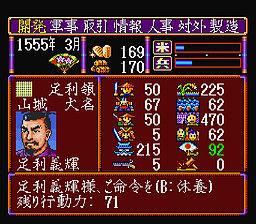
Lord of Darkness is played through menu-driven turns across a map of feudal states. A ruler must build an economy capable of feeding soldiers and raising revenue while also tending to administration, trade, information gathering, personnel, diplomacy, and war. Armies can be recruited, trained, moved, and committed to battles as rival domains are challenged. The larger objective is conquest, but military expansion depends on the steady management of the land and the people who support it.
Koei's fourth installment gives culture and technology a conspicuous place beside traditional battlefield planning. Tea ceremonies and the collection of tea utensils form part of the cultural side of a clan's development, while technological progress supports tools of war such as firearms and armored ships. Officers and their loyalty matter as well: retaining capable samurai, recruiting talent, and deciding who can be trusted with responsibility all shape the strength of a domain. These systems make a successful campaign about more than simply attacking the next province.
The Super Nintendo presentation adapts a dense historical simulation to a controller-based interface, with map screens, status displays, and command menus used to direct a clan through changing seasons. Up to eight people can take part by leading different factions, turning the contest for unification into a local multiplayer political struggle as well as a solo campaign. Lord of Darkness stands apart from the earlier localized Nobunaga games through its expanded nationwide scope and its emphasis on the cultural and technological choices that feed into power.
Its title can be misleading outside its series context: this is not a fantasy adventure, but a strategy game about the real historical period associated with Oda Nobunaga and his contemporaries. The North American subtitle distinguishes it from other releases named simply Nobunaga's Ambition, while the Japanese name Bushou Fuunroku identifies the same fourth-series chapter. Later remakes on Game Boy Advance and Nintendo DS revisited this installment, but the SNES version remains a focused 16-bit interpretation of Koei's ambitious campaign to unify Japan.
Gallery
Details
- Developer
- Koei
- Publisher
- Koei
- Genre
- Turn-Based Strategy
- Players
- 1-8
- Release Date
- January 1, 1994
- System
- SNES

/Wizardry_I-II-III_Story_of_Llylgamyn.png)