About
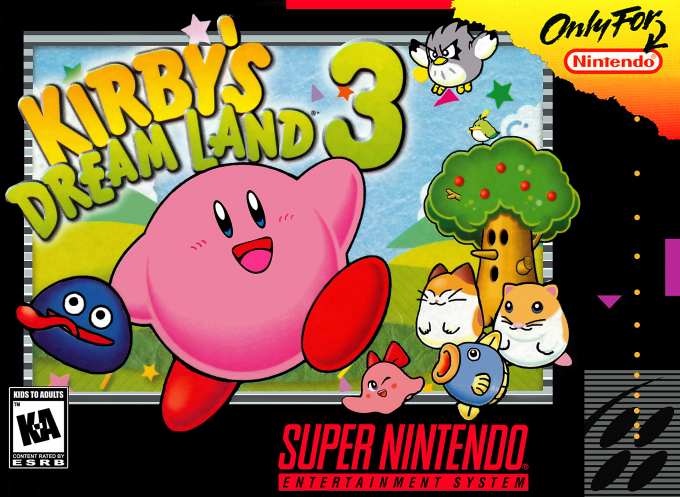
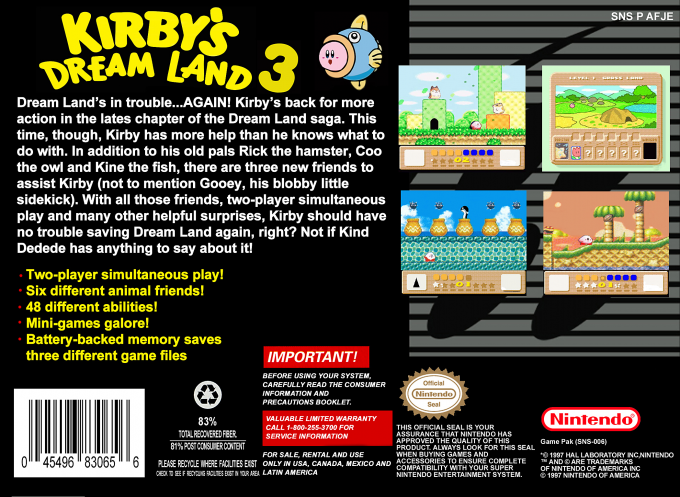
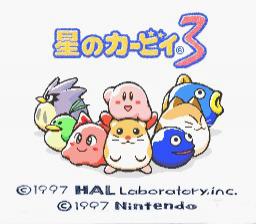
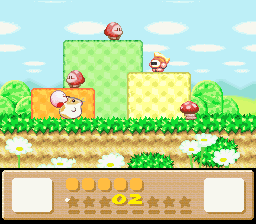
Kirby’s Dream Land 3 for the Super Nintendo Entertainment System is a side-scrolling platform game developed by HAL Laboratory and published by Nintendo. It arrived in North America in late 1997, with the Japanese Super Famicom release following in 1998 as Hoshi no Kirby 3. The game returns Kirby to Planet Popstar and continues the strand of the series associated with Kirby’s Dream Land 2, placing familiar allies and the invading Dark Matter at the center of a gentle-looking adventure with a more ominous problem beneath it.
The story begins while Kirby and Gooey are fishing on peaceful Popstar. A dark cloud breaks the planet’s rings and spreads its influence across the world, setting Kirby on a journey through a series of themed regions. King Dedede initially appears to be the source of the trouble, but the adventure gradually establishes that another force is involved. The premise gives each world a clear purpose while leaving the game’s emphasis on exploring colorful stages, rescuing friends, and uncovering the conditions for the complete ending.
Kirby’s basic SNES controls build on the series’ established platforming vocabulary. He walks, jumps, swims, floats through the air, inhales enemies, and can spit swallowed foes back as stars. Inhaling certain opponents grants a Copy Ability, allowing Kirby to attack or interact with the environment in different ways. These powers are not simply combat tools: stages hide obstacles and optional challenges that call for the right approach, encouraging players to notice the abilities and allies available in each area.
A defining feature of Kirby’s Dream Land 3 is its expanded group of Animal Friends. Returning companions Rick, Coo, and Kine are joined by Nago, Pitch, and ChuChu, and each changes how Kirby moves through a level. One partner may improve travel on land or in water, another may provide a different route through the air, and some can alter how a Copy Ability works. The combinations give the game’s stages extra variety and make their secrets feel tied to the personalities and strengths of Kirby’s companions rather than to a single universal move set.
The game also lets Kirby call Gooey, his blue, long-tongued friend. Gooey can be controlled by the computer in solo play or by a second player, making Kirby’s Dream Land 3 a two-player Super NES experience. Like Kirby, Gooey can deal with enemies and participate in the journey, while the arrangement keeps the focus on cooperation within the same scrolling stages. Alongside the main route, the worlds contain Heart Star objectives with small scenario-like tasks; completing them all opens the path to the game’s full conclusion and its ultimate confrontation with the Dark Matter threat.
Visually, the SNES game is known for its soft, hand-drawn presentation, with rounded characters, pastel scenes, and large illustrated backdrops that contrast deliberately with its cosmic villain. HAL Laboratory’s late-era Super Nintendo production also uses the cartridge’s SA-1 enhancement chip. Its late North American launch made it one of Nintendo’s final original SNES releases in that region, while its PAL release was delayed until later Virtual Console services. Kirby’s Dream Land 3 was subsequently included in Kirby’s Dream Collection: Special Edition and later made available through Nintendo’s subscription catalog, preserving this Animal Friends-focused chapter between Kirby’s Dream Land 2 and Kirby 64: The Crystal Shards.
Gallery
Details
- Developer
- HAL Laboratory
- Publisher
- Nintendo
- Genre
- Platformer
- Players
- 1-2
- Release Date
- November 27, 1997
- System
- SNES
/Dragon_Ball_Z_Super_Butouden.png)