About
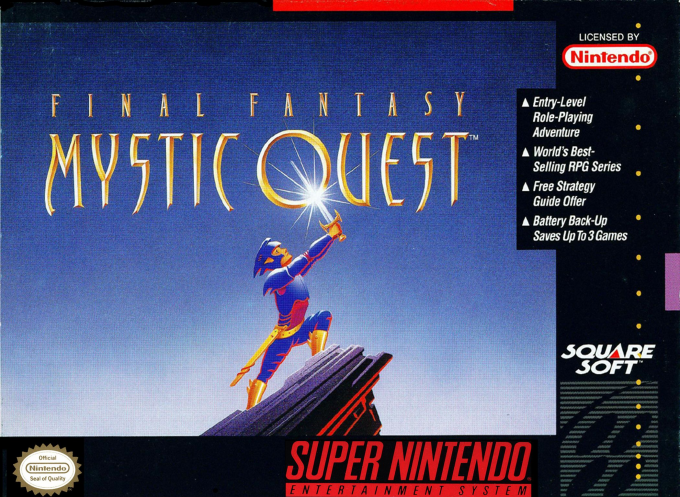
Final Fantasy Mystic Quest for the Super Nintendo Entertainment System is Square's 1992 role-playing game built as an approachable entry in the Final Fantasy series. Released in Japan as Final Fantasy USA: Mystic Quest and in PAL territories as Mystic Quest Legend, it places the young adventurer Benjamin in a world destabilized after four elemental crystals are taken. Rather than presenting a large party and dense character-building systems, the SNES game follows Benjamin through a focused quest to restore the forces of earth, water, fire, and wind.
The journey begins after an earthquake destroys Benjamin's home, drawing him into a prophecy and toward the central Focus Tower. From there, the story moves through the troubled regions of Foresta, Aquaria, Fireburg, and Windia. Benjamin meets allies including Kaeli, the axe-wielding resident of Foresta; Phoebe, a companion with magical ability; Reuben; and the treasure hunter Tristam. These companions join temporarily at different points, while the stolen crystals and the monsters guarding them give the adventure its clear sequence of goals.
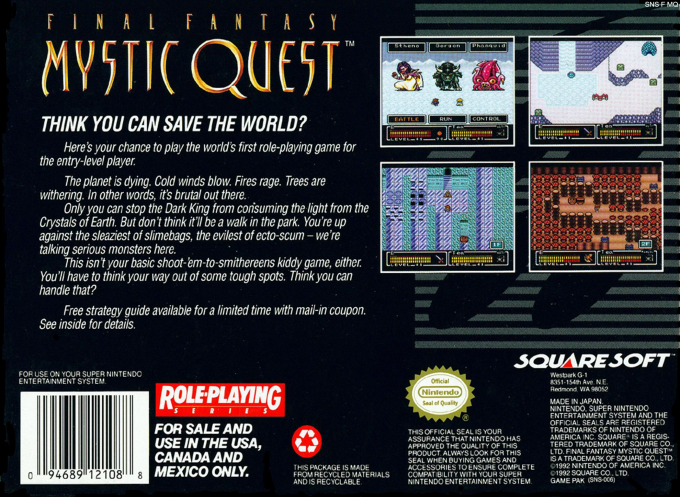
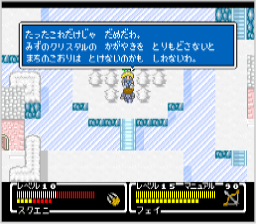
Mystic Quest uses a top-down view for towns, caves, towers, and other locations, but its overworld travel is structured around linked destination icons instead of unrestricted wandering. Open paths lead to new areas as tasks are completed, so dungeon progress directly expands the route forward. The game deliberately removes random encounters: enemies appear visibly in the field, allowing players to approach them or avoid them when possible. Battlefields also contain groups of encounters that can be cleared for rewards such as experience, money, armor, or magic.
Combat is turn-based and menu-driven, with Benjamin and a current companion facing enemies on a separate battle screen. The player can attack, cast magic, use items, defend, or attempt to run, and can choose whether the companion acts under direct control or computer control. Health is shown with bars, while victories provide experience and gold. Equipment management is streamlined compared with many role-playing games of the period: new armor replaces older gear automatically, and Benjamin's collection of weapons serves both combat and exploration.
Those field tools are a defining feature of Final Fantasy Mystic Quest on SNES. Swords, axes, bombs, and claws each have uses beyond dealing damage. An axe can cut certain trees, bombs can break through barriers, and the claw can function as a grappling device to cross gaps. Benjamin can also jump in designated areas. These action-oriented interactions turn many dungeons into compact obstacle courses of switches, gaps, blocked passages, and simple environmental puzzles, with weapons unlocking the way as much as they improve battle options.
Magic is gained from treasure or rewards rather than assigned through a conventional spellcaster class, and spells are organized by type with limited uses. The game also permits saving during exploration, another part of its effort to keep progress accessible. Its compact systems, visible enemies, and direct objectives distinguish it from the more elaborate mainline Final Fantasy games released around the same era, while the elemental crystals, towns, dungeons, and boss encounters retain familiar role-playing foundations.
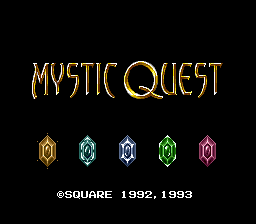
Square developed and published Final Fantasy Mystic Quest for the Super NES, initially releasing it in North America in October 1992 before Japanese and European editions followed in 1993. The regional names are especially important: the European title Mystic Quest Legend avoided confusion with the Game Boy game that had been called Mystic Quest in that market. The game later returned through Virtual Console releases, but its original identity remains that of a single-player SNES Final Fantasy spin-off designed around a concise, guided adventure.
For players exploring the Super Nintendo library, Final Fantasy Mystic Quest offers a self-contained route through an early-1990s Square RPG. Benjamin's mission moves from restoring local regions to confronting the force behind the crystal crisis, and each new destination adds a companion, dungeon challenge, or field ability to the voyage. Its distinctive mix of visible encounters, weapon-based exploration, and simplified role-playing mechanics makes it a notable branch of the Final Fantasy series rather than a conventional sequel to its numbered entries.
Gallery
Details
- Developer
- Squaresoft
- Publisher
- Squaresoft
- Genre
- JRPG
- Players
- 1
- Release Date
- October 5, 1992
- System
- SNES