About
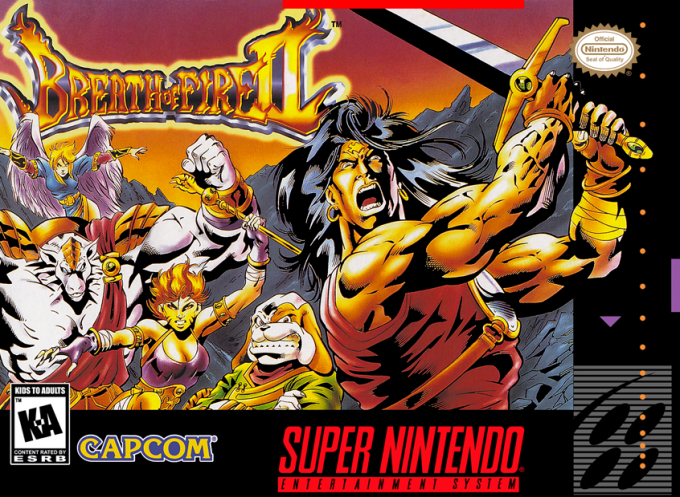
Breath of Fire II for the Super Nintendo Entertainment System is Capcom's turn-based role-playing sequel, originally released for Super Famicom in Japan in December 1994 and for the SNES in North America in December 1995. Set 500 years after the first Breath of Fire, it follows the young Ranger Ryu, whose father and sister vanished when he was a child and whose village has somehow forgotten they ever existed. After his companion Bow is falsely accused of theft, Ryu leaves home to uncover the truth, beginning a long fantasy journey that gradually reconnects him with the Dragon Clan and the threats surrounding it.
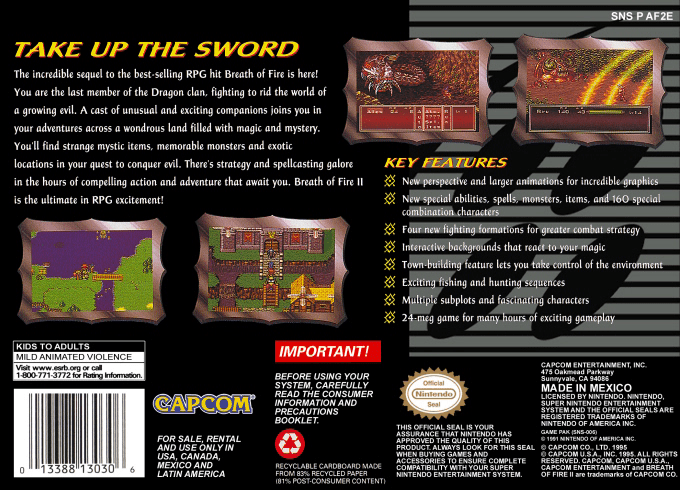
Exploration uses a top-down view as Ryu's group travels between towns, fields, caves, and story locations, speaking with residents, searching objects, and solving the practical problems that open the next route. The SNES controller keeps the essentials direct: the directional pad moves the party, face buttons confirm, cancel, open commands, and activate special functions, while the shoulder buttons help manage the party in the field and battle. A map command is available for navigation, and dragon statues provide the game’s cartridge-backed save points. Random encounters occur outside safe areas, with the Monster Meter indicating how likely an encounter is in the current region.
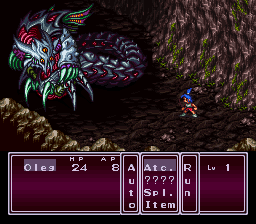
Battles shift to a separate perspective and are fought in turns. Up to four members form the active party, selecting attacks, spells, items, or defensive choices before agility helps determine the order in which actions play out. Victories award experience and strengthen the party through level growth, while formations let players arrange characters for different offensive, defensive, or speed-oriented advantages. The adventure recruits a varied cast with individual magic and field talents, so party composition matters beyond combat. Ryu’s own dragon transformations are a central source of power, and other companions can use personal actions to interact with obstacles, avoid hazards, or reach places that an ordinary party cannot.
The SNES Breath of Fire II also expands its role-playing systems with TownShip, a settlement built around Bow’s hideout. As Ryu encounters suitable residents on the journey, they can be invited to settle there, and donated funds can be used with different carpenters to shape its buildings. Six elemental Shamans add another tactical layer: joining them with party members can change a character’s form, improve attributes, and sometimes unlock different battle abilities. These systems sit alongside a quest that moves from small-scale Ranger work into a conflict involving demons, an influential church, and the mystery of Ryu’s missing family.
Capcom developed and published Breath of Fire II, with Tatsuya Yoshikawa designing its characters and Yuko Takehara composing its score. The Japanese release was titled Breath of Fire II: Shimei no Ko, while the English Super Nintendo version was handled by Capcom rather than the Square Soft-published North American edition of the first game. It later reached Game Boy Advance with interface and presentation changes, and the original-style game has appeared through Nintendo’s classic-game services, including Virtual Console and the Nintendo Switch SNES library. Those later versions make the sequel’s place in the series easier to revisit, but the SNES release remains the foundation for its world, party systems, and ambitious follow-up to the original adventure.
For players seeking a 16-bit Capcom RPG, Breath of Fire II combines a large connected journey with a deliberately varied party and several systems that reward attention away from the main battle menu. Its Ranger premise gives the opening a grounded purpose before the story broadens, while TownShip development, Shaman fusion, formations, personal actions, and dragon powers give the SNES adventure multiple ways to approach its challenges. The result is a direct sequel that preserves the series’ fantasy role-playing framework while building a more expansive journey around Ryu and his companions.
Gallery
Details
- Developer
- Capcom
- Publisher
- Capcom
- Genre
- JRPG
- Players
- 1
- Release Date
- December 1, 1995
- System
- SNES