About
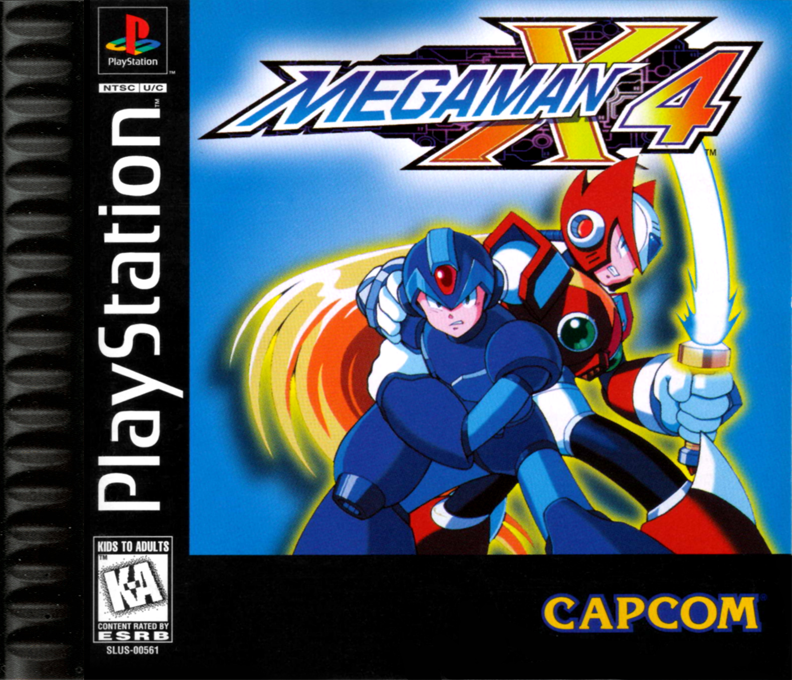
Mega Man X4 for PlayStation is Capcom's 1997 action-platform game and the fourth numbered entry in the Mega Man X series. Known in Japan as Rockman X4, it brought the series' fast, stage-based 2D design to Sony's 32-bit console while retaining the futuristic conflict between humans, Reploids, and Maverick Hunters. Players choose X or Zero before beginning; that decision determines the hero, story scenes, abilities, and several boss encounters for the entire campaign. The PlayStation release arrived alongside the Sega Saturn version in Japan, with PlayStation editions also reaching North America and Europe.
The campaign opens after an attack sends the floating city Sky Lagoon crashing into the city below. Suspicion falls on Repliforce, a powerful Reploid military organization, after its commander Colonel refuses to disarm for questioning. The resulting standoff grows into a bid for Reploid independence, and X and Zero are sent to confront eight Maverick allies of Repliforce. Their missions can be selected in different orders from a central stage screen, a series hallmark that lets players choose their next challenge and prepare for difficult bosses in their own way.
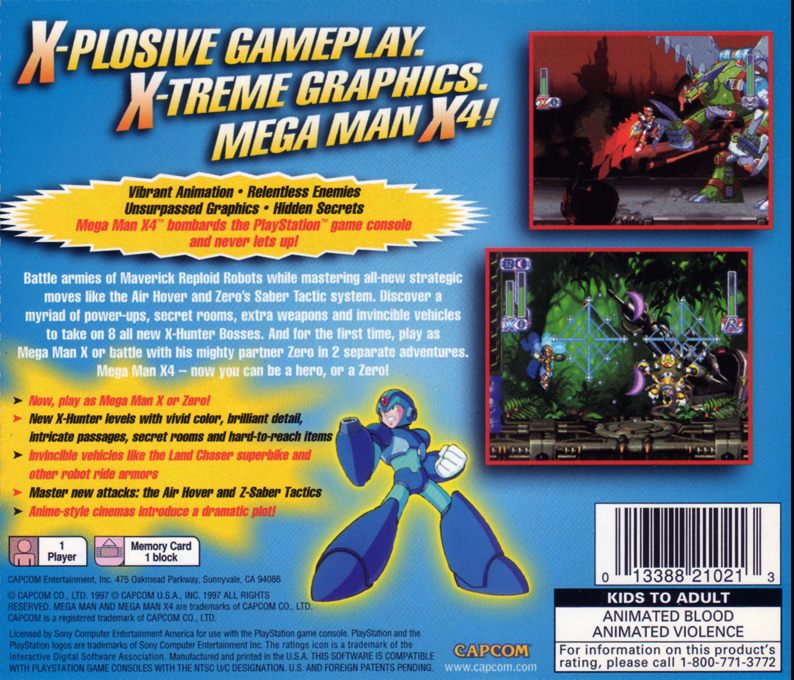
Each level combines running, jumping, wall climbing, dashing, enemy fire, hazards, and a final boss battle. The PlayStation game ranges across industrial facilities, jungles, frozen areas, military bases, and other science-fiction locations, with animated introductory and story sequences framing the action. Hidden upgrades reward exploration: Heart Tanks raise maximum energy, Sub Tanks store recovered health for later use, and some stages include Ride Chasers or Ride Armors that change the pace with vehicle sections. Defeating bosses advances the story and gives X access to new special weapons suited to particular situations.
X plays as the ranged specialist. His X-Buster can fire standard shots or charge for stronger attacks, and the weapons earned from bosses use limited energy. Capsules hidden through the stages can upgrade his armor, improving selected abilities and opening different tactical options. Zero instead relies on the close-range Z-Saber and is designed as a more mobile, technique-driven fighter. He does not collect X's boss weapons or armor parts, but boss victories teach him sword techniques and movement skills. Playing the same route as both characters therefore changes not only the dialogue and dramatic focus but also the way players approach enemies, spacing, and bosses.
Mega Man X4's plot places Repliforce's leaders General, Colonel, and Iris at the center of a conflict that is not initially presented as a simple struggle against obvious villains. X's route introduces the rookie Hunter Double, while Zero's has a more personal connection to Iris and revisits questions surrounding his past. As the campaign reaches Repliforce's spaceborne Final Weapon, the familiar Maverick Sigma is revealed to have manipulated the crisis for his own purposes. The separate scenarios share the same broad events but give the two Hunters distinct emotional stakes and confrontations.
For the PlayStation version, Capcom paired hand-drawn 2D stages and character sprites with full-motion animated cutscenes, giving the series a more cinematic presentation than its earlier 16-bit entries. The game was developed and published by Capcom, with Keiji Inafune serving as producer, and the animated sequences were produced by Xebec. Its first full campaign built around a playable Zero was an important expansion of the Mega Man X formula: earlier Mega Man X3 had allowed limited use of him, whereas Mega Man X4 makes either character a complete choice from the start.
Mega Man X4 later appeared in several re-releases, including Mega Man X Collection and Mega Man X Legacy Collection, but the 1997 PlayStation original remains a defining console version of the game. It preserves the pick-a-stage structure, demanding boss patterns, collectible upgrades, and twin-protagonist design that connect it closely to Mega Man X, Mega Man X2, and Mega Man X3 while setting up the series' PlayStation-era sequels. For players looking for Mega Man X4 on PS1, its central appeal lies in two genuinely different character styles moving through the same large-scale Repliforce crisis.
Gallery

Details
- Developer
- Capcom
- Publisher
- Capcom
- Genre
- Platformer
- Players
- 1
- Release Date
- July 15, 1997
- System
- PS1