About
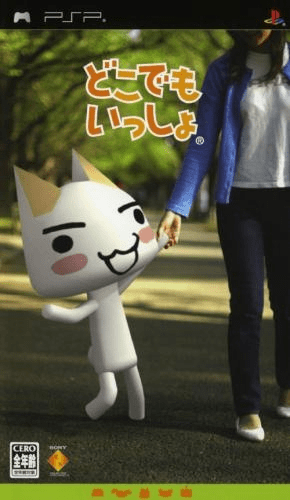
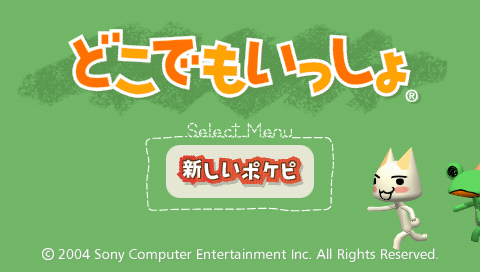
Dokodemo Issho brings Sony’s distinctive conversation game to the PlayStation Portable as a 2004 remake of the original PlayStation hit. Released in Japan by Sony Computer Entertainment, this version keeps the series’ gently playful premise intact: rather than pursuing combat, racing, or a conventional adventure, the player builds a relationship with one of the Pokepi, the small “Pocket People” who live inside the game. Its title can be read as “Together Everywhere,” an especially fitting idea for a series first associated with the PocketStation and then reshaped for Sony’s new handheld.
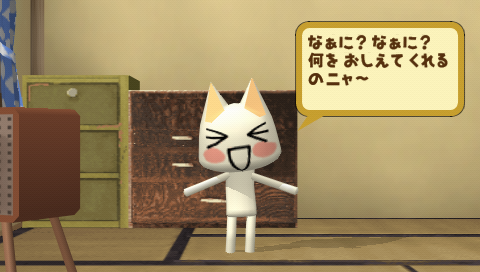
At the start, the player chooses a companion from the familiar group of five Pokepi. The best-known is Toro Inoue, the upright white cat who went on to become a major PlayStation mascot in Japan, but the appeal comes from seeing each character respond in its own manner. The game frames its interactions around everyday companionship. Players visit their Pokepi, talk, teach words and meanings, and gradually encounter dialogue shaped by the vocabulary they have supplied. The Pokepi do not simply repeat entries; they ask about their meaning and use them in conversation, making player input part of the game’s personality.
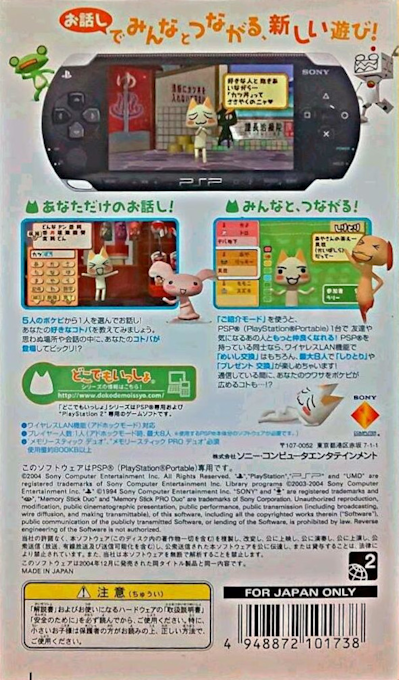
That word-learning system is the core of Dokodemo Issho. A player’s chosen phrases can produce affectionate, absurd, or unexpectedly funny exchanges as the characters try to understand what they have been taught. The PSP edition broadens this side of the game by allowing kanji in taught words and by providing a word memo for reviewing the vocabulary already entered. These changes make the portable remake more flexible for Japanese-language input while preserving the deliberately low-pressure rhythm that defined the original. It is a game about checking in, answering questions, and discovering how a companion’s small reactions can make a simple routine feel personal.
The PSP remake also changes the setting around those conversations. In addition to the Pokepi’s room, it introduces outings, allowing the player to visit places beyond the home space. During these excursions, Kuro, the series’ black-cat character, can appear and give souvenirs. Those keepsakes can be displayed in the room or exchanged through communication features, adding a collectible and social layer to the basic conversation loop. The original game’s PocketStation concept was built around taking a virtual companion away from the television; on PSP, the same idea becomes native to the hardware, with a complete handheld system supporting the relationship.
Communication is one of the remake’s most important additions. Sony’s pre-release PSP presentation described an “introduce friends” feature through which Pokepi could be introduced to other players and exchange learned-word data. The handheld’s wireless functions let players communicate with other Pokepi while away from home, fitting the series’ focus on shared vocabulary and small personal details. Instead of treating connectivity as competitive multiplayer, Dokodemo Issho uses it to circulate the language and souvenirs that give each player’s companion a slightly different character.
The move to PSP also gave the game cleaner, more colorful character presentation than the 1999 PlayStation original. The remake adds background music, although it changes the soundscape that had helped the earlier version suggest a lived-in room through ambient noises. Some original activities, including gifts and quizzes, do not return, so the PSP version is not a one-for-one replacement in every respect. It is best understood as a refreshed interpretation: a more accessible portable edition that expands word entry, travel, collecting, and local communication while retaining the central pleasure of spending time with a Pokepi.
Dokodemo Issho occupies an unusual place in PlayStation history because its most memorable action is conversation. The original game’s success helped establish Toro as an enduring symbol of the brand in Japan, and the PSP remake carries that character-driven identity into the handheld’s early library. For players interested in Japanese-only PlayStation curiosities, virtual-pet design, or the origins of Toro and the Pokepi, it offers a calm, charming example of a game built around language, routine, and the feeling of taking a tiny companion along wherever you go.
Gallery
Details
- Developer
- Sony Computer Entertainment
- Publisher
- Sony Computer Entertainment
- Genre
- Life Simulation
- Players
- 1
- Release Date
- December 16, 2004
- System
- PSP