About
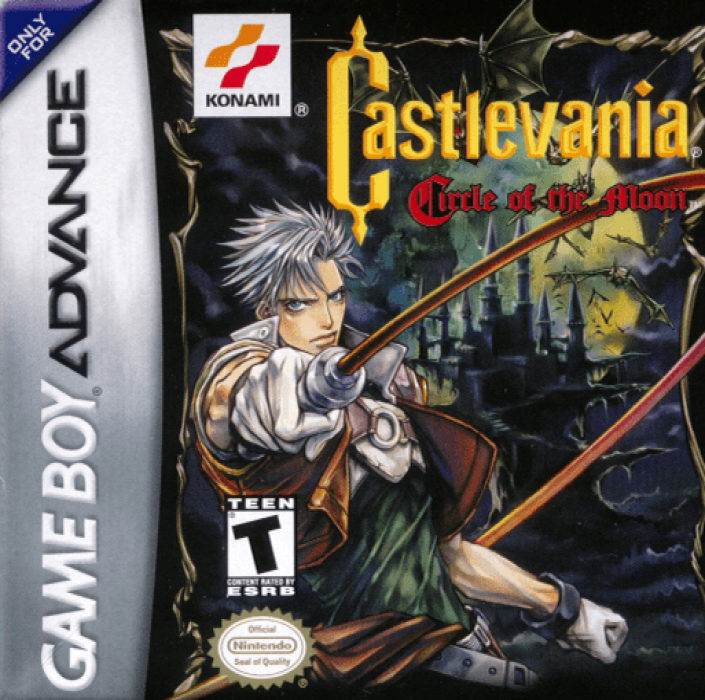
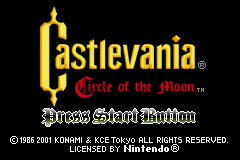
Castlevania: Circle of the Moon for Game Boy Advance is Konami's 2001 action-exploration adventure, released in Japan as Akumajo Dracula: Circle of the Moon and as simply Castlevania in PAL territories. Arriving with Nintendo's new handheld in Japan and North America, it places a whip-wielding vampire hunter in Dracula's vast castle for a self-contained chapter of the long-running series. The game combines side-scrolling combat with a connected world that gradually opens as its hero gains the tools and abilities to reach new rooms.
The story begins in 1830, when Camilla brings Dracula back at a castle outside Austria. Veteran hunter Morris Baldwin and his students Nathan Graves and Hugh Baldwin arrive too late to halt the ritual. Morris is captured, while Nathan and Hugh are thrown into the castle's depths. Nathan must search the fortress, confront Dracula's followers, and rescue his mentor before the Count can recover his full strength. Hugh's jealousy over Nathan inheriting Morris's Hunter Whip adds tension to their shared mission.
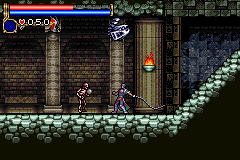
Nathan attacks primarily with the Hunter Whip, striking enemies ahead of him and using its motion to reach certain objects. Hearts collected from candles and defeated foes supply sub-weapons, including daggers, holy water, crosses, and axes. The castle is not a sequence of isolated levels: routes circle back through previously visited areas, and locked paths or unreachable ledges turn into accessible territory after key discoveries. A map records explored rooms, while save rooms and recovery points make continued expeditions through the castle practical.
Circle of the Moon also gives this adventure role-playing elements. Defeated enemies provide experience, allowing Nathan to grow stronger, and equipment can change his statistics. Its defining feature is the Dual Set-up System, or DSS. Enemies can leave behind Action and Attribute cards; pairing one from each group produces a different magical effect. Combinations can alter the whip, create protective or support effects, or call forth a summon, making the cards an important layer of experimentation alongside ordinary weapon use. Konami describes more than 80 resulting spell effects, from fire whips to ice-based attacks.
Exploration is therefore tied to both combat and discovery. The player reads the castle's layout, hunts for equipment and cards, and decides which tools best suit a difficult enemy or route. Bosses stand at major turning points, and familiar Castlevania imagery—undead creatures, candles, gothic corridors, and the looming threat of Dracula—frames an adventure built for repeated returns to earlier sections. Nathan's health, hearts, items, equipment, and selected DSS combination are all managed from the pause menu, while the Game Boy Advance controls keep movement, jumping, whip attacks, and sub-weapons close at hand.
Extra modes extend the original quest after completion or through file-select codes. They keep the same castle and protagonist but change Nathan's starting strengths and limits: one mode begins with the complete DSS card set, another removes DSS use in favor of greater physical power, and others emphasize sub-weapons or luck. These variations invite different approaches to the same routes and encounters rather than presenting separate campaigns.
Circle of the Moon marked the first Castlevania game for Game Boy Advance and helped establish the handheld's early library of large-scale action adventures. It later returned in the 2021 Castlevania Advance Collection with Castlevania: Harmony of Dissonance, Castlevania: Aria of Sorrow, and Castlevania: Dracula X. That collection adds modern conveniences such as save and load options, replay, rewind, a gallery, and a music player, while preserving Circle of the Moon's original 2D journey through Dracula's castle.
Gallery

Details
- Developer
- Konami
- Publisher
- Konami
- Genre
- Platformer
- Players
- 1
- Release Date
- June 11, 2001
- System
- GBA