About
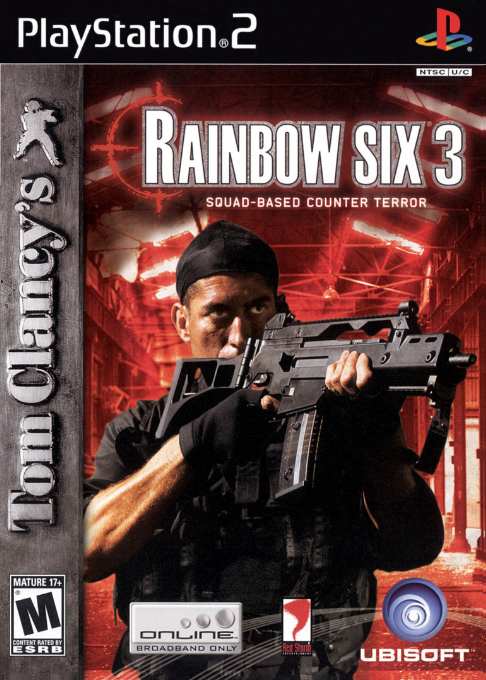
Tom Clancy's Rainbow Six 3 for PlayStation 2 is Ubisoft's 2004 tactical first-person shooter entry in the Tom Clancy's Rainbow Six series. Developed by Ubisoft Shanghai and published by Ubisoft, it brings the counter-terrorist premise to Sony's console as a tailored console game rather than a straight conversion of the Windows release subtitled Raven Shield. The North American PS2 edition arrived on March 24, 2004, with releases following in other territories.
The campaign puts players in the combat boots of Domingo “Ding” Chavez, the field commander of the multinational Rainbow counter-terrorist unit. A succession of attacks linked to Venezuelan oil exports and political instability sends the team from one urgent operation to the next. The story eventually points toward a plot involving presidential candidate Juan Crespo, his associates, and stolen chemical weapons, giving the missions a connected thriller framework instead of presenting them as unrelated exercises.
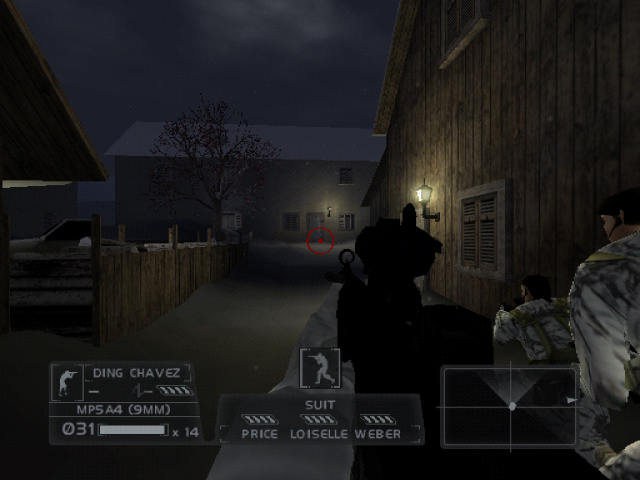
Each operation is played from the first-person perspective, with Chavez leading three computer-controlled specialists: Eddie Price, Louis Loiselle, and Dieter Weber. Rather than the extensive pre-mission planning associated with earlier PC Rainbow Six games, the PlayStation 2 version emphasizes real-time squad leadership. The player moves with the team, aims and fires weapons, watches angles, and issues practical commands such as moving, holding position, opening doors, clearing rooms, or using grenades. Careful room entry and communication matter because enemies can be dangerous at close range, while the squad AI can take cover and react to threats alongside the player.
The PS2 campaign contains 15 missions, including an additional scenario beyond the earlier console material. Briefings and cinematic scenes set up operations that range across urban interiors, industrial sites, and other high-risk locations. Weapons and equipment support the series' methodical tone, giving players a selection of firearms and tactical tools for close-quarters engagements. The console version is more forgiving than the contemporary PC game in one important respect: Chavez and his teammates use visible health segments, allowing them to survive some damage instead of relying entirely on the one-hit lethality often associated with the series.
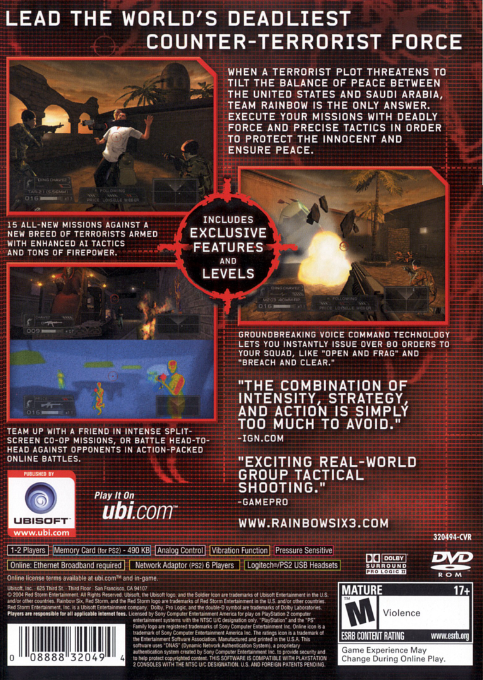
A defining PlayStation 2 feature is its headset support. With the appropriate hardware, players can use voice commands to direct AI teammates in the single-player game, reinforcing the feeling of commanding a unit while keeping the action in view. The feature sits alongside menu-based orders, so squad control remains part of the tactical loop even without spoken commands. That console-focused approach distinguishes this version from Raven Shield, whose planning tools, mission design, plot, and player control structure differ substantially.
Tom Clancy's Rainbow Six 3 on PS2 also expands its social options with a two-player split-screen cooperative mode, allowing two players to take on campaign action together on one console. Its multiplayer component was designed for both local competition and the PlayStation 2's online service, with several adversarial modes and PS2-specific maps. Ubisoft announced extra multiplayer maps for this edition, while the PS2 online mode supported fewer players than the original Xbox release. These details make the PS2 version a distinct branch of Rainbow Six 3 rather than simply the same game under a shortened title.
Released during the series' transition from detailed PC tactical planning toward more immediate console shooting, the PS2 edition preserves Rainbow's focus on team movement, controlled breaches, and counter-terrorist scenarios. It also stands apart from the Xbox-exclusive follow-up Black Arrow and the later Rainbow Six: Lockdown. For PlayStation 2 players, Tom Clancy's Rainbow Six 3 offers a self-contained 2004 campaign built around Domingo Chavez, AI squad coordination, voice-enabled commands, split-screen cooperation, and the close-range tension that defines this era of Rainbow Six.
Gallery
Details
- Developer
- Ubisoft
- Publisher
- Ubisoft
- Genre
- First-Person Shooter
- Players
- 2
- Release Date
- March 24, 2004
- System
- PS2