About
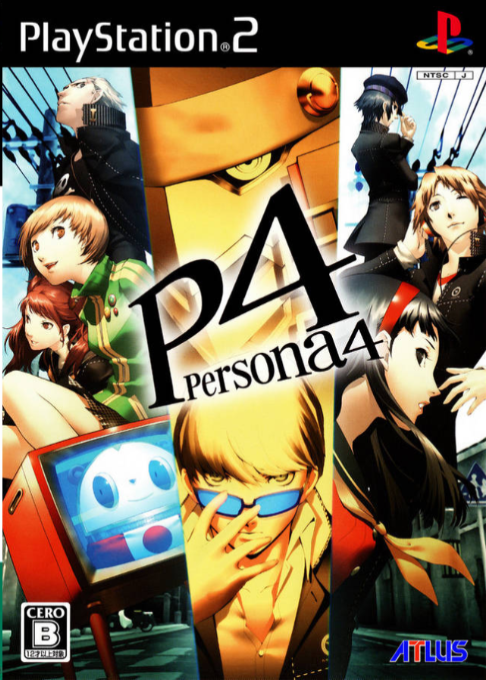
Persona 4 is the original PlayStation 2 role-playing game from Atlus, released in Japan on July 10, 2008. It arrived in North America as Shin Megami Tensei: Persona 4 on December 9, 2008, then reached Europe and Australia in March 2009. Atlus both developed the game and published it in Japan and North America; Square Enix handled the European PlayStation 2 release, while Ubisoft published it in Australia. Set in 2011, it follows a high-school student who moves from the city to the rural town of Inaba for a year, living with his detective uncle Ryotaro Dojima and young cousin Nanako. What begins as an unfamiliar new school life becomes a murder investigation after bodies are discovered hanging in impossible places.
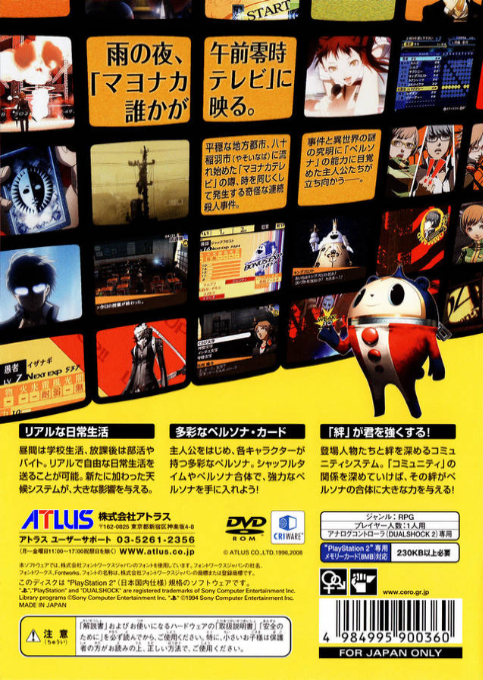
The mystery is rooted in the Midnight Channel, a local rumor claiming that someone will appear on a switched-off television during a rainy midnight. The protagonist, Yosuke Hanamura, and Chie Satonaka discover that televisions can lead to a hidden world, where a bear-like guide named Teddie helps them navigate. People who appear on the channel are in danger, and the group forms the Investigation Team to find them before the fog returns to Inaba. The case takes them through a small town shaped by its shopping district, school, family businesses, and changing weather, giving the supernatural investigation a deliberately everyday setting rather than placing it in a grand fantasy kingdom.
Its calendar structure divides each in-game day between school, free time, evenings, and major story events. Choosing how to spend limited time is fundamental: the protagonist can study, work part-time, join clubs, pursue hobbies, go shopping, or spend time with classmates and townspeople. These activities raise personal qualities such as Knowledge, Courage, Diligence, Understanding, and Expression, opening up dialogue options and opportunities elsewhere. Time matters because rescues have deadlines tied to the foggy weather; entering the TV World can consume a day, so planning dungeon expeditions around school life and relationships is part of the original game’s central rhythm.
Those relationships are represented by Social Links, each associated with a tarot Arcana. Spending time with a person advances that bond, reveals their concerns and growth, and provides practical benefits in the Velvet Room. When the protagonist fuses a Persona belonging to an Arcana with a stronger Social Link, it receives bonus experience. Social Links with party members also unlock combat-related abilities as they develop. The system makes the social side of Inaba more than an intermission between battles: friendships, family ties, and side stories directly support the player’s options in the role-playing side of the game.
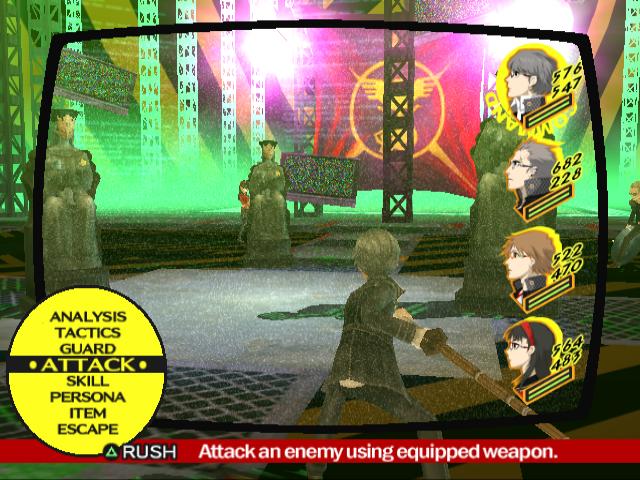
Inside the TV World, the team explores dungeon areas connected to people drawn into it. Floors are randomly generated, with roaming Shadows, treasure, equipment, stairs, and a boss encounter at the end. A four-person party fights in turn-based battles using weapons, items, and the elemental or support skills granted by Personas. Striking an enemy weakness or landing a critical hit knocks it down and earns an extra action; downing every enemy opens an All-Out Attack. The protagonist alone has the Wild Card ability, allowing him to carry and switch among multiple Personas. New Personas can be gained through post-battle Shuffle Time, registered for later use, or created by fusing two or more in the Velvet Room.
Personas are physical expressions of a character’s inner self, and the story ties their awakening to confronting emotions that have been denied or hidden. The party gradually includes Yosuke, Chie, Yukiko Amagi, Kanji Tatsumi, Rise Kujikawa, Teddie, and detective Naoto Shirogane, with each rescue and awakening adding both a companion and another perspective on Inaba’s murders. The narrative balances school comedy, family scenes, and a suspenseful search for the killer. Player choices can affect the outcome, including whether the group follows the evidence carefully enough to reach the original game’s fuller resolution, but the investigation is always driven by the team’s effort to reject easy answers and face the truth.
This description concerns the 2008 PlayStation 2 version, not Persona 4 Golden. Golden is an expanded PlayStation Vita edition first released in Japan in 2012, adding material such as the new character Marie, additional Social Links, extra story content, a new dungeon, and other changes; it later received releases on PC and modern consoles. It is also distinct from Persona 4 Revival, a separately announced remake. The original PS2 release remains the foundation: its Inaba setting, calendar-based life simulation, Social Links, television-world dungeons, Persona fusion, and murder-mystery story are the core design later versions build upon.
Gallery
Details
- Developer
- Square Enix
- Publisher
- Atlus
- Genre
- JRPG
- Players
- 1
- Release Date
- July 10, 2008
- System
- PS2