About
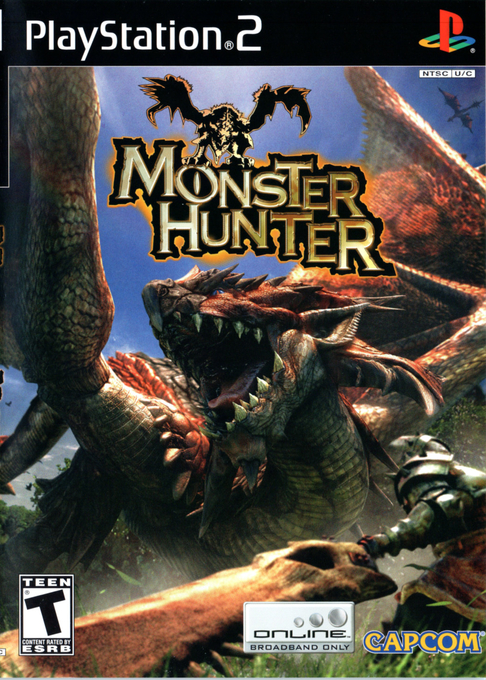
Monster Hunter is Capcom’s original 2004 PlayStation 2 action role-playing game and the first entry in the long-running hunting series. It casts the player as a newly arrived hunter in a fantasy wilderness where enormous creatures are both a danger and a source of materials. Rather than following a conventional character-leveling story, the game builds its progression around accepting assignments, learning the landscape, preparing supplies, and overcoming increasingly demanding prey. The North American PS2 release arrived on September 21, 2004, following the Japanese debut earlier that year.
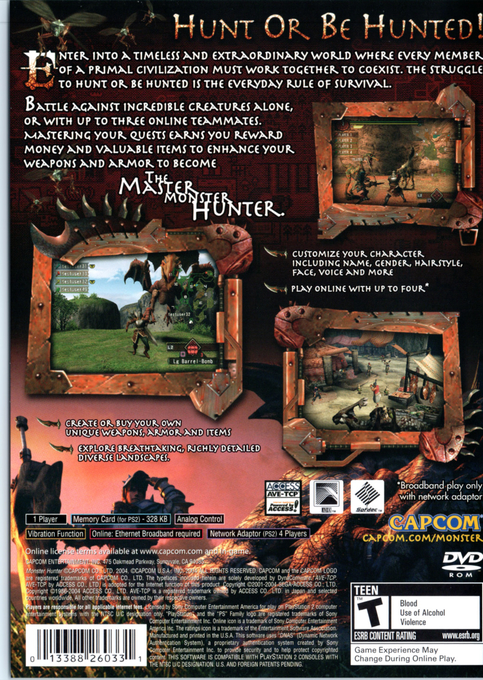
A hunter begins by creating an avatar, choosing details such as appearance and voice before taking work from the village and guild. Quests provide the structure for each outing: some ask for specific monsters to be defeated, while others focus on gathering resources, capturing a weakened target, or completing special objectives. Each mission has a time limit and a contract fee, so planning matters before leaving town. Success brings money, materials, and access to tougher assignments, while repeated defeats can end a hunt before its objective is met.
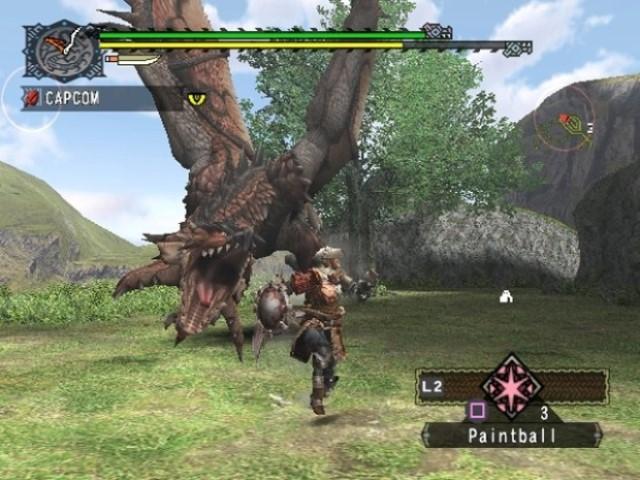
The core loop is built around observing a monster’s behavior and using the environment as much as a weapon. Players track targets across connected zones, watch for attacks, manage stamina, sharpen bladed equipment, and decide when to heal, retreat, or set a trap. Large creatures do not simply wait in an arena; they move through their habitats, fight back with distinct patterns, and can force a hunter to adapt when a plan goes wrong. This deliberate rhythm gives the original Monster Hunter a markedly methodical identity.
Equipment is central to that progression. Carving a defeated creature, collecting dropped parts, mining ore, fishing, and gathering plants all feed back into crafting and item preparation. Materials can be used to create stronger weapons and armor, while consumables such as healing items, traps, and other field tools are made by combining ingredients. The process makes each successful expedition useful beyond its immediate reward, as a difficult hunt may provide exactly the scales, claws, bones, or other components needed for the next upgrade.
The PS2 game allows hunters to choose from several melee and ranged weapon styles instead of permanently locking a character to one class. Sword and shield, great sword, lance, hammer, and bowgun options encourage different approaches to distance, defense, timing, and resource use. Armor is likewise tailored to weapon type and can offer protection or useful skills. Selecting a loadout before a mission is part of the challenge, especially when a monster’s elemental traits or behavior call for a different strategy.
Monster Hunter was designed during Capcom Production Studio 1’s push toward network-focused PlayStation 2 games. Its offline village content offers a solo route, but the larger online side was conceived around cooperation through the PS2 Network Adaptor. Up to four hunters could form a party to take on stronger monsters, share the pressure of a hunt, and pursue guild progression together. The original online service outside Japan closed in 2007, with the Japanese PlayStation 2 servers ending in 2011, making that network component an important part of the game’s historical context.
The international version also reflects an early example of the series evolving across regions. Dual Swords were added to the overseas PlayStation 2 release, while Japan later received the expanded Monster Hunter G in 2005. That revised edition was subsequently adapted for PSP audiences as Monster Hunter Freedom outside Japan. These related releases should not be confused with the original PS2 game: this version is the foundation that established the quest structure, material-driven equipment growth, and cooperative hunts that later entries developed further.
For PlayStation 2 players, Monster Hunter remains a formative Capcom adventure with a demanding, slower-paced approach to action. Its controls, camera, and early online design belong clearly to its era, but its ideas are already recognizable: study the target, prepare carefully, turn hard-won monster parts into better gear, and return to the field ready for a bigger challenge. It is both a standalone fantasy hunting RPG and the starting point for one of Capcom’s defining game series.
Gallery
Details
- Developer
- Capcom
- Publisher
- Capcom
- Genre
- JRPG
- Players
- 1
- Release Date
- September 21, 2004
- System
- PS2