About
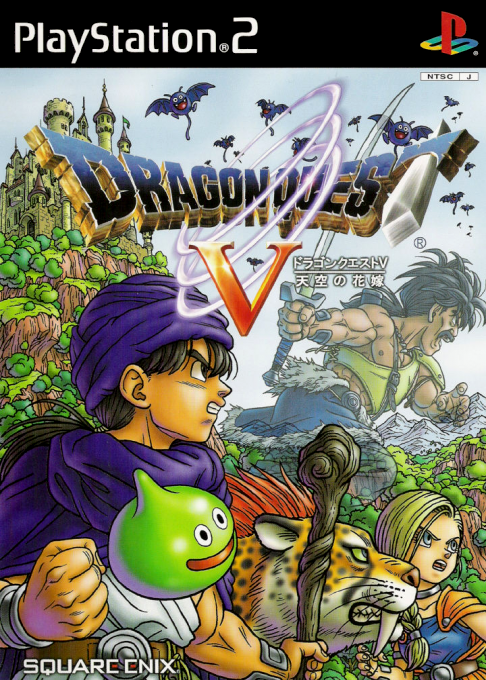
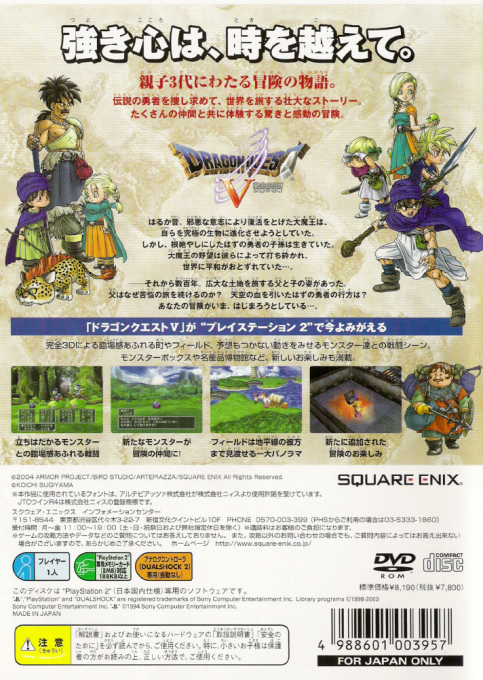
Dragon Quest V: Tenkuu no Hanayome for PlayStation 2 is Square Enix’s 2004 Japanese remake of the 1992 Super Famicom role-playing game. Developed by ArtePiazza with Matrix Software and published by Square Enix, it rebuilds the adventure for PS2 while preserving the distinctive premise: the hero’s journey unfolds across decades of his life. Its story is not simply a quest undertaken by one static adventurer. Childhood, adulthood, marriage, and parenthood each become a separate stage, so the places, relationships, and unanswered questions of the opening hours gain new meaning as time moves on.
The adventure begins with the young hero travelling alongside his father, Pankraz. Their search is connected to the hero’s missing mother and to a prophesied Legendary Hero, but the early travels also establish friendships and mysteries that carry forward into later generations. A tragedy separates the hero from his father, and the next major section resumes after years have passed. The grown hero escapes a life of forced labour and pursues the truth behind his family’s past, with the world’s changing circumstances giving the long narrative a sense of continuity rather than treating its chapters as unrelated episodes.
In adulthood, a central choice asks the hero to choose a bride from Bianca or Flora. That decision determines his partner and the shape of his household, before the story moves into its family-focused final act. The hero’s children join the wider quest, and the search for the Legendary Hero takes an unexpected turn through that next generation. The campaign returns to earlier ideas, characters, and locations while widening the stakes from a father’s unfinished search to an effort shared by an entire family. This PlayStation 2 version follows the original two-bride structure; the third marriage candidate introduced for the later Nintendo DS remake is not part of it.
Exploration proceeds through towns, overworld routes, castles, caves, and other fantasy locations, with equipment, magic, and item use supporting the party’s progress. Battles use the series’ first-person, menu-driven turn-based format. Each round calls for choices such as attacking, casting spells, using items, defending, or relying on tactical commands, then actions resolve according to the combatants’ speed. Victories grant experience and gold, allowing characters and recruited companions to grow stronger and enabling new weapons, armour, and spells to change how a party approaches difficult areas.
Monster recruitment is one of Dragon Quest V’s defining systems. After certain battles, defeated monsters can ask to join the hero. Recruited creatures gain levels, can be equipped where appropriate, and can take places alongside human companions, turning ordinary encounters into opportunities to expand the roster. The PS2 remake greatly increases the selection of recruitable monsters over the Super Famicom release, with 71 species able to join. Choosing which allies to raise and bring along becomes an important layer of party building, especially because different monsters and characters offer different spells, statistics, and resistances.
The remake also expands the active battle group from three members in the Super Famicom original to four. Other companions can wait in the wagon and be exchanged as the situation allows, making the broader roster useful without requiring every recruit to be in the front line. The returning tactics system can direct allies through behaviour settings, while players can also issue manual commands to the party. Together with the generational cast, the larger active group makes the PS2 version particularly suited to experimenting with combinations of relatives, story companions, and monsters.
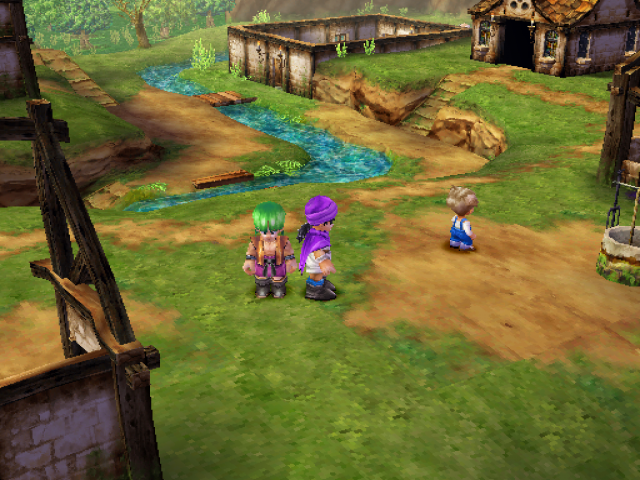
Its most immediately visible revision is the move to fully three-dimensional environments and character models. The PS2 presentation lets the player rotate the camera to view areas from different angles, and environmental interactions receive direct visual treatment: objects such as pots can be picked up and broken rather than only described in text. The music was newly orchestrated and performed by the NHK Symphony Orchestra, giving familiar melodies a different presentation from the Super Famicom’s synthesized sound. These changes modernize the world’s appearance and atmosphere without replacing the traditional command-based structure of play.
Additional PS2 material includes the local trinkets museum, where regional specialties found throughout the journey can be collected and turned in for rewards. A post-game bonus dungeon opens after completing the main adventure, providing an extra challenge beyond the ending. The release also arrived during a period when Square Enix was revisiting earlier Dragon Quest games: this remake preceded the Nintendo DS version, whose later additions and worldwide English release should not be confused with the 2004 PlayStation 2 edition. As a PS2 remake, it is a version of Dragon Quest V that pairs the original’s family-spanning design and monster allies with a 3D presentation, expanded party capacity, and its own set of extras.
Gallery
Details
- Developer
- Arte Piazza
- Publisher
- Square Enix
- Genre
- JRPG
- Players
- 1
- Release Date
- March 25, 2004
- System
- PS2