About
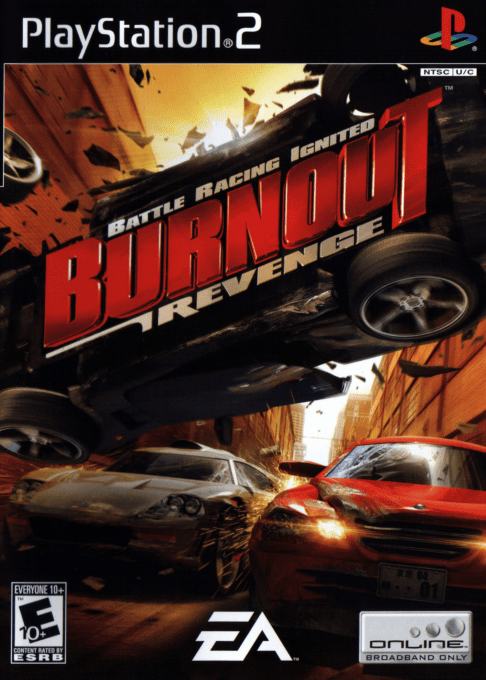
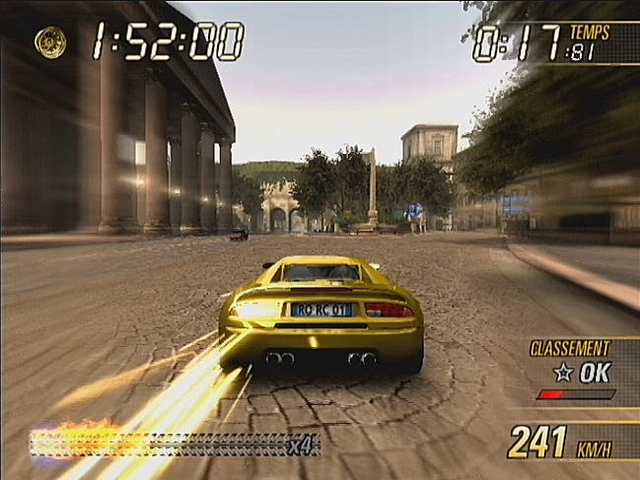
Burnout Revenge for PlayStation 2 is Criterion Games' 2005 arcade racing game, published by Electronic Arts. Released in North America in September before arriving in Europe and Japan later that year, it follows Burnout 3: Takedown and turns its highway racing into a contest where speed, risk, and deliberate collisions all matter. The PS2 game sends drivers through traffic-heavy courses inspired by locations such as Detroit and Rome, asking them to win races while also using their car to disrupt the competition.
At the wheel, the player accelerates with X, steers with the directional buttons or left stick, brakes or reverses with Square, and fires boost with R1. Boost is earned by driving aggressively: threading through traffic, drifting, tailgating rivals, and using the wrong side of the road. A Takedown—forcing a rival into a crash—both punishes an opponent and restores the boost supply. The result is an arcade racer in which positioning and split-second evasive driving are as important as choosing the fastest line through a corner.
Revenge expands that formula with Traffic Checking. Rather than treating every civilian vehicle as an obstacle, drivers can ram small and medium cars travelling in the same direction, sending them forward as hazards for rivals. A checked vehicle that hits an opponent counts as a Traffic Takedown, making traffic itself part of an attack. Jumps can also set up Vertical Takedowns when a landing crushes a competitor. When a particular rival takes the player down, that driver is marked for a Revenge Takedown, giving the next successful retaliation a special point of focus.
The single-player World Tour is arranged as a series of events and ranks. Completing events raises a driver's Revenge Rank and opens later challenges. Standard races share space with Road Rage, which challenges players to wreck opponents before time expires or their own vehicle is destroyed; Burning Lap time trials; and Eliminator races, where the last-place car is removed at regular intervals. Traffic Attack builds an event around checking traffic for cash and time. Crash mode shifts the perspective from finishing first to causing the most expensive pile-up at a junction, with a Crashbreaker allowing a wrecked car to trigger further impacts.
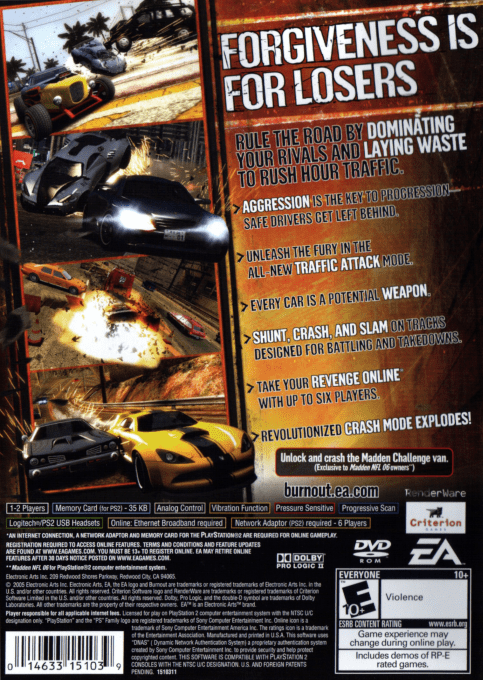
Burnout Revenge also supports local multiplayer on PlayStation 2, with the manual covering play for up to six people through the required Multitap setup. Crash Battle has players tackle a junction together, while Crash Party lets participants take turns over several rounds and Crash Tour applies a low-score, golf-like structure to crash attempts. The original PS2 release also offered online competitive races and crash events for up to six players, although that service is no longer active. Its vehicle roster includes unlockable crash-event cars, with some bonuses tied to compatible save data from other Criterion or EA games.
The PlayStation 2 and original Xbox editions arrived in 2005; an enhanced Xbox 360 version followed in 2006 with visual upgrades, extra Crash Tour junctions, and expanded online features. Those differences make the PS2 version the original console release rather than a direct match for the later 360 edition. Within the Burnout series, Revenge stands as the immediate successor to Takedown's aggressive approach, retaining races, Road Rage, and Crash while making same-direction traffic a central tactical tool. Its mix of racing, stunts, and car-to-car combat captures a distinctly mid-2000s arcade design built around chasing a finish line and creating mayhem on the way there.
Gallery
Details
- Developer
- Criterion Games
- Publisher
- Electronic Arts
- Genre
- Racing & Driving
- Players
- 1-2
- Release Date
- September 23, 2005
- System
- PS2