About
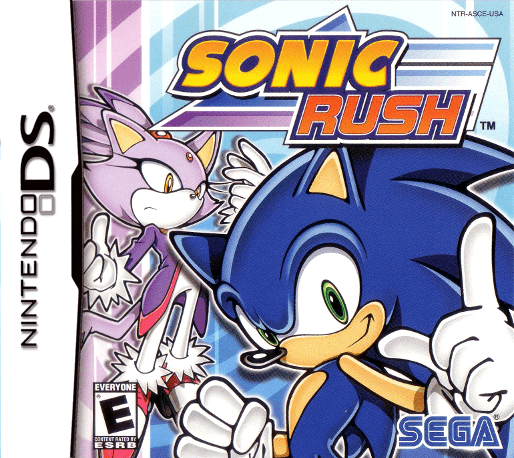
Sonic Rush for Nintendo DS is a 2005 high-speed platform game from Sega, developed by Sonic Team and Dimps. It brings Sonic’s side-scrolling action to the handheld with a presentation built around the system’s two vertically stacked screens: stages continue from one display to the other, giving the player a taller route to race through. Sega released the game in North America in November 2005, followed later that month by its Japanese and European releases. It is a standalone Sonic adventure, but it also introduced Blaze the Cat, who would become a recurring character in the series.
The game is built around two playable leads, Sonic and Blaze. Each follows a separate route through the same set of zones, meeting different opponents and approaching the central conflict from a different side. Sonic uses his familiar speed, jumps, spin attacks, and homing-style aerial attacks, while Blaze has her own movement and combat techniques tied to her flame-based abilities. Their stories gradually intersect as a crisis involving the Chaos Emeralds, Blaze’s Sol Emeralds, Dr. Eggman, and Eggman Nega threatens both of their worlds.
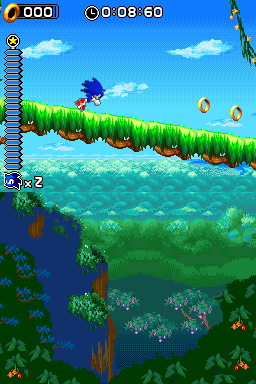
Most of Sonic Rush is a fast 2D platformer. Players run through two-act zones, collect Rings, break monitors for items, defeat Badniks, and negotiate hazards, springs, rails, loops, and environmental devices. Ring collection serves the usual protective role: taking damage scatters a character’s Rings, while being hit with none left costs a life. The levels reward route awareness as much as raw speed, with upper paths, hidden items, and quick opportunities to recover from mistakes. A time limit keeps each act moving, and the clear screen grades a performance, making replaying levels for a stronger result part of the design.
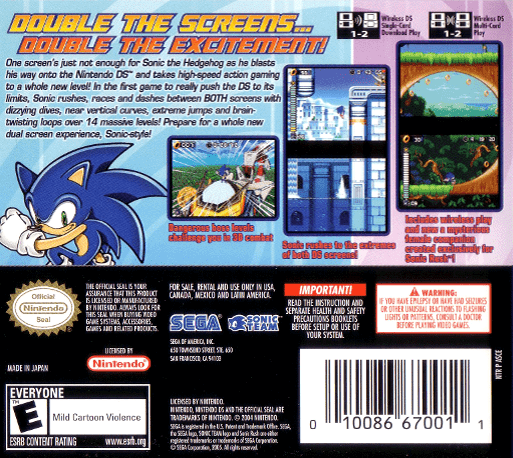
Its defining new mechanic is the Tension Gauge. Tricks performed from ramps and other launch points, as well as certain attacks, build energy for a powerful boost. Triggering it lets Sonic or Blaze surge forward, smash through enemies, and cross stretches of ground at exceptional speed. The gauge therefore gives players a reason to look for aerial trick opportunities instead of simply holding forward. The action is mainly side-on, but the character models and the end-of-zone battles use 3D visuals; each zone concludes with a boss encounter that shifts the focus from rapid traversal to learning an enemy machine’s attack pattern.
Sonic Rush also uses the Nintendo DS hardware beyond its twin displays. Special Stages employ stylus control as the player steers through a curved course in pursuit of Chaos Emeralds. The game includes Time Attack for pursuing quicker clears and records, plus a two-player race mode for local wireless competition. A single game card can also send a demo to another Nintendo DS through Download Play, while players with their own copies can race one another directly.
The game arrived while Sega was adapting Sonic’s long-running formula to new hardware, but its focus stays close to the series’ classic rhythm of momentum, Rings, hazards, and alternate routes. The expanded vertical playfield makes the Nintendo DS version visually distinctive without abandoning that side-scrolling foundation. Its blend of 2D stages, 3D boss scenes, touch-controlled bonus play, Sonic and Blaze’s parallel journeys, and an energetic boost system led naturally to the 2007 Nintendo DS follow-up, Sonic Rush Adventure.
Gallery
Details
- Developer
- SEGA
- Publisher
- SEGA
- Genre
- Platformer
- Players
- 1
- Release Date
- November 15, 2005
- System
- NDS