About
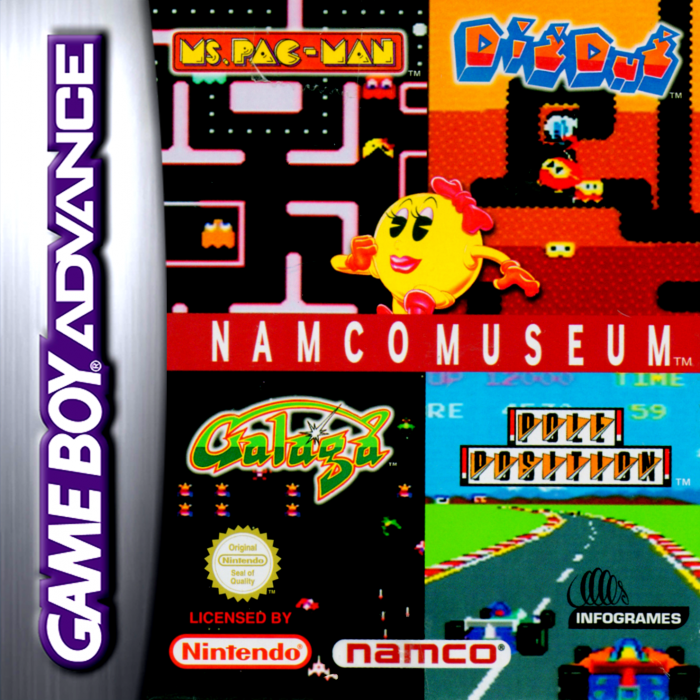
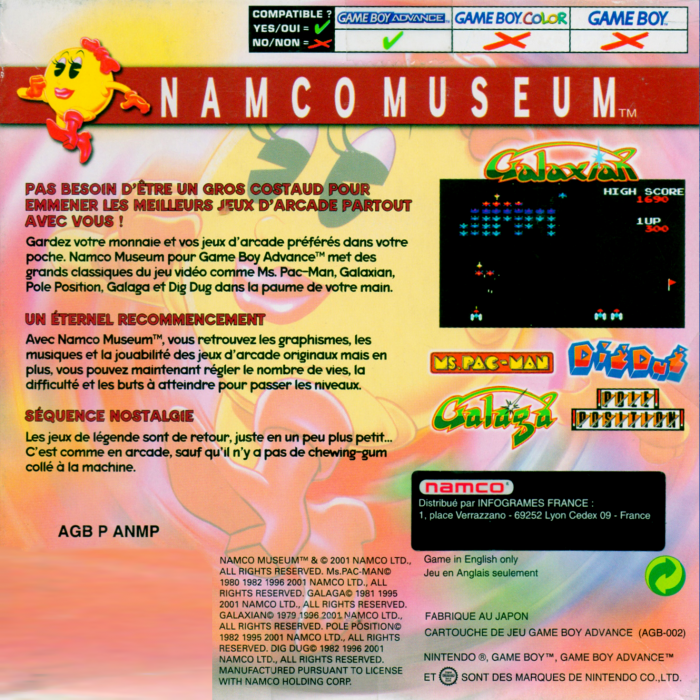
Namco Museum for Game Boy Advance is a 2001 arcade compilation developed by Mass Media and published by Namco. Released for Nintendo's Game Boy Advance, it brings five foundational Namco coin-op games to a single cartridge: Ms. Pac-Man, Galaga, Galaxian, Pole Position, and Dig Dug. Rather than a new adventure built around those names, it is a portable collection aimed at preserving the distinct rules, scoring systems, attract displays, and quick-restart appeal of the original arcade games. The result spans maze chasing, fixed-screen shooting, driving, and underground action in a compact single-player package.
Ms. Pac-Man sends the player through a series of mazes, eating dots and avoiding the colored ghosts while using power pellets to temporarily turn the pursuit around. Galaxian and Galaga shift the action into space: a lone fighter moves along the bottom of the screen, firing upward at alien formations that swoop down to attack. Galaga adds its famous risk-and-reward twist when an enemy beam can capture the player's ship, creating an opportunity to return it and fly with doubled firepower. Each game rewards careful movement, timing, and the pursuit of ever-higher scores rather than a long campaign with a final ending.
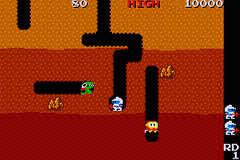
Dig Dug trades open space for a network of dirt-filled tunnels. Its hero advances by digging routes through the ground and dispatching underground foes, either with an air pump or by dropping rocks at the right moment. Pole Position changes pace again with a behind-the-car race view: players qualify for position, navigate bends, avoid other vehicles, and try to finish laps before the timer expires. The five games therefore retain very different rhythms, from the measured planning of a maze to the split-second reactions required by a descending alien attack or a fast corner on the circuit.
The Game Boy Advance format shaped the way this edition presents arcade games originally designed around vertical screens. Ms. Pac-Man offers a choice between a scrolling view that keeps the sprites larger and a reduced full-maze view that displays the entire layout at once. Dig Dug also uses a scrolling field, while Galaga and Galaxian use a compressed presentation with status information beside the play area. Pole Position, whose arcade design used a horizontal display, fits the handheld screen more naturally. These adjustments make the collection a specific GBA adaptation, not simply the same version found on home consoles.
Namco Museum includes options based on the original games' adjustable arcade settings, letting players tailor such details as difficulty and lives where applicable. That makes it easy to approach the games as straightforward introductions or to set a more demanding challenge for score chasing. The collection also keeps the focus on the individual games instead of the walk-through virtual museum presentation used by several earlier PlayStation volumes. Selecting a title takes players directly to its arcade-style experience, with the familiar title and attract sequences reinforcing the connection to the cabinet originals.
As part of the long-running Namco Museum series, this Game Boy Advance release offers a cross-section of the company's arcade history from the late 1970s and early 1980s. Galaxian represents an early alien shooter, Galaga builds on that formula, Ms. Pac-Man remains one of the era's best-known maze games, Dig Dug combines digging with tactical enemy handling, and Pole Position captures an influential style of arcade racing. For Game Boy Advance owners, Namco Museum assembles those very different classics in one cartridge while adapting their displays and settings to portable play.
Gallery

Details
- Developer
- Mass Media
- Publisher
- Namco
- Genre
- Compilation
- Players
- 1
- Release Date
- December 7, 2001
- System
- GBA