About
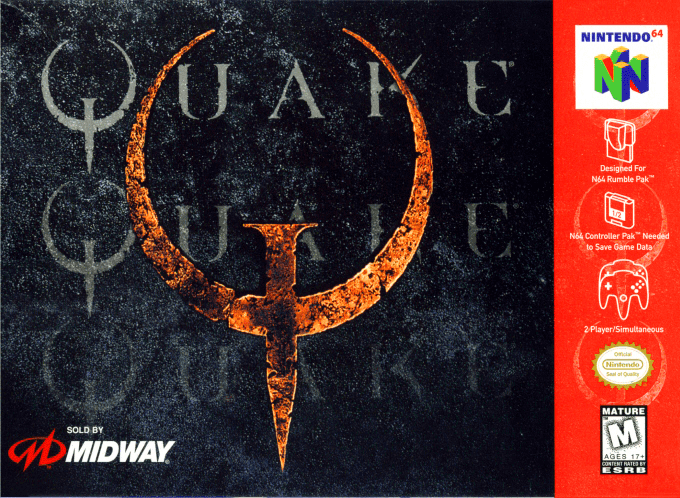
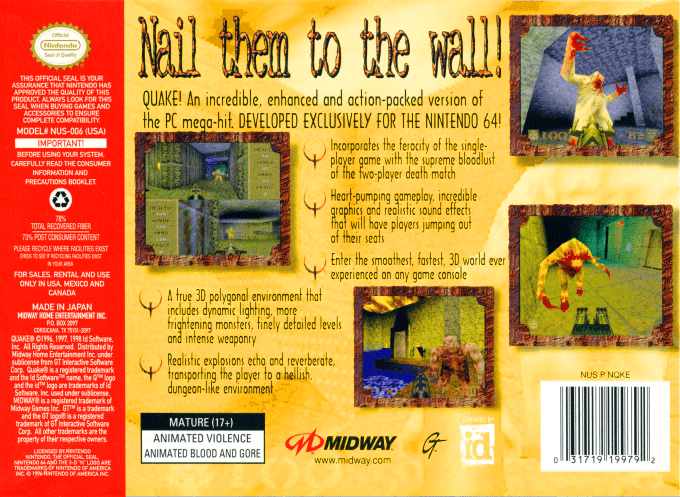
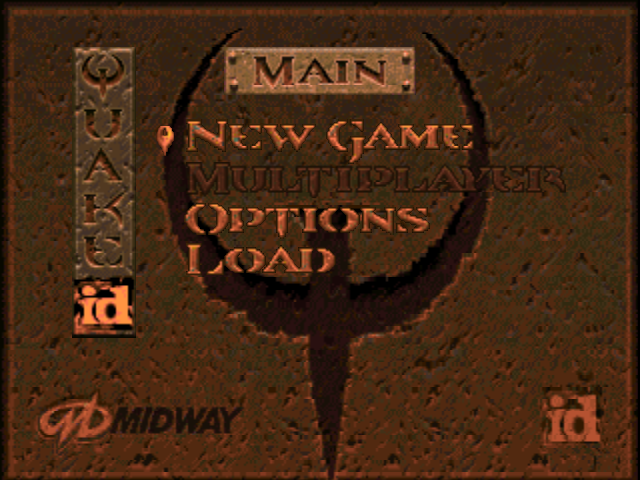
Quake for Nintendo 64 is Midway's 1998 cartridge conversion of id Software's landmark 1996 PC first-person shooter. A military experiment with "slipgates" has opened a route for the hostile force code-named Quake, and the last surviving Ranger enters the gates to take the fight back. The result is a fast, tense trek through military installations, medieval stonework, rusted machinery, and otherworldly ruins, where a key, a switch, or a hidden door can be as important as a full ammo box.
The campaign is built around Quake's distinct blend of exploration and violent momentum. Rooms loop back on themselves, lifts expose new paths, and secret areas reward players who examine suspicious walls and ledges. Enemies attack from corridors, waterlogged tunnels, and dark corners: shambling ogres launch grenades, armored knights rush in close, fiends leap great distances, and the towering Shambler makes a late-game encounter feel dangerous even when a player is well armed. Health, armor, ammunition, and the exit to the next map must be found while surviving the ambushes in between.
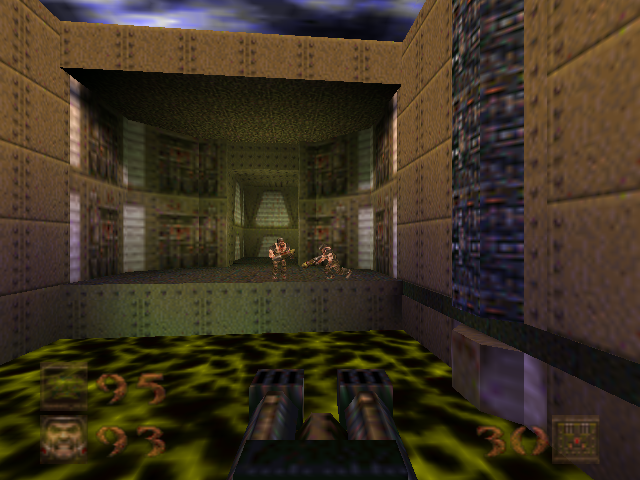
Quake's weapon set gives each fight a different rhythm. The axe remains a desperate last resort, while the shotgun and double-barreled shotgun establish the basic close-range arsenal. Nailguns rapidly fill a space with projectiles, the grenade launcher lets shots bounce around corners, and the rocket launcher enables powerful splash damage as well as risky rocket jumps. The lightning gun is devastating at short range but consumes cells quickly. Its three-dimensional level design and polygonal enemies set it apart from the earlier Doom games, and vertical spaces, bridges, slopes, water, and explosive movement all shape the combat.
This is specifically the Nintendo 64 edition, not a complete replica of the PC release. Midway retained 25 single-player levels but left out The Grisly Grotto, The Installation, The Ebon Fortress, The Wind Tunnels, The Sewage System, and Hell's Atrium. It also removes the PC game's start hub for choosing an episode: select a difficulty setting from the menu, then proceed through the included levels in sequence. Those cuts and structural changes matter for players comparing versions, but the remaining campaign still delivers the original's interlocking bases and grim fantasy spaces.
The hardware conversion gives Quake N64 its own audiovisual character. Midway simplified some environment detail for the cartridge and console hardware, while the Nintendo 64's colored lighting casts the stone corridors, metal rooms, and monster-filled spaces in richer hues. Aubrey Hodges composed a separate, ominous score for this version, using electronic and orchestral textures rather than simply carrying over the original PC release's Trent Reznor and Nine Inch Nails audio. The N64 controller's analog stick is used for movement and aiming through configurable controls, making this a living-room interpretation of a game designed around a keyboard and mouse.
Multiplayer is the major N64-specific addition. Quake N64 does not include cooperative play, but it supports two players in split-screen deathmatch on the six original PC deathmatch maps and the exclusive arena The Court of Death. That makes it a different proposition from the PC game's network-centered multiplayer: instead of dialing in or building a LAN session, two players can immediately compete from one cartridge and console. The mode has the familiar hunt for weapons, armor, and advantageous routes, with teleporters and tight arena turns making every encounter unpredictable.
It is also worth separating Quake N64 from the 1997 Sega Saturn version and from the later, distinct Quake II for Nintendo 64. The Saturn port was built with Lobotomy Software's SlaveDriver engine and has no multiplayer, whereas Midway's N64 release preserves Quake's own campaign material in a revised console package and adds local deathmatch. For players seeking the first Quake on original Nintendo hardware, this is the version: a dark, demanding shooter with deliberate exploration, explosive weapons, and a port-specific atmosphere rather than a generic label for every console Quake.
Gallery
Details
- Developer
- Midway
- Publisher
- GT Interactive Software
- Genre
- First-Person Shooter
- Players
- 1-2
- Release Date
- April 28, 1998
- System
- N64