About
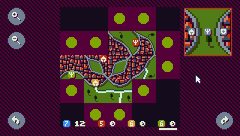
Carcassonne for TIC-80 is an independently made digital remake of the classic medieval tile-laying board game. Created by András Parditka and published as a TIC-80 cartridge, it turns the familiar task of growing a shared countryside into a compact strategy game for the fantasy computer. Every session builds a new landscape from connected roads, cities, farms, and churches, while players compete to make the most productive use of a limited supply of followers.
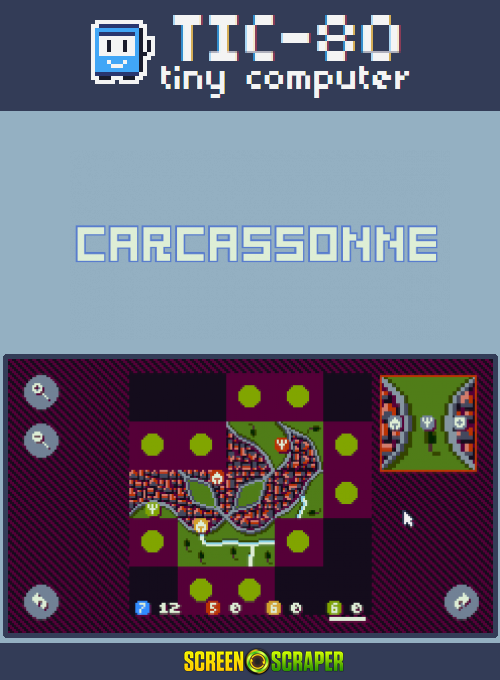
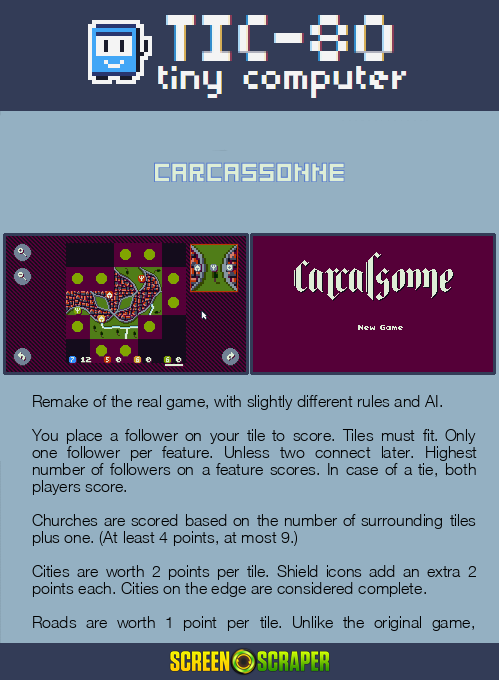
Play centers on choosing where to place each terrain tile. A tile has to match the features beside it, so a road must continue into a road and city walls must meet city walls. Once a piece is set down, a player can assign a follower to one of its features in an attempt to claim the eventual score. A claimed feature normally cannot accept another follower, though separately claimed areas may be linked later; the player with the most followers on the resulting feature earns the points, while tied leaders both score.
The TIC-80 version uses its own scoring and completion rules rather than reproducing every rule of the tabletop game. Cities score two points for each tile, with shields adding bonuses, and roads score one point per tile. Churches are valued from the number of surrounding tiles, while farms award points for connected cities after their adjacent cities are complete. Cities along the board’s edge count as complete here, and road junctions do not divide roads as they do in the original board game.
Its tile set is designed so the board can always be filled, and the game only presents tiles that can be legally placed. That removes the dead draws that can complicate physical tile-laying games and keeps attention on placement, timing, and the decision to commit or recover followers. Followers return after scoring, making their availability another important part of planning a turn.
Carcassonne includes two computer opponents for solo play. The first selects random legal moves, providing a straightforward opponent, while the second looks for high-scoring opportunities or moves that return followers to use again. The cartridge was made on a phone using Termux and Vim, with Wren used for its code, making it a distinctly small-scale reinterpretation of a well-known tabletop design for TIC-80.
Gallery

Details
- System
- TIC-80