About
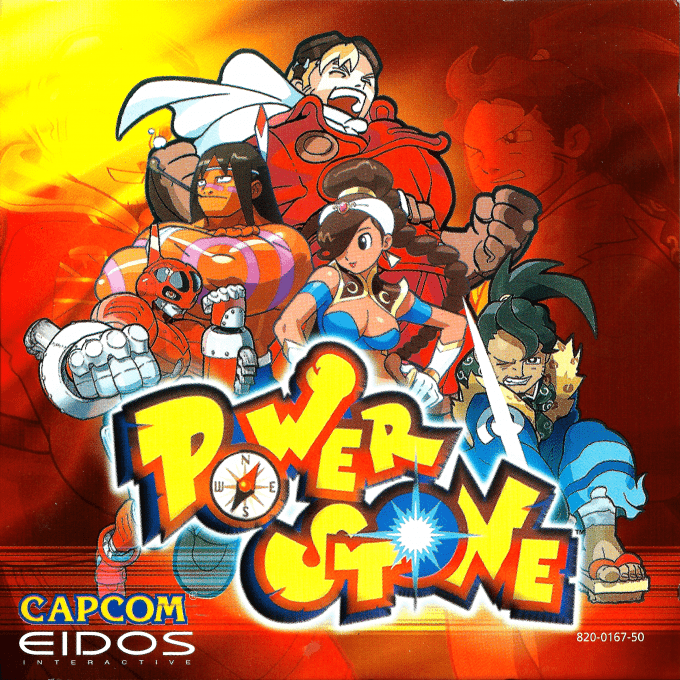
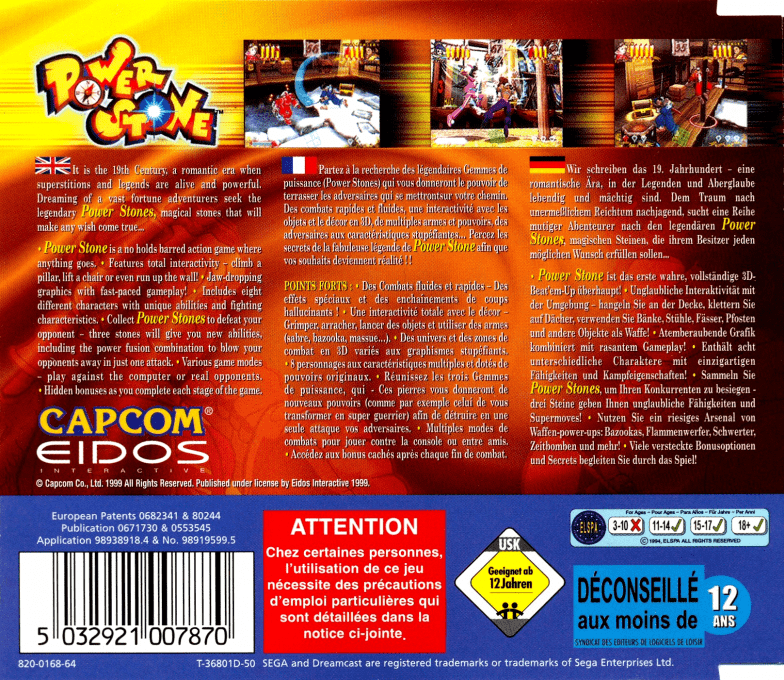
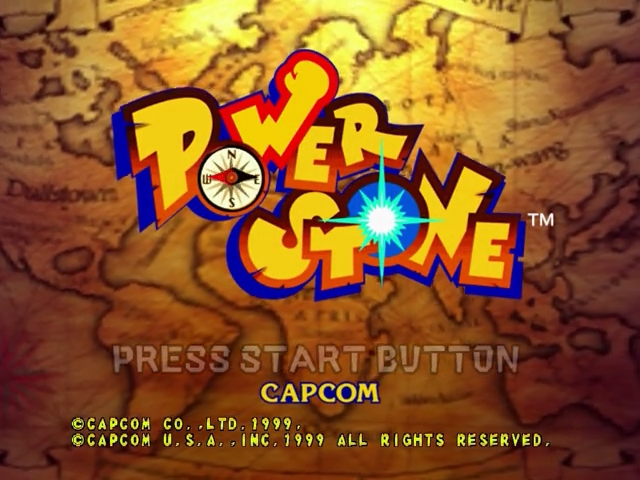
Power Stone Dreamcast is Capcom’s 1999 arena-fighting game, a home conversion of the company’s Sega NAOMI arcade release. It brings one-on-one battles into fully three-dimensional, globe-trotting stages rather than restricting opponents to a single horizontal plane. Capcom developed the game; its Dreamcast release arrived first in Japan in early 1999, with North American and European editions following later that year. Capcom handled the game in some territories, while Eidos Interactive published the European release represented here. The result is a fighting game built around movement, scavenging and quick decisions as much as familiar attacks and throws.
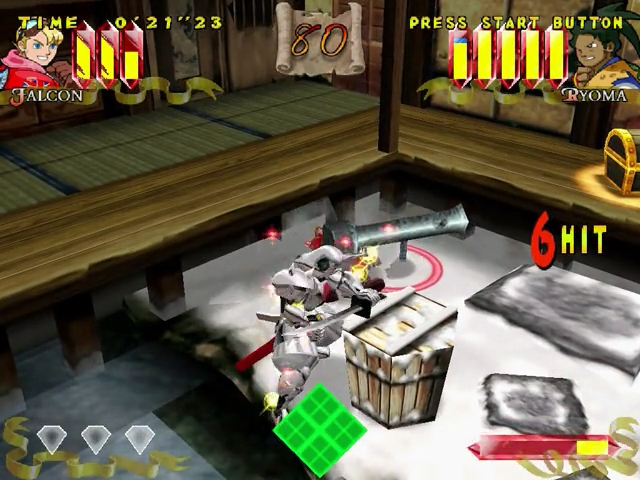
Each match places two combatants in a compact interactive location and asks one player, or two competing locally, to empty the opponent’s life bar. Fighters can run around an arena, close distance, evade danger and attack directly, but the surroundings are an equally important part of the contest. Weapons and usable objects appear around a stage: players can grab what is at hand, turn it on an opponent and fight over the next useful pickup. This gives individual rounds a shifting rhythm, since control of the space and the items within it can matter as much as landing a clean strike.
The game’s signature mechanic is the collection of the colored gems named Power Stones. Gathering three changes a character into a temporary powered-up form with a separate set of spectacular attacks. That advantage is not permanent: its energy is finite, and using powerful techniques consumes it, so deciding when to transform and when to spend the remaining power becomes part of every close battle. The system makes the gem hunt visible to both players and creates a clear contest within the contest—whether to pursue the stones, interrupt the other fighter’s collection, or use ordinary attacks and arena equipment to keep control.
Power Stone frames these clashes with a late-19th-century adventure premise. Legends speak of a treasure able to grant wishes, drawing fortune seekers from around the world into conflict. The playable lineup includes the boxer Edward Falcon, martial artist Wang-Tang, swordsman Ryoma, ninja performer Ayame, fortune teller Rouge, the bandaged Jack, heavyweight Gunrock and the towering Galuda; hidden challengers expand the roster. Their contrasting designs and transformation forms give the game a colorful, character-driven identity, while successive computer-controlled opponents let a solo player work through the cast and the game’s varied locales.
The Dreamcast edition is closely tied to the arcade original because Sega’s NAOMI hardware and Dreamcast shared related technology. Capcom itself described the NAOMI version and the console version as releases only a week apart in Japan, illustrating its strategy of developing for arcade and home play together. At home, the game supports its single-player challenge as well as head-to-head play with standard Dreamcast controllers or arcade sticks, making the arena format practical for quick local matches. It should not be confused with Power Stone 2, the 2000 follow-up that changed the formula to allow up to four simultaneous players, or with the later Power Stone Collection compilation for PSP. The original remains the focused two-combatant entry that established the series’ transforming-gem battles and object-filled 3D arenas.
Gallery
Details
- Developer
- Capcom
- Publisher
- Eidos Interactive
- Genre
- Fighting
- Players
- 1-2
- Release Date
- October 14, 1999
- System
- Dreamcast