About
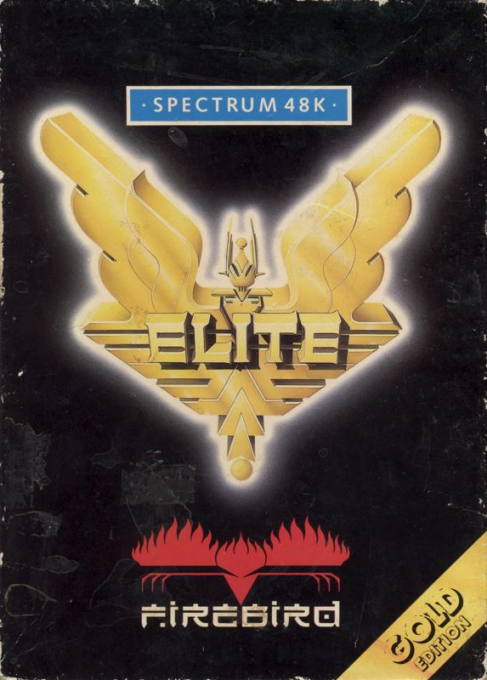
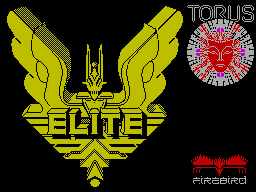
Elite for the ZX Spectrum is the 1985 Firebird release of David Braben and Ian Bell's landmark space trading and combat game, converted for Sinclair's 8-bit machine by Torus. It puts the player in command of a Cobra Mark III with modest funds, basic equipment and no prescribed route to victory. Rather than following a conventional campaign, the game turns a galaxy of star systems into a working frontier: decide where to travel, what cargo to buy, which dangers to confront and how to build a reputation capable of reaching the coveted Elite rating.
The adventure begins at Lave, where Commander Jameson can dock at the orbital station, inspect local commodity prices and plot a hyperspace jump to a nearby world. Legal trade offers a steady way to earn credits, but poorer and less stable systems can offer greater rewards alongside pirates and tighter scrutiny from the authorities. Credits pay for practical improvements to the Cobra, including stronger weapons and shields, added cargo capacity, extra energy reserves, a fuel scoop and an automated docking computer. Each purchase broadens the range of options available on the next trip.
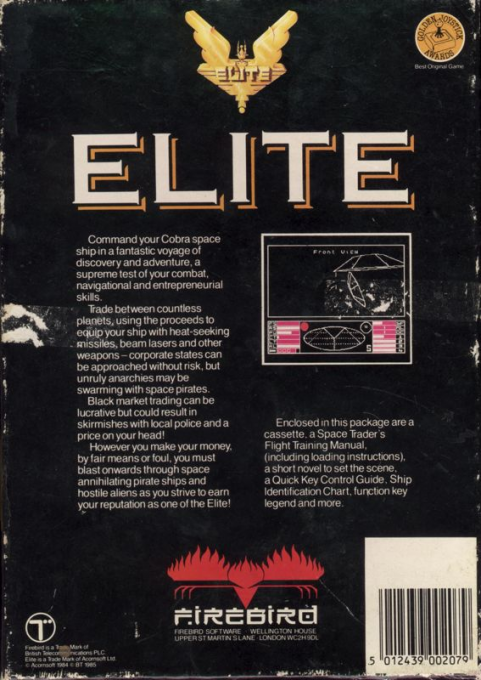
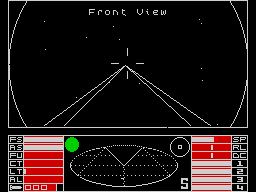
Flight takes place from the cockpit in a wireframe 3D view of deep space. A commander uses the ship's drives to approach stations, evade hostile craft, line up shots and collect drifting cargo. Manual docking is a memorable test of timing, as the Cobra must match the rotation of a station before entering its bay. Combat can lead to bounty payments, while destruction, piracy and illegal cargo also carry consequences. The game leaves morality and occupation largely in the player's hands: trading, bounty hunting, mining and raiding are all possible ways to fund a growing ship.
Interstellar travel is limited by the Cobra's fuel range, so route planning matters as much as reflexes. A hyperspace jump links nearby systems, while refuelling is normally done at a station or, for commanders equipped with a fuel scoop, by carefully skimming a star. The universe is arranged into eight galaxies, each containing 256 procedurally generated worlds. Their economies, governments, names and prices create opportunities for regular trade routes, but their different conditions also shape the likelihood of trouble. Thargoid encounters can interrupt a jump and force an unexpected battle in witch-space, adding danger even to a planned journey.
Spectrum Elite preserves the open-ended foundation that made the original so unusual on home computers, while adapting it to the ZX Spectrum's keyboard and supported joystick controls. Torus's version is associated with a distinctive supernova rescue mission not present in the original BBC Micro edition, giving established commanders an additional special assignment beyond routine commerce and combat. The Firebird package also presented the game as a larger fictional world, with reference material and the accompanying novella The Dark Wheel helping give context to its trading lanes, dangerous systems and alien threat.
The primary aim is not simply to accumulate the most money. Combat performance is tracked through ranks that rise from Harmless toward Elite, making ship-to-ship battles meaningful alongside economic progress. A player may spend hours refining safe routes and saving for upgrades, or seek faster advancement by entering riskier territory. Missions, rare equipment and access to further galaxies give the long-form structure extra milestones without removing the freedom to choose a personal path.
Elite arrived on the ZX Spectrum after its 1984 BBC Micro debut and became one of the era's defining examples of a vast simulation built within the limits of an 8-bit computer. Its generated star systems meant that a compact program could suggest an enormous, persistent-feeling universe, while its mixture of navigation, trade, dogfighting and player choice supplied a model for many later space games. The Spectrum release remains a particularly notable version for bringing that ambitious design to Firebird's home-computer audience in 1985.
Gallery
Details
- Developer
- Torus
- Publisher
- Firebird Software
- Genre
- Other Simulation, Other Strategy
- Players
- 1
- Release Date
- January 1, 1985
- System
- ZX Spectrum