About
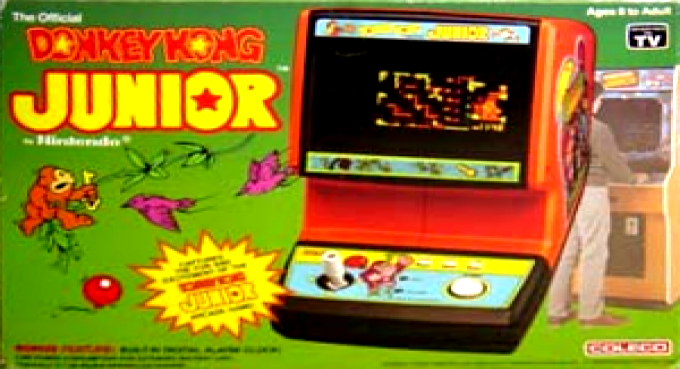
Donkey Kong Jr. Game & Watch (Coleco) is a tabletop electronic adaptation of Nintendo's Donkey Kong Jr. concept, marketed by Coleco in North America during the early 1980s. Rather than being a port of the arcade game's four scrolling stages, this compact LCD game reshapes the rescue story into a single fixed-screen challenge. Donkey Kong has been chained by Mario, and the player guides his son, Junior, through a hazardous route to recover the keys and free him.
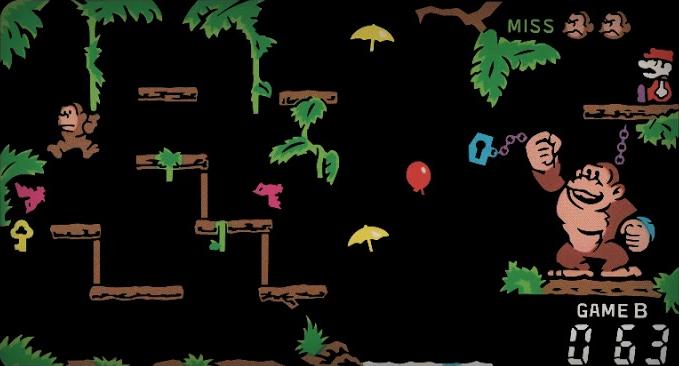
The action begins with Junior collecting a key before moving through the upper trees. The player uses the unit's directional controls to steer him between branches and avoid the bird-like hazards that occupy the route. The objective is not simply to survive: each trip must carry the key all the way to Donkey Kong's restraints. That clear, repeatable task gives the game an immediately readable rhythm while the changing enemy patterns make timing matter.
The middle of the playfield is the tabletop version's most memorable obstacle course. Junior rides descending umbrellas on one side and rising balloons on the other, carefully switching between them to cross the gap above the water. A bad move can send him into the pool and cost a miss, so the section asks players to watch both the movement of the platforms and the route ahead. It is a distinctive LCD interpretation of the series' climbing-and-rescue theme rather than a direct recreation of the arcade layouts.
At the top, Junior tries to place the key in one of the locks securing his father. Donkey Kong's moving chain adds another timing test, and completing a lock sends Junior back to the start to fetch another key. Releasing all four locks completes the rescue and increases the pace for the next cycle. The scoring rewards successful movement and progress, including points for reaching umbrellas or balloons, dealing with birds by using coconuts, and opening locks.
Like other early electronic games, Donkey Kong Jr. (Coleco) is built around repeating runs, score improvement, and the pressure of limited mistakes. A game ends after three misses, while reaching 300 points can clear existing misses; a perfect run at that milestone activates Chance Time, in which points count at double value until the next error. The result is a focused tabletop take on a major Nintendo character game: a small-screen rescue mission whose route, visual presentation, and score-chasing rules are tailored to the Game & Watch-style hardware.
Gallery

Details
- Developer
- Coleco Industries
- Publisher
- Coleco Industries
- Genre
- Platformer
- Players
- 1
- Release Date
- June 26, 1982
- System
- Game & Watch