About
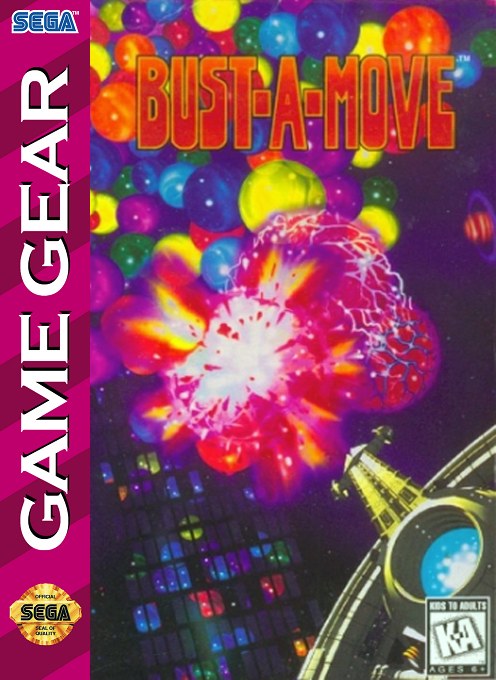
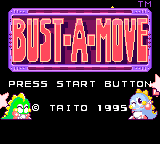
Bust-A-Move on Sega Game Gear is a compact handheld interpretation of Taito’s bubble-matching puzzle game, known in Japan as Puzzle Bobble. Developed for this version by Santos and released in 1996, it brings the series’ simple arcade premise to Sega’s color portable at a point when the Game Gear library was already nearing its end. The game draws on the world of Bubble Bobble, with the familiar dinosaur characters and cheerful presentation framing a fast, approachable score-chasing puzzle challenge.
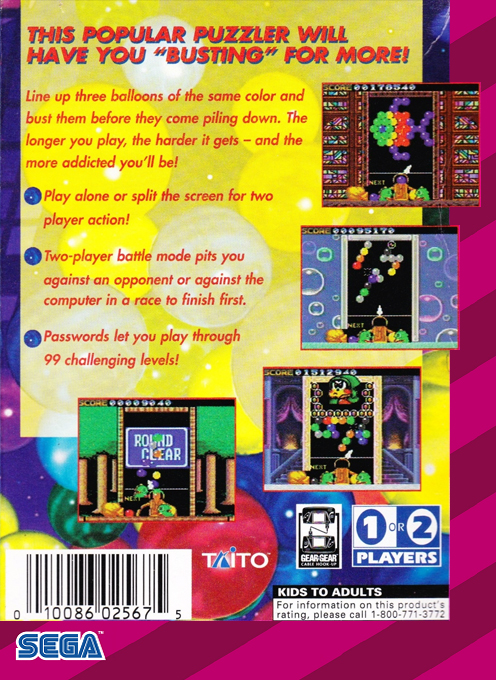
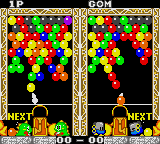
Each stage begins with colored bubbles arranged across the top of a vertically scrolling playfield. The player controls a launcher at the bottom and aims each new bubble upward, including angled shots that rebound from the side walls. Connecting three or more bubbles of the same color makes that group burst. Any bubbles left hanging without a connection to the ceiling also fall away, turning a carefully placed shot into a much larger clear and rewarding players who look beyond the most obvious match.
The central pressure comes from the advancing ceiling. Shots that do not solve the board bring the cluster lower after a limited number of turns, reducing the room available near the bottom line. Letting the bubbles cross that line ends the round. Because the colors supplied by the launcher are tied to those still on the board, successful play is a balance of immediate clearing, setting up future groups, and using banks off the walls to reach awkward spaces. The rules are easy to learn, but a crowded layout can demand quick planning and precise aim.
The Game Gear edition retains the recognizable visual language of the original Puzzle Bobble while adapting it to a small screen and handheld controls. Bright bubble colors make matching information readable at a glance, and the compact arena keeps the action focused on the next angle and the growing threat above. Rather than trying to reproduce the original arcade hardware feature for feature, this version presents the formula as a self-contained portable game built around short rounds that can be revisited for another attempt.
Bust-A-Move’s appeal comes from the way its arcade-style action puzzle design creates satisfying chains of cause and effect. A single bubble can complete a group, remove its support, and send a whole section of the arrangement tumbling down. That possibility gives every shot more weight than a basic color match. Missed opportunities also matter, since a cautious shot may preserve a troublesome formation while the board continues to descend. The result is a game that can be played casually yet steadily rewards an understanding of geometry, timing, and board management.
Santos handled the Game Gear conversion, with credits for the edition including director and planner Jin, programmers Tatsuo Ariga and Goripon, graphics designer Some1, and sound contributor Fumito Tamayama. Its 1996 release places it among the later Game Gear titles, while its underlying game concept traces back to Taito’s 1994 arcade Puzzle Bobble. The international Bust-A-Move name is therefore associated with the same foundational bubble-shooting game, not with the later numbered sequels that expanded the series on other systems.
For retro puzzle fans, Bust-A-Move offers a direct route to one of the genre’s most influential match-three mechanics on Sega hardware. Its rounds make effective use of the Game Gear’s portable format: they begin with an immediately understandable objective, become tense as the ceiling drops, and encourage another try after a close loss. Whether the goal is clearing a difficult board efficiently or simply enjoying the Bubble Bobble-themed atmosphere, this Game Gear version remains a focused example of why Puzzle Bobble’s formula endured across arcades, home consoles, and handhelds.
Gallery
Details
- Developer
- Santos
- Publisher
- SEGA
- Genre
- Tile-Matching Puzzle
- Players
- 1-2
- Release Date
- January 1, 1996
- System
- Game Gear