About
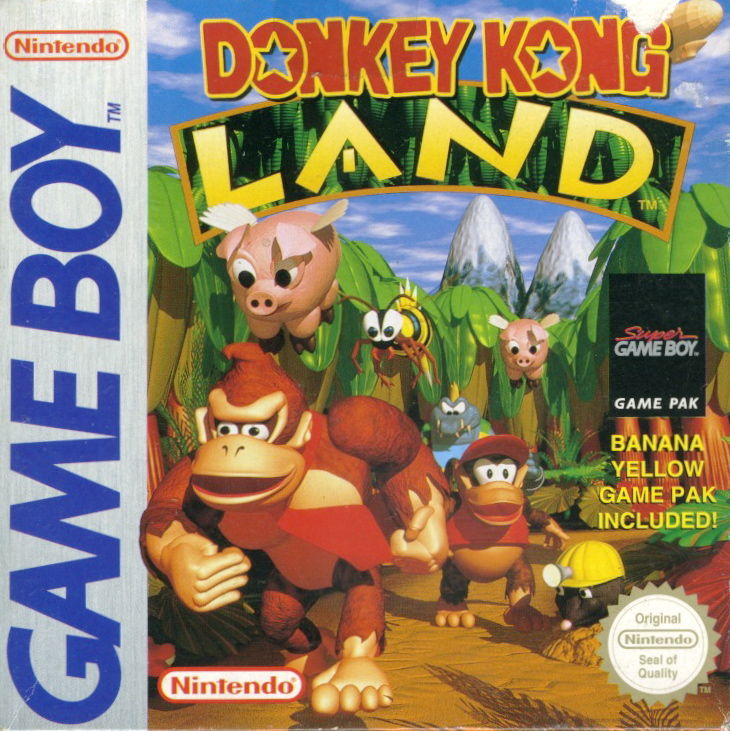
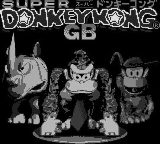
Donkey Kong Land for Game Boy is a 1995 side-scrolling platform game developed by Rare and published by Nintendo. Conceived as a handheld companion to the Super NES hit Donkey Kong Country rather than a straight conversion, it brings Donkey Kong and Diddy Kong to Nintendo's monochrome portable for a fresh jungle adventure. The game arrived in North America in June 1995, Japan in July as Super Donkey Kong GB, and Europe in August, giving Game Boy owners their own route into Rare's Donkey Kong world.
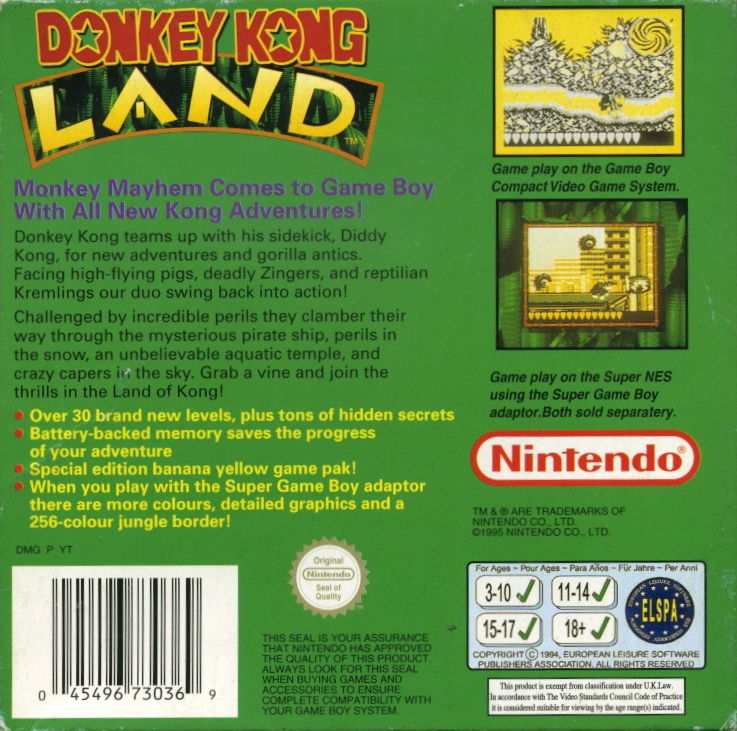
The story begins with a challenge from Cranky Kong, who doubts that the younger Kongs can repeat their success on Game Boy hardware. King K. Rool and his Kremling forces steal the Kongs' banana hoard, setting Donkey and Diddy on a trip to recover it. Their quest ranges beyond familiar jungle scenery through pirate ships, snowy routes, underwater ruins, high cliffs, cloud-filled stages, and the industrial spaces of Big Ape City. Every world is capped by a confrontation with one of the Kremlings' larger threats before the pursuit can continue.
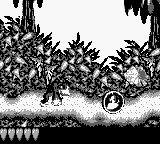
Gameplay centers on precise platforming across 30 levels. Donkey Kong brings power while Diddy Kong moves more quickly, and the player can switch between the two with the Select button. Both characters can jump on opponents, roll through hazards, grab and throw objects, break open crates, and use barrels to reach otherwise inaccessible areas. The Game Boy's A button handles jumping, while B is used for actions such as running and picking up objects, making the basic moveset compact but flexible.
The levels reward careful exploration as well as reaching the exit. Bananas line routes and provide an extra life after enough have been collected, while balloons add lives directly. Hidden bonus areas, lettered K-O-N-G tokens, secret paths, and barrel cannons encourage a close look at each stage. Enemies include Kremlings alongside hazards and creatures such as flying pigs and Zingers, so progress often depends on reading the terrain, choosing a safe jump, and deciding when to keep momentum or slow down.
Animal helpers return in a more selective role. Rambi the rhino can charge through obstacles, and Expresso the ostrich offers a different way to handle certain stretches of a level. The Game Boy hardware permits only one of the two main Kongs to be shown during play, so the partner waits offscreen until called in; their shared health and the character-switching system remain central to the action. A DK barrel restores the unavailable Kong, preserving the two-character rhythm without requiring both sprites on the screen at once.
Donkey Kong Land deliberately differs from Donkey Kong Country in its layouts, bosses, enemies, and locations. Its four worlds use an overworld map to track advancement, and its K-O-N-G letters serve an especially important purpose: collecting a full set records progress. This replaces the save point arrangement associated with the Super NES game and makes the letters a practical goal during ordinary play. The result is an original Game Boy campaign that echoes Country's platforming vocabulary while supplying stages designed around the handheld's display and controls.
Rare also adapted the series' pre-rendered visual approach for Game Boy sprites and paired it with music by David Wise and Graeme Norgate. The original cartridge stood out on store shelves in banana yellow instead of the system's usual grey. Donkey Kong Land supports the Super Game Boy, allowing the Game Boy cartridge to be played through a Super NES with added presentation features, and it remains a single-player adventure from start to finish.
As the first entry in the Donkey Kong Land line, this Game Boy release was followed by Donkey Kong Land 2 and Donkey Kong Land III. It later returned on Nintendo 3DS Virtual Console in 2014, preserving a notable early effort to reshape a major Super NES-style platform series for Nintendo's smaller 8-bit handheld. For players interested in the era, Donkey Kong Land offers a distinct parallel adventure rather than a compressed replay of Donkey Kong Country.
Gallery
Details
- Developer
- Rareware
- Publisher
- Nintendo
- Genre
- Platformer
- Players
- 1
- Release Date
- August 24, 1995
- System
- GB