About
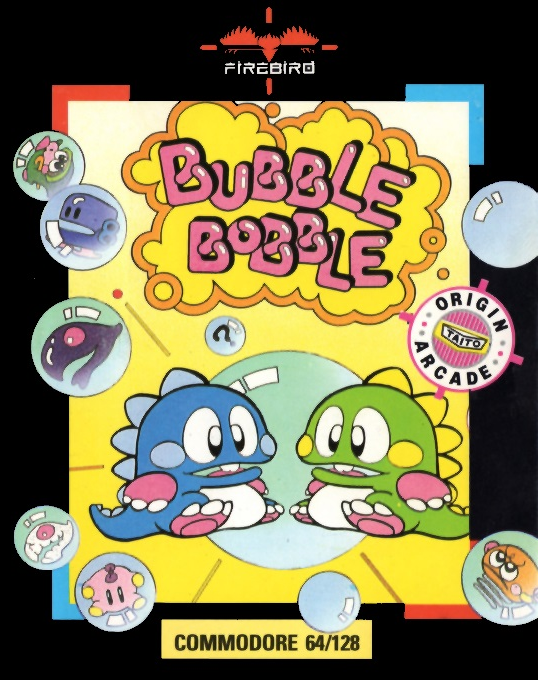
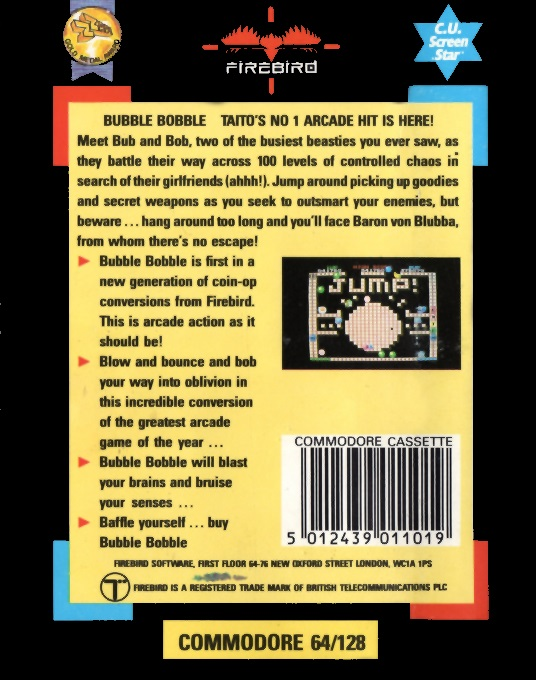
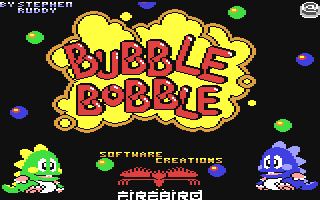
Bubble Bobble for Commodore 64 is a single-screen action-platform game released in 1987. It adapts Taito’s 1986 arcade game for the home computer, with Software Creations handling the conversion and Firebird publishing the European release; Taito distributed the game in the United States. The starring pair are Bub and Bob, two young men changed by magic into small, bubble-blowing dragons. Their mission sends them through the Cave of Monsters to free their kidnapped girlfriends and eventually regain their human forms.
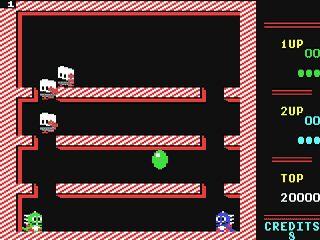
Each of Bubble Bobble’s 100 stages fits on one screen. Bub and Bob run across ledges, jump between platforms, and can drop through an opening at the bottom of a stage to reappear from above. The objective is simple but demanding: clear every monster before moving on. Contact with an enemy or a hostile projectile costs a life, and enemies become more dangerous when left alive. Taking too long also brings in the invincible Baron von Blubba, forcing the players to stop delaying and finish the screen.
The dragons’ bubbles make the C64 game more than a straightforward platformer. A fire button sends a bubble forward; it rises after a moment and can imprison an enemy. Touching the captured foe’s bubble pops it, defeating the monster and turning it into a score item to collect. A well-placed bubble can also act as a temporary step, letting a player climb toward a higher platform, approach a difficult target, or reach a bonus. The result is a compact game of movement, timing, and route planning in which the same tool supports attack and traversal.
Items give the action extra variety. Food left by defeated enemies supplies points, while special bubbles and power-ups can change the immediate situation. Fire, water, and lightning bubble effects can remove threats quickly, and other pickups can improve a dragon’s speed or bubble-making ability. The value of a clear depends on how it is achieved as well as whether it succeeds: trapping several enemies before bursting their bubbles can produce a stronger reward. Letter bubbles can be gathered to spell EXTEND for an additional life, and the stages also contain hidden opportunities for players who meet particular conditions.
Bubble Bobble on Commodore 64 supports one player or simultaneous two-player cooperative play. Player one uses a joystick in port 2 and player two can use port 1, with left and right for movement, up to jump, and fire to blow bubbles. Co-op changes the rhythm substantially: both dragons can cover a screen, rescue each other from awkward positions, and coordinate attacks, but a stray bubble or hasty movement can also interfere with a partner’s route. The game’s end sequence gives the cooperative mode added importance, because completing the final stage together reveals a fuller ending than a solo completion.
The C64 version carries the arcade design into a machine with a very different technical character while retaining its recognizable one-screen structure, 100-level journey, cartoon enemies, and unusual bubble mechanic. Programmer Stephen Ruddy, graphics artist Andrew Threlfall, and musician Peter Clarke are credited for the conversion. Bubble Bobble became one of several home-computer interpretations of Taito’s hit, and its Commodore 64 release was later reissued by The Hit Squad. Its combination of approachable controls, escalating screens, secrets, and shared play explains why the game remains closely associated with the Commodore 64 library as well as the wider Bubble Bobble series.
Gallery
Details
- Developer
- Taito
- Publisher
- Taito
- Genre
- Platformer
- Players
- 1-2
- Release Date
- January 1, 1987
- System
- Commodore 64
/Doc_Cosmos_The_Saga_Begins.png)