About
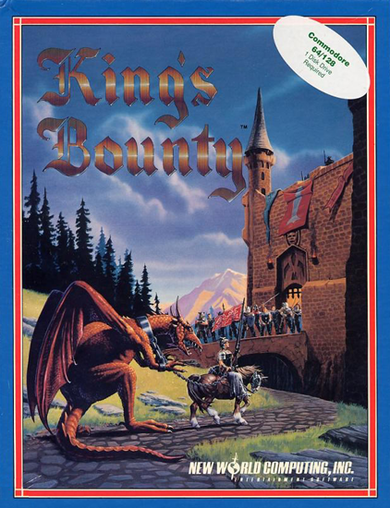
King's Bounty for Commodore 64 is New World Computing's 1990 single-player fantasy strategy and role-playing game, designed by Jon Van Caneghem. The player serves King Maximus as one of four adventurers - Knight, Paladin, Barbarian, or Sorceress - and must recover the stolen Sceptre of Order. This Commodore 64 release belongs to the original turn-based game, not the later Genesis version with real-time overworld movement and not the modern King's Bounty series that began in 2008.
The kingdom's crisis begins with the theft of the Sceptre by the forces of chaos led by Arech Dragonbreath. King Maximus sends the hero on a commission across a fantasy realm divided into four continents, where castles, towns, treasure, hostile armies, and recruitable creatures shape the route forward. The central goal is simple to state but broad in practice: find the Sceptre before the king dies. The game sets its deadline according to the chosen difficulty, so every trip, detour, and battle consumes valuable time.
Each hero class begins with different strengths. Their magical ability, leadership, starting forces, and weekly income vary, making the choice affect both early tactics and the kind of army that can be maintained. The king pays a weekly commission, while soldiers also require weekly wages. Recruiting stronger units can give a force the power needed for later opponents, but an army that costs more than its income can desert. Unit relationships matter as well: mixing compatible creatures supports morale, whereas incompatible troops make a fighting force less dependable.
Progress revolves around hunting 17 increasingly dangerous villains. Defeating a villain brings its bounty and reveals part of the map that points toward the Sceptre's hiding place. The player can also uncover map pieces through treasure and a set of eight artifacts, some of which improve the hero's capabilities. Because the placement of the Sceptre, artifacts, and villain-held castles is shuffled for a new game, the same broad quest can lead through a different pattern of discoveries. A player who correctly infers the hiding place need not collect every available map fragment.
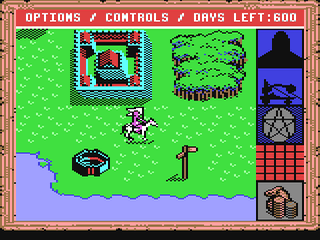
On the Commodore 64, exploration is governed by turns rather than the continuous overworld action introduced for the Genesis port. Visiting locations, crossing terrain, and moving between areas all feed into the calendar pressure of the mission. Encounters with wandering armies and occupied castles shift the game to tactical, stack-based battles. The hero's troops occupy battlefield positions, take turns against the enemy force, and must be directed carefully because numbers alone do not guarantee a victory.
Magic adds another layer to King's Bounty's campaign management and combat. Adventure spells can help the hero travel, locate a villain's castle, create a bridge, halt time briefly, or bolster leadership, while battle spells can damage enemies, move troops, freeze an opposing stack, restore units, or copy a force. Together with recruiting, bounties, treasure, and randomized objectives, those systems make the Commodore 64 game a compact campaign of calculated risk. Its blend of roaming a fantasy map, developing a commander, and leading creature armies established ideas that Van Caneghem later developed more fully in Heroes of Might and Magic.
Gallery

Details
- Developer
- New World Computing
- Publisher
- New World Computing
- Genre
- Tactical RPG
- Players
- 1
- Release Date
- January 1, 1990
- System
- Commodore 64