About
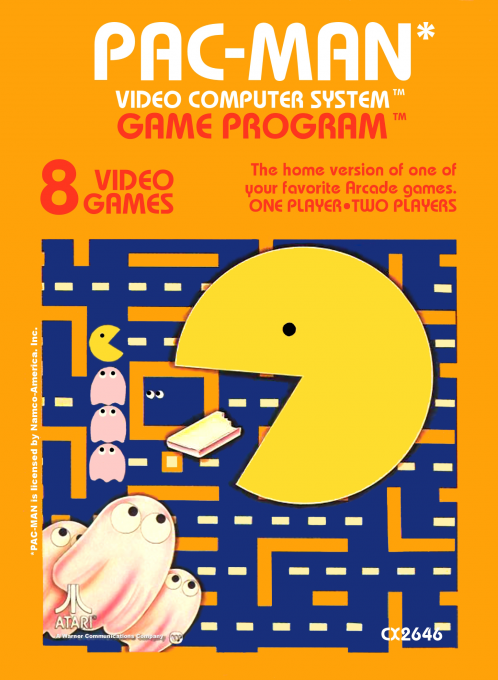
Pac-Man for Atari 2600 is Atari's 1982 home-console adaptation of Namco's landmark 1980 maze game. Developed and published by Atari and programmed by Tod Frye, it brings the yellow maze runner and his ghostly pursuers to the Atari Video Computer System through a cartridge designed for the console's far more limited hardware. It is a distinct version of Pac-Man rather than a pixel-for-pixel arcade conversion: its maze, visuals, sound, routes, and scoring objects have their own character, making it an important snapshot of how one of the era's biggest arcade phenomena was translated for the living room.
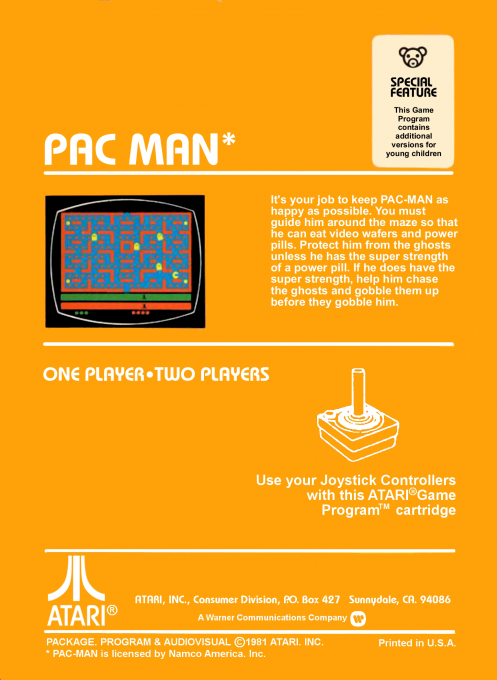
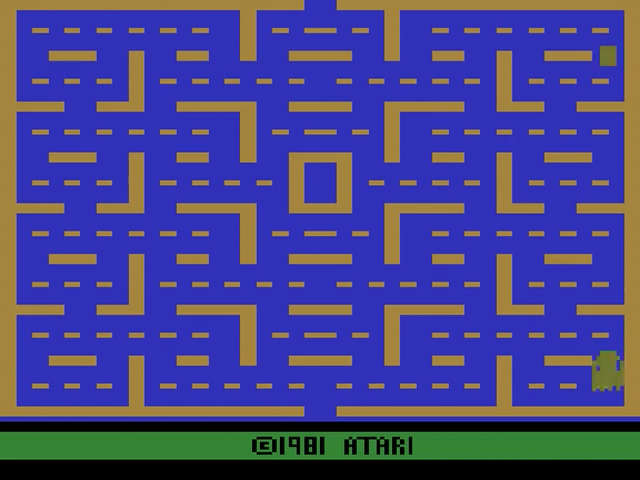
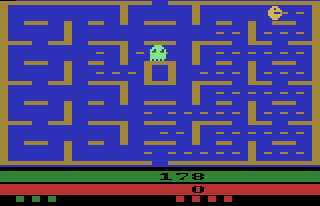
Using an Atari joystick, the player guides Pac-Man through Mazeland, collecting the short rectangular video wafers spread along its passages. Each wafer is worth one point, and clearing the screen refills the maze and awards an extra life. The immediate challenge is survival. Four ghosts patrol the corridors and cost Pac-Man a life on contact, while the maze's openings at the top and bottom connect to one another and offer an escape route for either side. The joystick's red button can start a game, but directional movement is the essential control once a round begins.
Four flashing Power Pills, positioned at the maze's corners, briefly reverse the balance of play. After Pac-Man eats one, the ghosts become vulnerable, allowing him to chase them for escalating bonuses: 20, 40, 80, and 160 points for successive ghosts before the effect expires. Eaten ghosts leave their eyes behind and return to the central chamber before resuming the chase. The port substitutes periodically appearing vitamins for the arcade game's fruit; each is worth 100 points. These choices encourage players to decide when to preserve a Power Pill for safety and when to draw the ghosts together for a larger score.
Pac-Man offers eight selectable game programs, combining different Pac-Man and ghost speeds. Some settings move the player character slowly, others quickly, and the ghost pace ranges from a crawl to a run. One-player games use the left controller port, while two-player options have players alternate turns after Pac-Man is caught. The Atari 2600's physical difficulty switches further affect play: the advanced setting shortens the time that Power Pills and vitamins remain available. This gives the cartridge a useful range of accessible and more demanding configurations without changing its central maze routine.
The Atari 2600 edition is especially known for the compromises required by its platform. Its simplified blue maze uses top-and-bottom tunnels instead of the arcade game's side passages, the consumables are wafers rather than tiny dots, and its ghosts visibly flicker as the system shares limited on-screen drawing resources among moving characters. Pac-Man himself and the ghosts also look and sound unlike their arcade counterparts. Those changes made the release controversial among players expecting a close arcade recreation, yet they also reveal the practical constraints facing early cartridge designers.
Commercially, Pac-Man for Atari 2600 became the system's best-selling game, selling more than eight million cartridges over its lifetime. That success reflects the extraordinary demand to bring Pac-Man home in 1982, even as the port's departures from the arcade original became widely discussed. Its legacy is therefore twofold: it remains a recognizable high-score maze game in its own right, and it is a defining historical example of the gap between arcade hardware and the first mass-market home-console adaptations.
Gallery
Details
- Developer
- Atari
- Publisher
- Atari
- Genre
- Maze
- Players
- 1-2
- Release Date
- March 16, 1982
- System
- Atari 2600