About
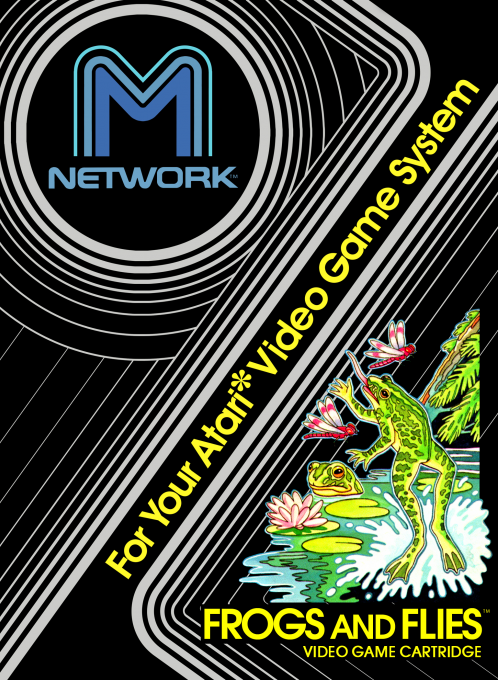
Frogger for the Atari 2600 brings Konami's 1981 arcade crossing challenge to Atari's cartridge-based home console. Parker Brothers published the North American 2600 version in 1982 under licence from Sega, with programmer Ed English adapting the game for the system. The goal is immediately clear but relentlessly demanding: guide a line of frogs from the sidewalk at the foot of the screen to the home bays above the river, surviving one short journey at a time. It is an action game built around timing, position, and the nerve to make the next hop before a safe opening disappears.
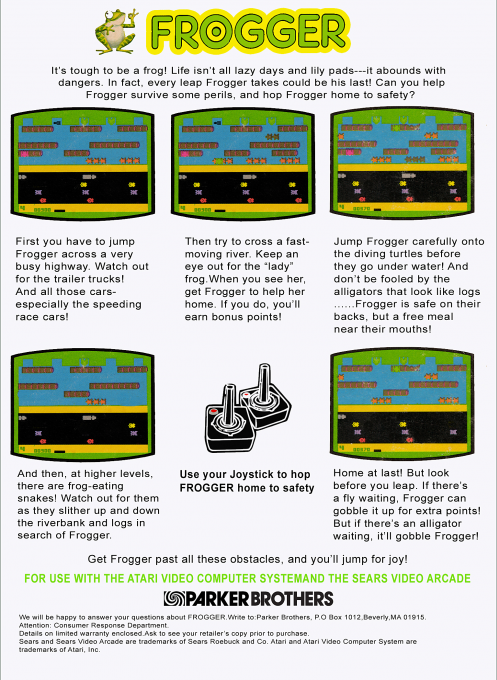
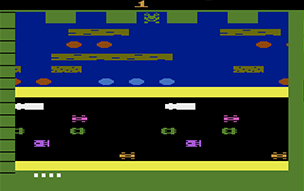
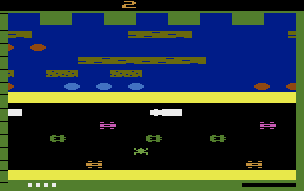
Each frog begins below five lanes of traffic. Cars and trucks travel in alternating directions at different speeds, so a route that looked open a moment ago can vanish before the next move. After reaching the riverbank, the challenge changes from dodging vehicles to choosing safe moving platforms. Logs, turtles, and alligators can carry Frogger across the water, while the river itself is fatal. A player must also watch for diving turtles, snapping alligator jaws, and snakes that appear as the game becomes tougher. The finish line is a row of home bays; landing a frog safely fills one, and filling all five advances the action to a harder round.
The Atari 2600 version uses the standard joystick for four-direction hops. In game variations 1 through 4, each push makes a single deliberate jump, which makes careful corrections as important as quick reactions. Variations 5 and 6 introduce Speedy Frogger, allowing repeated hops while the joystick is held. Parker Brothers included six modes in all: three one-player games and three alternating two-player games, with pairs of modes offering easy, more difficult, and Speedy settings. The console's difficulty switches add another platform-specific rule: in one setting, being carried off either side of the screen costs a frog, while the other lets a frog reappear on the opposite side after drifting beyond the edge.
A run is governed by a 30-second time limit for each frog, represented by a time band that warns the player as the deadline closes in. The cartridge begins with five frogs, awards points for forward movement and successful trips home, and adds bonuses for time remaining, rescuing the lady frog, catching a fly, and completing a full set of five homes. Reaching 1,000 points can earn an extra frog when fewer than four remain. These rules make progress more than a simple race upward: a player weighs the value of a risky bonus against the need to preserve frogs and secure the next open home bay.
Frogger on Atari 2600 is a dedicated conversion of an arcade-era classic rather than a new sequel or remake. English worked from an arcade Frogger cabinet during development, while the finished cartridge reshaped the concept around the 2600's controls, game-select modes, and console switches. Its compact road-and-river layout keeps the central idea intact: every screen asks the player to read motion, commit to a path, and manage a dwindling supply of frogs. For players exploring Atari 2600 games, this Parker Brothers release is a notable home version of a game whose simple upward journey became one of the defining designs of the early video-game era.
Gallery
Details
- Developer
- Parker Brothers
- Publisher
- Parker Brothers
- Genre
- Platformer
- Players
- 1-2
- Release Date
- January 1, 1982
- System
- Atari 2600