About
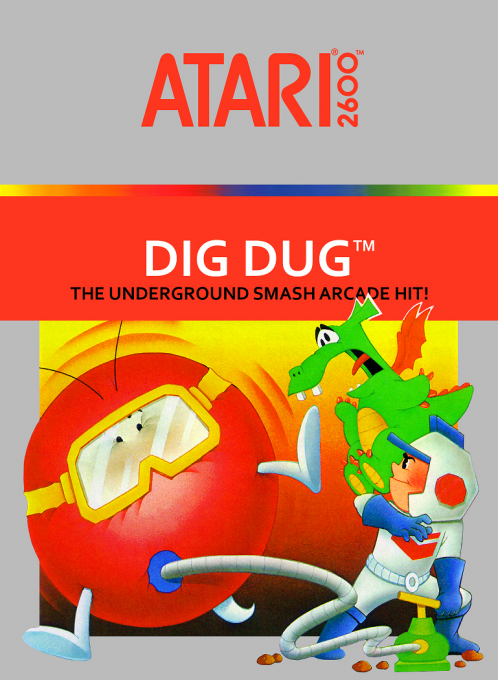
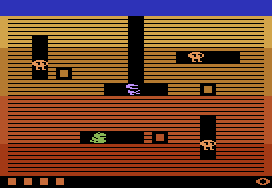
Dig Dug for the Atari 2600 brings Namco’s 1982 arcade digging game to Atari’s joystick-driven home console. Published by Atari in 1983 and credited to Namco in this release’s catalog data, it casts the player as the helmeted digger Taizo Hori, better known by the game’s title. Each round begins in a field of colored earth populated by two familiar underground threats: red, goggle-wearing Pookas and green, fire-breathing Fygars. The central goal is simple but demanding: clear the screen of every enemy and survive long enough to descend into the next stage.
The Atari 2600 version preserves the original game’s defining rhythm of digging routes through the soil and deciding when to stand and fight. Moving the joystick carves a narrow tunnel in one of four directions, creating both a path for the player and a changing map for pursuing monsters. Dig Dug’s pump is the primary tool. A successful hit holds a Pooka or Fygar in place, and repeated pumps inflate it until it bursts. Releasing too early lets the enemy deflate and recover, so every confrontation involves a small calculation about distance, timing, and whether there is room to escape afterward.
Rocks introduce a second, more tactical way to remove enemies. By tunneling beneath a boulder and moving clear, the player can send it falling through the open shaft. A well-positioned drop can crush one or more monsters and score more heavily than the pump, but it can also waste a useful rock or put Dig Dug in danger. The playfield therefore rewards planning tunnels around the boulders instead of digging blindly. As stages progress, enemy movement becomes harder to contain and the space between a safe route and a trap grows smaller.
Pookas and Fygars do not merely follow the tunnels forever. When blocked or delayed, they can shift into ghostly forms that travel through the dirt to find a new approach, then become solid again in an open passage. This keeps the pressure on even after the player builds a seemingly secure maze. Fygars add another concern because they can breathe fire along a clear horizontal tunnel. Learning which corridors leave room to retreat, and when to turn a chase into an ambush, is a large part of the game’s lasting appeal.
Between the hazards, Dig Dug offers a score chase built around quick decisions. Defeating enemies, using rocks efficiently, and collecting bonus vegetables when they appear all raise the total. The vegetable prizes change as the game advances, giving later rounds a stronger reward while the enemies grow more aggressive. The Atari 2600 cartridge supports one or two players, allowing alternating turns in the classic arcade style. Its compact controls make the action immediately approachable, while the escalating rounds give experienced players plenty of opportunity to refine routes, recover from mistakes, and pursue a higher score.
As an Atari home adaptation, Dig Dug is especially notable for retaining the arcade game’s unusual mixture of maze navigation and direct combat. The recognizable Pookas, Fygars, pump, falling rocks, and animated digging all carry the identity of Namco’s original into a console format designed around a single button and a directional stick. Rather than relying on a fixed maze, each screen lets players create their own tunnels, so two attempts can develop very differently. That flexible structure makes Dig Dug a durable example of early arcade design: easy to understand within seconds, yet full of tense choices whenever another enemy closes in underground.
Gallery

Details
- Developer
- Namco
- Publisher
- Atari
- Genre
- Maze
- Players
- 1
- Release Date
- January 1, 1983
- System
- Atari 2600