About
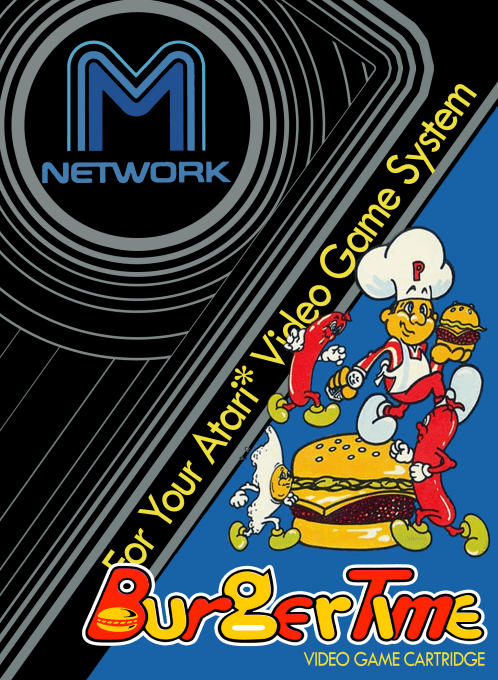
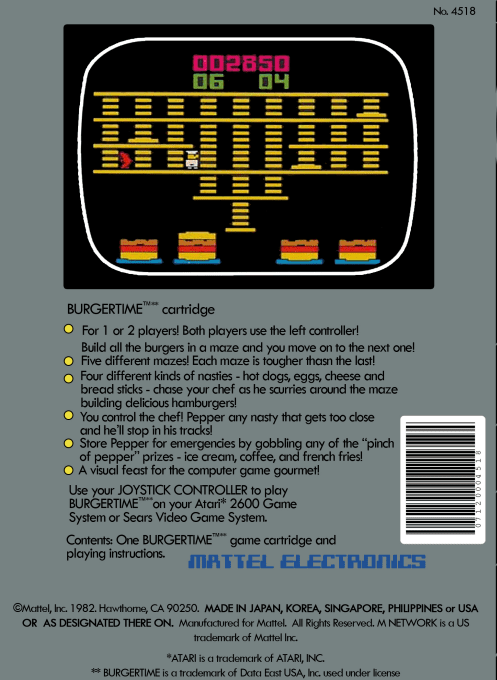
BurgerTime for the Atari 2600 is M Network’s 1983 home conversion of Data East’s arcade food-chase game. Published under Mattel Electronics’ M Network label and licensed from Data East USA, it puts the player in control of chef Peter Pepper, whose shift is spent assembling enormous hamburgers in a maze of platforms and ladders. This Atari 2600 version turns the arcade premise into a compact action-and-strategy game: finish every burger on the screen while keeping clear of the animated food enemies closing in around the kitchen.
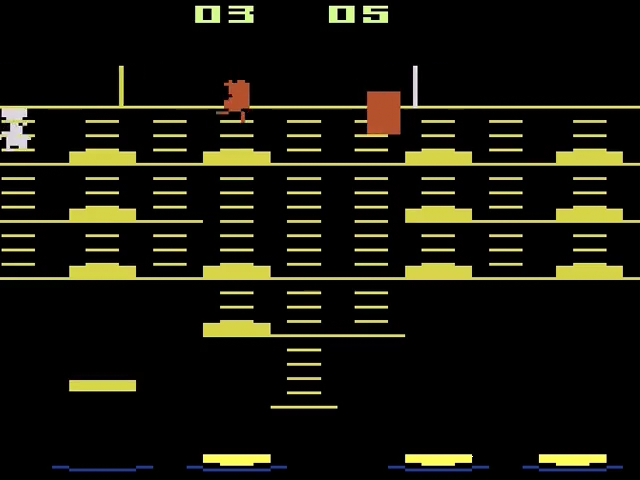
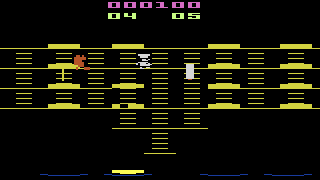
Each maze is built around ingredients positioned on horizontal planks above waiting plates. Peter Pepper moves with the left joystick, climbing ladders and walking the full width of buns, meat, lettuce, cheese and other burger parts. Covering an ingredient makes it drop down one level, and the goal is to work every required piece all the way to the bottom so the stacked burgers are complete. The task looks simple, but the chef has to choose routes carefully: an ingredient only falls after he crosses it, and each trip across a plank can leave him exposed to an approaching enemy or boxed in at a dead end.
Peter’s pursuers are the game’s comic “nasties,” including hot dogs, eggs, cheese and bread sticks. Contact with one costs a chef, so falling ingredients serve as both the central construction tool and a defense. Timing a drop can squash an enemy or carry one downward with the food, adding points while clearing a route. Peter also begins with a limited supply of pepper. Pressing the controller button releases a short pepper cloud in the direction he faces, stopping a nearby nasty long enough for him to slip past. Because the chef pauses to use it, pepper is most useful when it opens an immediate escape rather than when an enemy can simply be avoided.
BurgerTime Atari 2600 supports one player or two players taking turns, with the highest score deciding the winner. The console’s right difficulty switch selects the player count, while the left switch can freeze and resume play. Players begin with five chefs and earn an extra one at 10,000 points. Completing a maze advances the action to another layout, where the arrangement of planks, ingredients and enemies changes the safest routes through the screen. The scoring system rewards more than simply finishing a board, encouraging risky ingredient drops and well-timed enemy traps as the chase becomes more demanding.
The cartridge is a distinct Atari 2600 adaptation rather than the arcade game reproduced unchanged. Ron Surratt programmed this version and Patricia Lewis Du Long is credited for its sound effects and music. The conversion had to express BurgerTime’s busy kitchen on the 2600’s limited hardware, so some enemies are represented with simplified shapes and colors. Its designers also worked to keep the on-screen action readable despite the system’s sprite limitations. A PAL edition was produced for international release, and later production runs added an easy/hard difficulty choice through the television-type switch while correcting an earlier collision issue involving cheese and eggs.
BurgerTime began in Japanese arcades in 1982 as Hamburger and became BurgerTime in markets outside Japan. Its cheerful culinary theme, ladder mazes and constant threat from living ingredients made it especially suitable for the early home-console era, when arcade conversions were a major part of many libraries. The Atari 2600 release sits within M Network’s broader effort to bring Mattel-associated games to Atari’s console, but its identity remains tied to Data East’s original. For players who enjoy score-driven maze action, it combines route planning, quick joystick movement and the satisfying chain reaction of sending a burger ingredient—and perhaps a pursuer—down toward the plate.
Gallery
Details
- Developer
- M Network
- Publisher
- M Network
- Genre
- Platformer
- Players
- 1-2
- Release Date
- August 1, 1983
- System
- Atari 2600