About
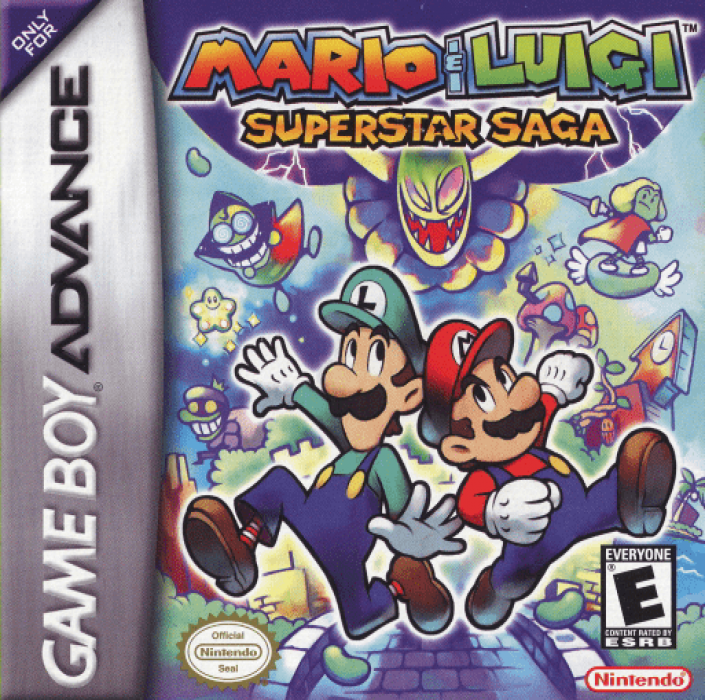
Mario & Luigi: Superstar Saga for Game Boy Advance is a 2003 single-player role-playing adventure developed by AlphaDream and published by Nintendo. It begins the Mario & Luigi series by sending the famous brothers beyond the Mushroom Kingdom to the neighboring Beanbean Kingdom. After the witch Cackletta steals Princess Peach's voice, Mario and Luigi set out to recover it, travelling with an unusually reluctant ally: Bowser. The quest combines the characters, jumps, and visual energy of a Mario game with an RPG built around exploration, dialogue, equipment, and carefully timed combat.
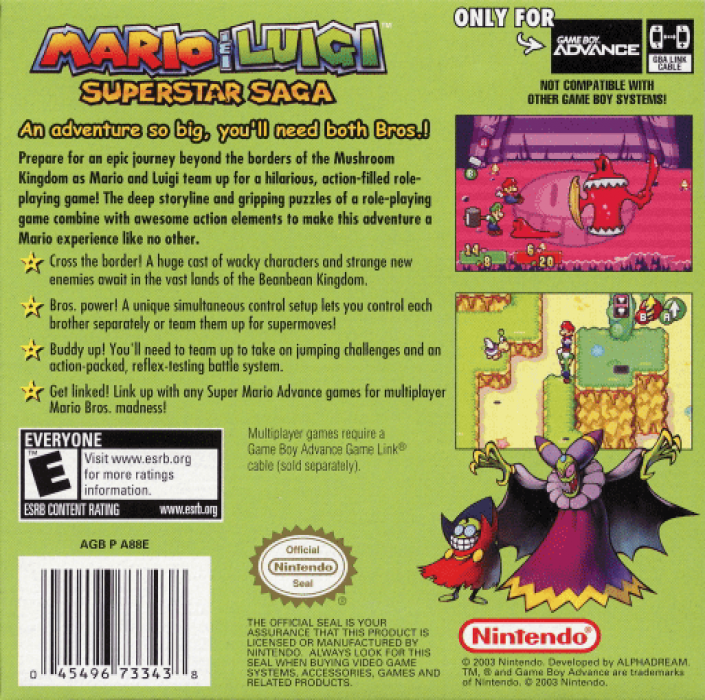
The central idea is that both brothers are active at once. Mario leads with the A Button and Luigi follows with the B Button, so moving through the world, crossing hazards, and solving environmental puzzles become cooperative actions even in a one-player game. The lead position can be changed, and the brothers gradually acquire tools that open new routes. Hammers, for example, do more than strike enemies: the two can use their abilities on each other to alter their shape or movement, making room for puzzles based on narrow passages, height, and distance.
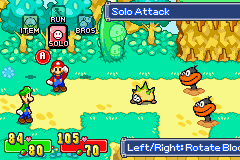
Battles are turn-based, but they reward attention rather than simply selecting a command and waiting. Mario and Luigi have separate health, statistics, equipment, and button inputs. A well-timed press can strengthen a jump or hammer attack, while reading an enemy's movement and pressing the appropriate button can let a brother jump clear, block with a hammer, or counterattack. Enemies react differently to the brothers' available attacks, and the party earns experience from victories. Leveling up raises their capabilities and lets players choose an additional stat to improve, while items, badges, and gear offer further ways to prepare for tougher encounters.
As the journey progresses, the brothers learn Bros. Attacks: coordinated, more powerful moves that spend Bros. Points and ask the player to execute a sequence of timed inputs. This makes timing part of both offense and defense, from ordinary encounters to larger boss fights. If one brother is knocked out, the other can still move and fight, but their combined techniques are unavailable until the fallen partner is revived. The structure alternates between traversing connected areas of the Beanbean Kingdom, handling its obstacles and puzzles, meeting characters, and entering battles initiated by contact with visible enemies in the field.
The Beanbean Kingdom gives Superstar Saga its own identity within the broader Mario setting. Mario and Luigi encounter its ruler Queen Bean, Prince Peasley, the persistent thief Popple, Cackletta, and her eccentric assistant Fawful while searching for the stolen voice and the powerful Beanstar. The story moves through mountains, castles, towns, and other stylized locations, using the brothers' changing abilities to revisit and advance through the kingdom. Its comedy comes from the contrast between familiar Mushroom Kingdom figures and a new cast and country, while Bowser's shifting role keeps the rescue mission from following the most obvious path.
Mario & Luigi: Superstar Saga arrived in North America on November 17, 2003, with European Game Boy Advance releases following that November. It was followed by Mario & Luigi: Partners in Time on Nintendo DS, establishing the series around two-character control and action-command RPG battles. Nintendo later brought the original Game Boy Advance game to Wii U Virtual Console in 2014; that version retained the adventure for one player but did not include the original cartridge's communication features. A separate Nintendo 3DS remake, Mario & Luigi: Superstar Saga + Bowser's Minions, arrived in 2017 with updated presentation and added content, while the Game Boy Advance original remains the series' starting point.
Gallery
Details
- Developer
- Alpha Dream
- Publisher
- Nintendo
- Genre
- JRPG
- Players
- 1-4
- Release Date
- November 17, 2003
- System
- GBA