About
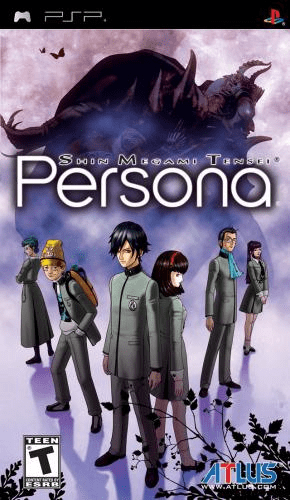
Shin Megami Tensei: Persona is Atlus’s 2009 PlayStation Portable remake of the first Persona game, originally released in Japan as Megami Ibunroku Persona for PlayStation in 1996. Developed and published by Atlus, the PSP version reached North America on September 22, 2009, simultaneously on UMD and PlayStation Network. It follows students at St. Hermelin High in Mikage-cho after the “Persona” fortune-telling game awakens their ability to call forth manifestations of their inner selves. Supernatural disruptions, hostile demons, and a reality-altering conspiracy turn their ordinary town into the setting for a psychologically minded role-playing adventure.
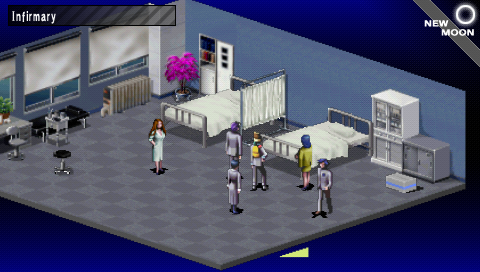
This is an early Persona in both tone and structure, closer to the dungeon-heavy Megami Tensei tradition than the calendar-driven school-life format of later entries. Exploration moves between an overhead town map, angled views in many story locations, and first-person navigation inside dungeons and buildings. Random encounters occur during travel, and the changing lunar phase affects demon behavior. The party searches labyrinths, visits shops and the Velvet Room, and works through a story that can follow the principal SEBEC route or the alternate Snow Queen scenario.
Combat takes place on a grid, so formation and each character’s position matter when deciding who can reach an enemy or support an ally. A turn can be used for a conventional weapon attack, a firearm, an item, analysis, or a Persona action. Personas provide elemental damage, healing, status effects, and other skills; they gain experience separately from their users and can learn more abilities through use. This makes party composition more than a choice of favorite characters, since a character’s placement, available Persona, and spell range all shape an encounter.
Demons are not simply targets. The Contact command lets the party try conversational approaches tailored to a demon’s personality, producing anger, fear, joy, or interest. A successful exchange may end a fight, yield an item, or earn a spell card. Those cards feed the customization system at the Velvet Room, where Igor can summon Personas and combine compatible cards, sometimes with an item, to create new Personas and pass along skills. The result is a loop of dungeon exploration, negotiation, and Persona-building rather than a straight succession of battles.
The PSP edition substantially revises the original presentation and accessibility while preserving its core game. It adds a widescreen display, enhanced graphics and sound, new animated cutscenes, adjustable difficulty, balance changes, and altered encounter rates. Shoji Meguro, a composer on the original game who directed this version, supplied newly composed and rearranged music. The remake’s changes are aimed at making the 1996 design more approachable on a handheld without changing it into the later social-simulation style associated with Persona 3 onward.
It is important not to confuse this release with the North American PlayStation version, Revelations: Persona. Both derive from the same original game, but the 1996 localization changed character names, appearances, place names, and dialogue, and omitted the Snow Queen route entirely. Shin Megami Tensei: Persona uses a newly translated English script that is much closer to the Japanese original, restores the original character identities, and includes the previously unavailable route. It is therefore not a new first installment: it is the fuller, revised PSP version of Persona’s foundational story and systems.
For players coming from modern Persona games, its defining appeal is seeing the series’ identity before Social Links, daily schedules, and stylized life-sim routines became central. The high-school setting, Jungian ideas, Personas, the Velvet Room, and the recurring “Aria of the Soul” are already present, but the play is built around mapped dungeons, demon contact, turn-based grid tactics, and flexible Persona construction. That combination makes the PSP release both a historical starting point for the series and a distinct old-school Atlus role-playing game.
Gallery

Details
- Developer
- ITL
- Publisher
- Atlus
- Genre
- JRPG
- Players
- 1
- Release Date
- September 22, 2009
- System
- PSP