About
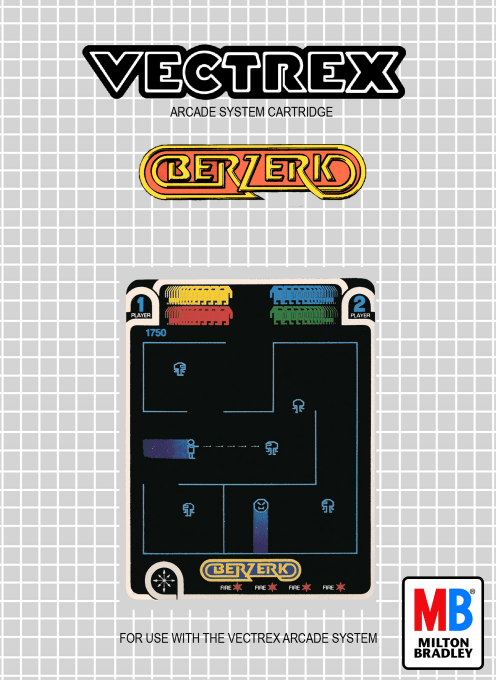
Berzerk for Vectrex brings Stern Electronics’ 1980 arcade maze shooter to GCE’s self-contained vector console. Released in 1982 as part of the Vectrex launch-era library, it casts the player as a lone humanoid trapped in a succession of electrified robot mazes. The original arcade game was created at Stern by Alan McNeil; GCE manufactured this cartridge under license, adapting its tense chase-and-escape structure to the Vectrex’s built-in screen, analogue joystick and monochrome vector display with a colour screen overlay.
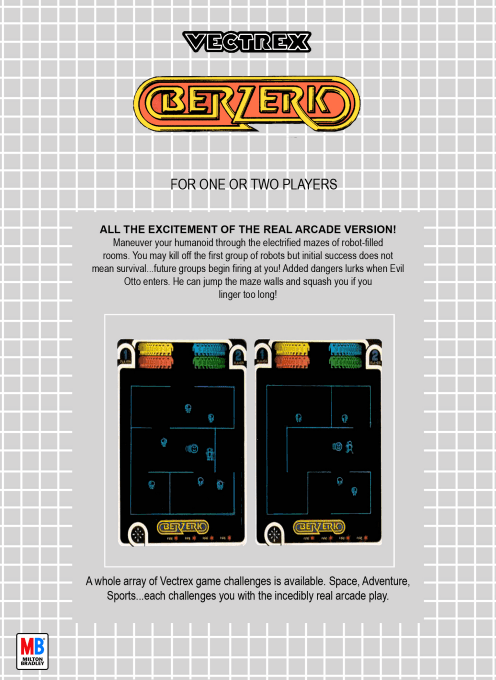
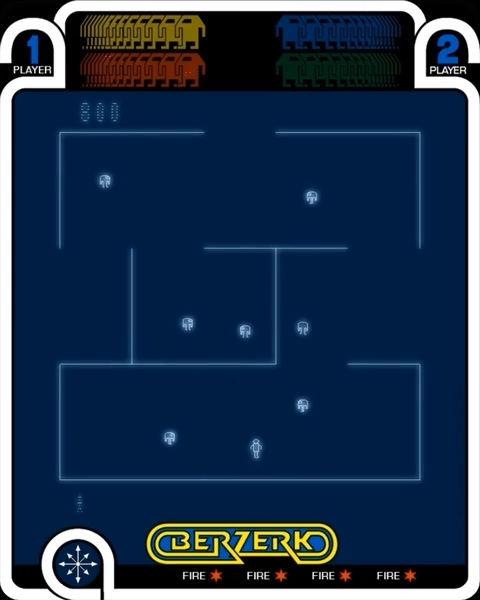
Each maze is a compact hazard course. The humanoid enters among one to eleven hostile robots and can move in any of eight directions, threading through corridors while avoiding the charged walls. Pressing the fire control shoots in the direction of travel, so every attack involves a trade-off between mobility and aim. Contact with a wall, robot or robot bullet costs a life, but players are not required to eliminate every enemy: they can leave through an indicated exit whenever an opening is available and arrive in another maze with a fresh group of pursuers.
The pressure rises as the score climbs. Early robots do not shoot, making the first rooms useful for learning the movement and firing rhythm, but later groups become faster and send more bullets through the maze. Destroyed robots are worth points, and clearing an entire room earns a bonus based on the number that occupied it. The Vectrex edition begins with three humanoids and awards an extra one at 5,000 points. Its high-score display remains available while the powered console and cartridge stay in place, a small but fitting incentive to make another run.
Berzerk’s defining threat is Evil Otto, the smiling face that arrives after the action has gone on for a while. Otto ignores the maze’s walls, cannot be destroyed by the player’s bullets and tries to crush the humanoid outright. His arrival changes the purpose of a room: a player who had been carefully collecting robot kills may suddenly have to abandon the fight and dash for an exit. This invulnerable pursuer gives the game a distinct rhythm of cautious shooting, hurried movement and last-second escapes.
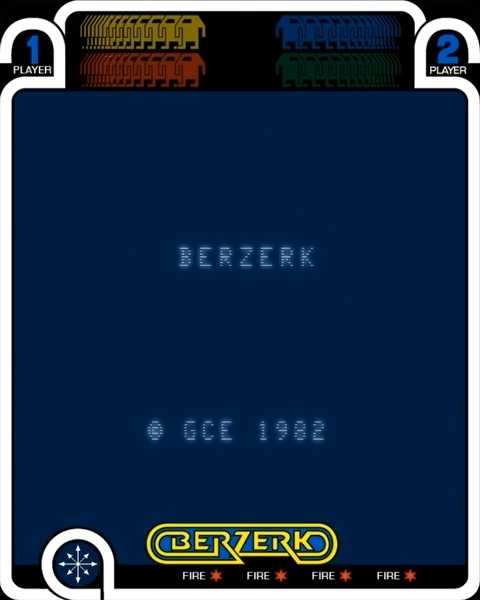
The cartridge supports one or two players. In the two-player option, competitors take turns on the Vectrex’s built-in controller rather than playing simultaneously. Button 1 selects the player count before a game begins, Button 4 starts the first maze and serves as the firing control during play. The dedicated overlay supplied for the console screen identifies the eight movement directions and adds colour framing to the display, while the hardware’s vector lines give the mazes and robots a different visual character from the raster arcade cabinet.
Berzerk sits squarely in the early-1980s arcade tradition of simple rules that steadily create harder decisions. It is also an important home-console example of a game designed around pursuit: the robots restrict the safe routes, while Evil Otto ensures that no maze can be treated as a permanent refuge. The Vectrex version arrived alongside the system’s first wave of cartridges, preserving a well-known Stern design on a platform whose integrated display and arcade-style controls made short, score-focused sessions a natural fit.
Gallery
Details
- Developer
- Stern
- Publisher
- GCE
- Genre
- Maze, Shoot 'em Up
- Players
- 1-2
- Release Date
- January 1, 1982
- System
- Vectrex